
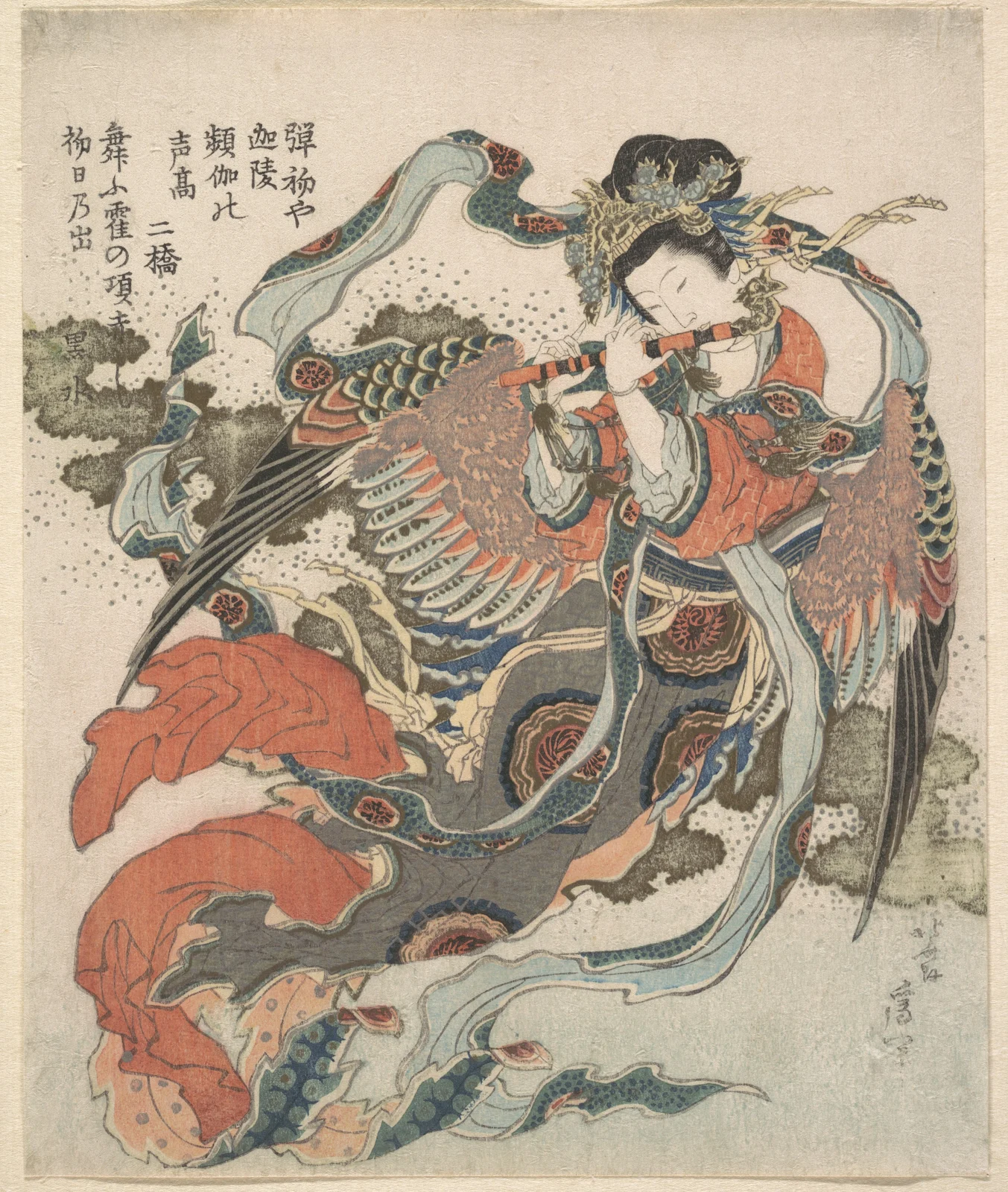
Hokusai’s human-headed Karyōbinga with feathered wings playing a flute, 1820–33
Hokusai’s New Year card presents the Buddhist celestial bird as a richly dressed musician with a human head and feathered wings. The flute, hands, costume and flowing ribbons belong to this Japanese artistic representation; the image is not a zoological portrait.
Overview
The University of Michigan Museum of Art describes the kalavinka as a human-headed bird of the Buddhist Land of Ultimate Bliss whose exceptional voice comforts living beings. Its Korean roof tile, on loan from the YooGeum Museum, places the winged figure within a lotus design, with two arms spread in a protective pose. The museum gives Gareungbinga as its Korean name; its 2010 label dates this example to the eighth or ninth century.
The Metropolitan Museum identifies the Japanese name Karyōbinga in Hokusai’s Mystical Bird, a surimono dated1820–33. Its explanation again combines a human head, bird body and heavenly music. The print’s New Year poems are by Nikyō and Kokusui. These objects show regional artistic settings for a sacred Buddhist being rather than evidence of a zoological species.
Busk’s1873 birth-story of Vikramâditja mentions a kalavinka’s melodious voice among auspicious signs. Her note, following Jülg, instead proposes an ordinary kokila or Indian cuckoo for that passage. That localized nineteenth-century identification remains an attributed interpretation; it does not erase the hybrid form documented by the museum objects.
Origins & earliest records
Buddhist sacred bird traditions represented in Korean and Japanese art
Records & interpretation
Official museum object descriptions and complete Busk narrative with notes directly read; no independent pixel inspection claimed.
Selected bibliography
Documented works and useful reading. This is not a list of every appearance.
- 01
Roof-end tile with kalavinka design
Object LTL2009.7.8; eighth–ninth-century gallery dating, broader676–935 metadata
- 02
Mystical Bird (Karyōbinga)
MetJP1868; dated1820–33
- 03
Sagas from the Far East
Vikramâditja’s Birth268; note6 pp398–399
Family & connections
A source-supported family tree or inspiration record has not yet been compiled for this profile. Related reading below indicates a connection in subject matter, not a proven lineage or creative influence.
Primary records and illustrations
UMMA LTL2009.7.8; The Met JP1868; Busk1873
Official object records and Vikramâditja’s Birth. UMMA2017catalogue38/2010gallerylabel; MetJP1868; Busk268 andnote6
Complete relevant museum descriptions read through web; Met54433 separately read; complete Busk birth narrative and12notes read. Human-headed form derives from museum cataloguing, not invented from Busk. No image pixel review. BMobject1919-0101-0-36 returned403 and is not pursued or used as a profile source.
References
Sources supporting this profile. Linked pages have their own scope and editorial standards.
- Institutional object record and gallery commentaryUMMA, Roof-end tile with kalavinka design, LTL2009.7.8Research access: 2026-10-05
- Institutional object recordThe Met, Hokusai, Mystical Bird, JP1868Research access: 2026-10-05
- Historical literary adaptationBusk, Vikramâditja’s Birth and note6Research access: 2026-10-05
Image credits
Historical illustrationHokusai’s human-headed Karyōbinga with feathered wings playing a flute, 1820–33
Hokusai’s New Year card presents the Buddhist celestial bird as a richly dressed musician with a human head and feathered wings. The flute, hands, costume and flowing ribbons belong to this Japanese artistic representation; the image is not a zoological portrait.