
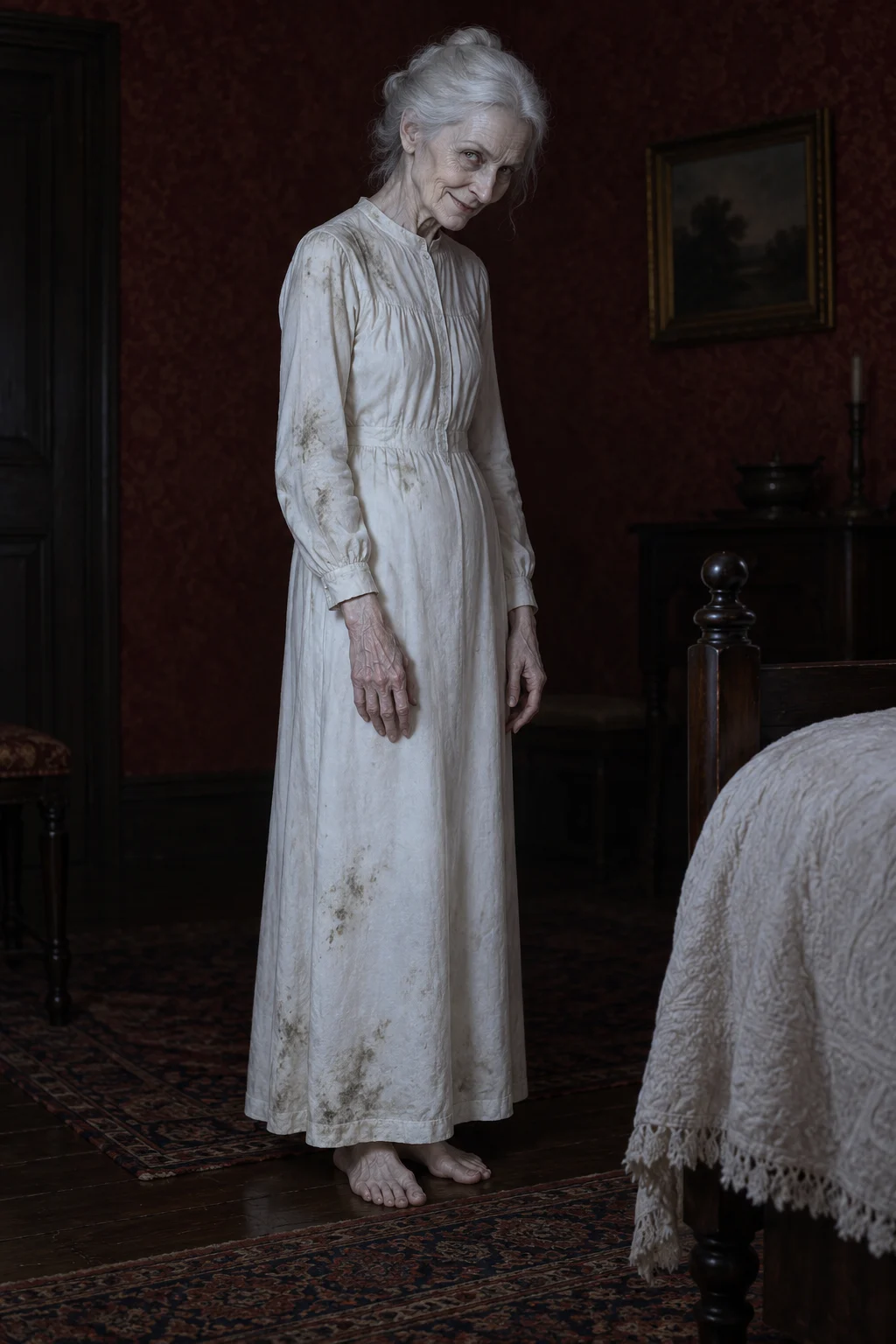
AI-generated interpretation of Benson’s Julia Stone; the white-haired human apparition and marked white garment follow the tale, while precise features, pose and dress construction are reconstructed.
No fangs or animal traits are supplied by the story. The illustration is an independent literary interpretation, not a historical portrait or evidence of a haunting.
Overview
Julia Stone first enters the narrator’s life through a recurring dream. Beginning when he is about sixteen, he repeatedly visits a red-brick house where his former schoolfellow Jack Stone lives with his silent family. Mrs Stone always announces that he has been given the room in the tower. Over fifteen years the dream changes: she grows grey and weak, and eventually dies, yet her voice continues to assign the room from beyond the garden gate. A gravestone identifies her by name and declares her evil memory. The narrator distinguishes this persistent nightmare from an ordinary dream coincidence, but cannot explain it.
A later visit to John Clinton’s rented Sussex house reproduces the building and the dreaded invitation. In the tower bedroom hangs Julia’s self-portrait, showing an old, withered, white-haired woman whose apparent frailty contrasts with the narrator’s impression of vicious delight. Her narrow eyes leer, and her hands are clasped upon her knee. The portrait is removed, leaving unexplained blood on the hands of all three men who carry it. That night it is back on the wall. A flash of lightning also reveals a figure with the portrait’s face leaning over the bed, dressed in a close-fitting white garment marked by mould. The narrator feels a hand at his neck and hears her promise to feast and, later, to feast together with him. He strikes out and escapes; Clinton subsequently sees the returned portrait and an earth-stained burial garment on the floor.
The final account associates Julia with a failed burial after her death by suicide in the tower room. Her coffin is said to have emerged from the churchyard ground on three occasions before she was buried outside the house’s garden gate; a later secret exhumation finds it full of blood. These details complete the story’s predatory haunting without explaining its mechanism or establishing every conventional vampire trait. No pointed teeth, bat form or general rule about vampire transformation is supplied. The testimony, dream, portrait and burial sequel belong to Benson’s authored fiction, rather than to a documented Sussex haunting.
First appearances & development
E. F. Benson’s English supernatural story, consulted in The Room in the Tower and Other Stories, explicitly marked Second Edition and Published 1912. The collection’s preface states its aim of giving readers unsettling moments.
Canon & continuity
The complete selected story, including the burial and exhumation sequel, the complete preface and the dated title were read. The story’s reports are retained as fictional narration; no real grave, portrait or apparition was independently verified.
Selected bibliography
Documented works and useful reading. This is not a list of every appearance.
- 01
The Room in the Tower and Other Stories — The Room in the Tower
London: Mills & Boon, Limited; Second Edition. Historical title and copyright page retained; selected tale on pages 1–22.
Family & connections
A source-supported family tree or inspiration record has not yet been compiled for this profile. Related reading below indicates a connection in subject matter, not a proven lineage or creative influence.
References
Sources supporting this profile. Linked pages have their own scope and editorial standards.
- Primary historical authored fictionThe Room in the Tower — dated title, preface and complete selected storyResearch access: 2026-10-18
Image credits
AI-generatedAI-generated interpretation of Benson’s Julia Stone; the white-haired human apparition and marked white garment follow the tale, while precise features, pose and dress construction are reconstructed.
No fangs or animal traits are supplied by the story. The illustration is an independent literary interpretation, not a historical portrait or evidence of a haunting.