
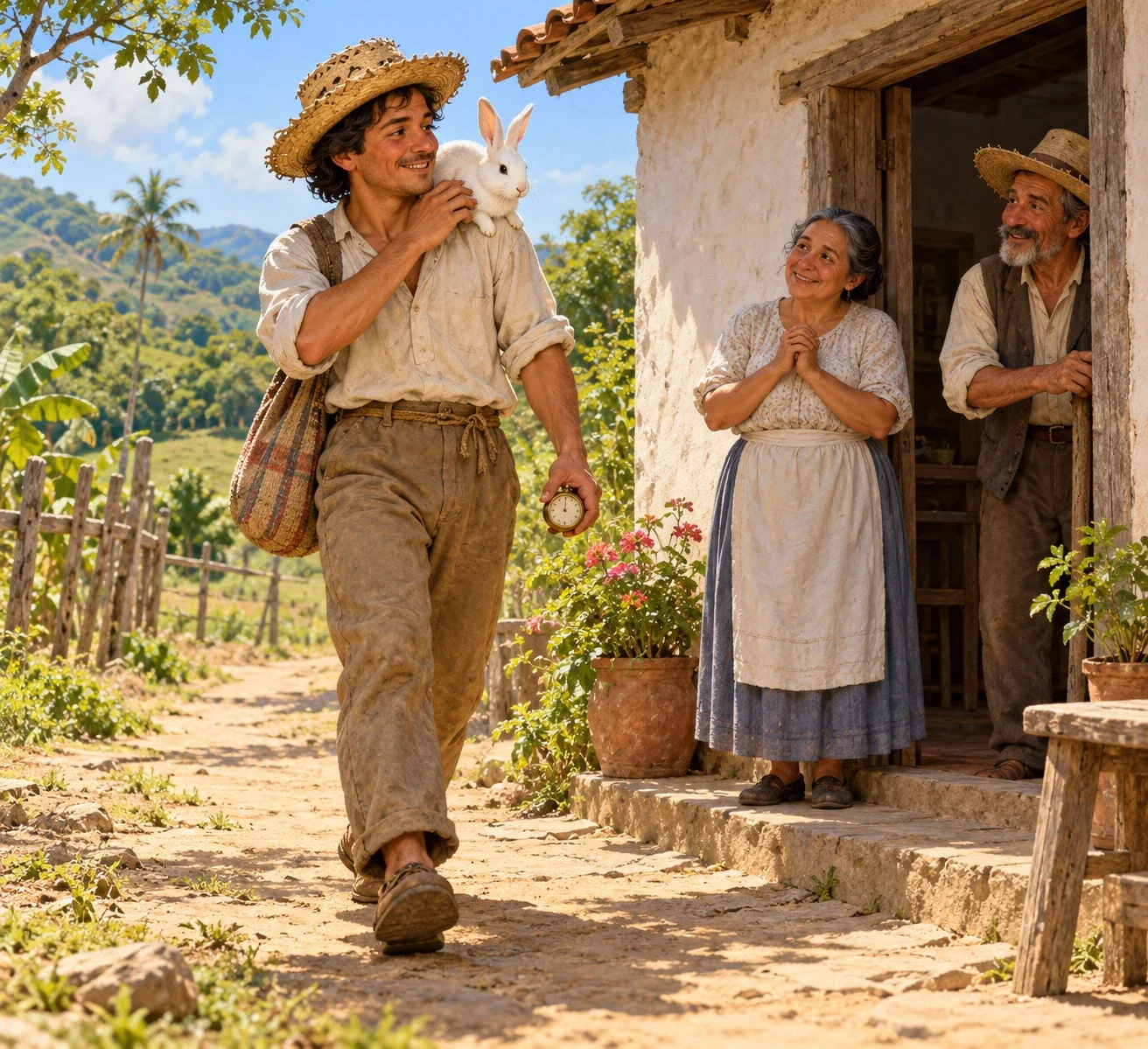
AI-generated interpretation of the ordinary rabbit-return deception in Mason and Espinosa’s selected Puerto Rican Juan Bobo tale. Clothing, faces, clock design and domestic setting are editorial choices, not authenticated costume or actual magic.
AI-generated interpretation of the ordinary rabbit-return deception in Mason and Espinosa’s selected Puerto Rican Juan Bobo tale. Clothing, faces, clock design and domestic setting are editorial choices, not authenticated costume or actual magic.
Overview
The selected Juan Bobo is a worker who lives with his mother and invites his compadre to visit at eleven. He prepares two white rabbits that cannot be distinguished from each other and sets two clocks to the same time. He takes one rabbit and one clock to work, leaving their counterparts at home. When the visitor arrives, the mother releases her rabbit as if sending it to fetch Juan. Juan times his own return and arrives stroking the second rabbit on his shoulder. The visitor sees what appears to be an obedient animal returning with its owner, while the narrative has already shown the audience how the substitution works.
The compadre wants the apparent messenger and pays Juan for it. He dismisses a human servant because he expects the rabbit to take over the task of fetching him for meals. Once released, however, the rabbit simply disappears. His return to confront Juan produces a second deception. Juan has his mother remove the fire and ashes from beneath food that is already cooked. They present the meal as the work of a pot that cooks without fuel. The hungry visitor enjoys the food and purchases the pot despite Juan’s pretended reluctance. At home he dismisses the cook, but the unheated pot cannot cook the beans put into it.
Juan anticipates the next angry visit and prepares a third fraud with his mother. A concealed bladder of animal blood allows them to stage an apparent killing. Juan then plays a whistle and calls on his mother to move successive parts of her body until she stands up. The reader knows that she was never dead: her responses make the performance look like a revival to the deceived visitor. The compadre pays for the supposed instrument of resurrection. When he later kills his own wife and tries to repeat the performance, the whistle has no such power. The narrative explicitly leaves the woman dead and the husband imprisoned, while Juan becomes rich.
All three marvels depend on staging, cooperation and the buyer’s willingness to accept the seller’s account. The rabbits are ordinary animals, the pot retains the results of earlier cooking, and the whistle accompanies a living participant’s performance. This distinction is central to the profile: Juan is not given an authenticated power to command animals, cook by magic or resurrect the dead. His successful fraud also has a fatal consequence that is not erased by the ending’s account of his wealth. The story describes a trickster’s success without making the deceived wife’s death an actual resurrection or an endorsement of his conduct.
Origins & earliest records
This profile follows the complete main telling of tale 37 in Mason and Espinosa’s 1921 Porto-Rican Folk-Lore, printed on pages 176–178. The separate shorter Version a on page 179 is not merged into it. The introduction dates Mason’s Puerto Rican collection to 1914–1915, says that many texts were written down by schoolchildren, and warns that the Juan Bobo label absorbs and recombines narratives also known under other names. No individual teller, child writer or precise village is credited for this selected telling in the inspected passage. The collection’s location establishes a Puerto Rican witness, not an exclusive birthplace or national ownership of its motifs.
Records & interpretation
The complete Spanish account and its ending were read. Printed page 177 was checked against the preserved journal scan, confirming the white-rabbit substitution and already-cooked meal. The staged revival and the wife’s actual death belong to the same selected account, not to a blended retelling assembled from neighbouring variants. The introductory comparison with other picaresque names is historical editorial framing; it does not make every Juan Bobo, Juan Tonto or Pedro de Urdemalas story the biography of one historical person.
Selected bibliography
Documented works and useful reading. This is not a list of every appearance.
- 01
Porto-Rican Folk-Lore: Folk-Tales
Journal of American Folk-Lore 34(132), pp.143–208; complete main tale 37, pp.176–178; introductory remarks, pp.143–144. Original Spanish telling, not a modern English adaptation.
Family & connections
A source-supported family tree or inspiration record has not yet been compiled for this profile. Related reading below indicates a connection in subject matter, not a proven lineage or creative influence.
References
Sources supporting this profile. Linked pages have their own scope and editorial standards.
- Historical collected Spanish narrative and editorial framingMason–Espinosa 1921, complete main tale 37 and introductory remarksResearch access: 2026-10-23
Image credits
AI-generated illustrationAI-generated interpretation of the ordinary rabbit-return deception in Mason and Espinosa’s selected Puerto Rican Juan Bobo tale. Clothing, faces, clock design and domestic setting are editorial choices, not authenticated costume or actual magic.
AI-generated interpretation of the ordinary rabbit-return deception in Mason and Espinosa’s selected Puerto Rican Juan Bobo tale. Clothing, faces, clock design and domestic setting are editorial choices, not authenticated costume or actual magic.