A sourced illustration has not yet been added. This gap is included in the coverage record.
Overview
The lions in this account confer together because the women praise the ostrich’s voice and do not similarly admire theirs. One proposes arranging a calling-and-dancing occasion to test that preference. Another explains the ostrich’s fine sound as coming from his lungs, in contrast to the lion’s mouth. Their scheme is to kill the ostrich and obtain his lungs, hoping to acquire his voice. A narrator’s note says that lion and ostrich were men at the time of their quarrel; the account thus gives the animal figures a former human setting rather than presenting an ordinary encounter between wild species.
During the gathering, the lion calls first, while the ostrich remains at home. The women withhold applause. When the ostrich arrives, his voice resounds afar, and they compare the lion’s disappointing sound to calling with his tail in his mouth. Angered by their preference, a lion scratches and kicks the ostrich, who kicks back and explains the grievance aloud. The explanatory notes connect the injuries with marks on the ostrich’s body and a damaged nail. They also distinguish this initial fight from the later occasion when the lion kills and eats him; those events are not compressed into an immediate death at the performance.
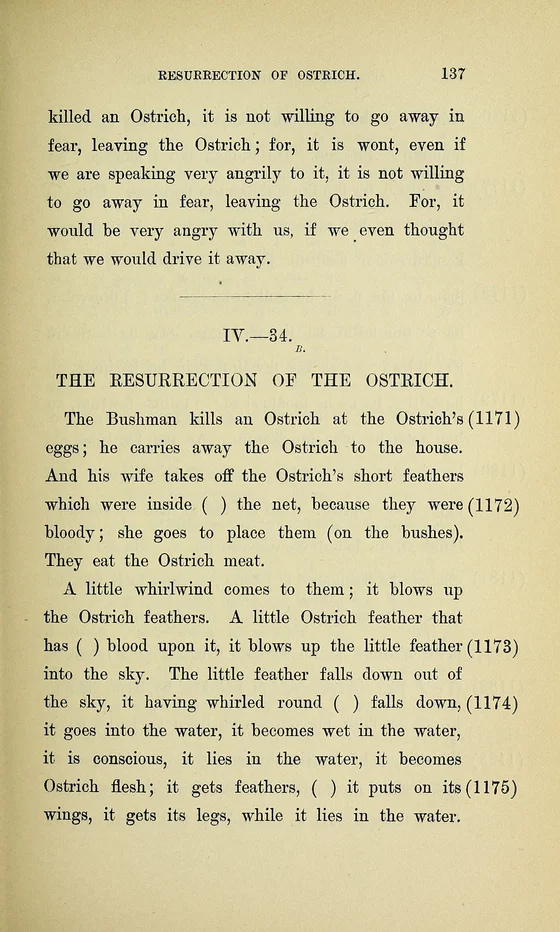
Dia!kwain then relates his grandfather’s use of the story to discuss boys’ voices, rivalry and the desire for praise. That autobiographical continuation is a second layer of the witness, alongside the animal episode. It includes an historical food practice associated with the ostrich’s lungs, summarized here as reported context rather than instructions. The boys question it, and their grandfather compares resentment of fine-voiced companions to the lion’s jealousy. The closing note describes a lion’s unwillingness to abandon a killed ostrich, completing the source’s movement from former-human rivalry to observations about its animal form.
Origins & earliest records
Bleek and Lloyd, Specimens of Bushman Folklore (1911), IV.—28a, The Lion Jealous of the Voice of the Ostrich, complete pp. 126–137, including the last translated note before the next tale. Heading credits Dia!kwain’s 1875 Katkop dictation from paternal grandfather |Xugen-ddi.
Records & interpretation
Complete episode, personal continuation and explanatory notes read. Notes distinguish the fight from the later killing and explicitly say both figures were men. A separate 1878 description of the performance by |han#kass’o is editorially inserted context, not the main story’s narrator credit.
In the literature
“The women cherish him only.”
IV.—28a, The Lion Jealous of the Voice of the Ostrich; complete pp.126–137/all notes; brief narrative excerpt p.131 · Bleek–Lloyd original English translation; Lucy C. Lloyd, editor; B. identifies the earlier report listing
Lions resent the women’s preference for the ostrich’s fine call and arrange a contest. The women still praise the ostrich; one lion attacks him and the ostrich retaliates. Notes place them in an earlier human-like state, explain the ostrich’s scar and distinguish the fight from a later killing. A final note describes the lion’s refusal to abandon an ostrich kill.
Selected bibliography
Documented works and useful reading. This is not a list of every appearance.
- 01
Specimens of Bushman Folklore
IV.—28a, whole pp. 126–137; final translated note continues onto p. 137. Main 1875 Dia!kwain attribution separate from |han#kass’o’s 1878 performance explanation.
- 02
Specimens of Bushman Folklore — IV.—28a, The Lion Jealous of the Voice of the Ostrich; complete pp.126–137/all notes
London: George Allen & Company,1911; original bilingual edition. Complete selected English account(s) and all notes read; original contributor/heading, excerpt and ending pages visually checked.
Family & connections
A source-supported family tree or inspiration record has not yet been compiled for this profile. Related reading below indicates a connection in subject matter, not a proven lineage or creative influence.
Located primary passages
Specific passages supporting details in this entry, grouped by their published witness.
Specimens of Bushman Folklore
London: George Allen & Company,1911; original bilingual edition. Complete selected English account(s) and all notes read; original contributor/heading, excerpt and ending pages visually checked.
- Lions resent the women’s preference for the ostrich’s fine call and arrange a contest. The women still praise the ostrich; one lion attacks him and the ostrich retaliates. Notes place them in an earlier human-like state, explain the ostrich’s scar and distinguish the fight from a later killing. A final note describes the lion’s refusal to abandon an ostrich kill.
No entire volume, original manuscript/performance or independent translation of facing |Xam claimed. Referenced other versions and reports not independently read; adjacent tales not treated as complete new coverage. Practical food/performance instructions omitted.
References
Sources supporting this profile. Linked pages have their own scope and editorial standards.
- Primary collected fable, contributor recollection and explanatory notesOriginal 1911 bilingual edition: Lion Jealous of the Ostrich’s VoiceResearch access: 2026-10-05
Image credits
A sourced illustration has not yet been added. This gap is included in the coverage record.