
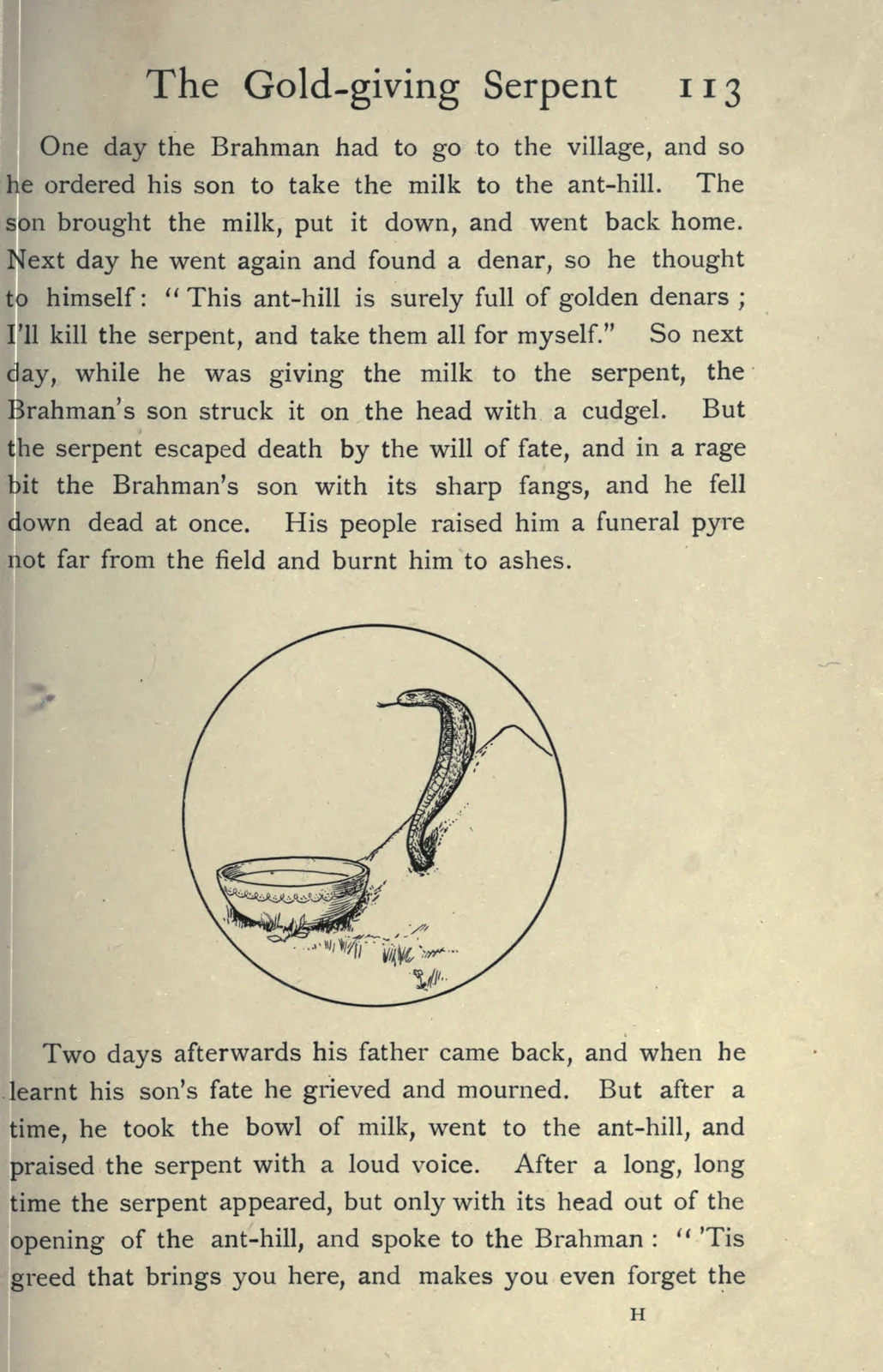
Whole illustrated book page with surrounding printed narrative: A hooded serpent rises from a hole in an ant-hill beside a shallow decorated bowl, enclosed in a circular line drawing.
The complete 1892 book page presents Batten’s serpent, ant-hill and offering bowl within Jacobs’s named Haridatta tale. The surrounding printed text belongs to the same source witness.
Overview
In Joseph Jacobs’s 1892 “The Gold-giving Serpent,” the poor farmer Haridatta sees a large hooded snake emerge from an ant-hill. He interprets it as his field’s neglected guardian and offers milk. A gold denar appears in the bowl the following morning, and the exchange becomes a daily occurrence. The narrator reports the reward; the initial identification of the snake as the field’s deity belongs to Haridatta.
When Haridatta leaves his son in charge, the son assumes that the ant-hill contains a hoard and strikes the serpent’s head with a cudgel. The wounded creature survives and fatally bites him. After the funeral, Haridatta returns with another offering. The serpent finally appears at the entrance, accuses him of greed and declares that neither can forget what has happened. It gives him one costly pearl, forbids further visits and disappears. The lost friendship is not restored, and the son remains dead.
Jacobs identifies his source as the Pañcatantra, book III, tale v, through Theodor Benfey’s translation. This is a located literary witness, not a record of a named contemporary worshipper’s practice. Its hood does not establish a modern species identification, and the narrative does not demonstrate that the ant-hill actually contains the treasure the son imagines.
Origins & earliest records
South Asian literary fable in Jacobs’s English adaptation through Benfey
Records & interpretation
Complete selected English narrative and its specific source/comparative notes directly read.
Selected bibliography
Documented works and useful reading. This is not a list of every appearance.
- 01
Indian Fairy Tales
XV, “The Gold-giving Serpent,” pp. 112–114; notes pp. 246–248. David Nutt, London. Jacobs credits Pañcatantra III.v through Benfey, volume II, pp. 244–247.
Family & connections
A source-supported family tree or inspiration record has not yet been compiled for this profile. Related reading below indicates a connection in subject matter, not a proven lineage or creative influence.
Primary records and illustrations
Indian Fairy Tales
Joseph Jacobs, London: David Nutt, 1892. XV, “The Gold-giving Serpent,” pp. 112–114; notes pp. 246–248
Master jacobs-indian.html; complete individual chapter and notes cached in data/cache/asia-continuation/. Attribution follows Jacobs’s explicit source note: Pañcatantra III.v through Benfey, volume II, pp. 244–247. Page locators from transcription; original printed scans and source-language texts not collated. No image verification or reuse claimed.
References
Sources supporting this profile. Linked pages have their own scope and editorial standards.
- Historical English literary adaptationJacobs, Indian Fairy Tales (1892) — XV, “The Gold-giving Serpent,” pp. 112–114; notes pp. 246–248Research access: 2026-10-05
Image credits
Historical illustrated book-page facsimileWhole illustrated book page with surrounding printed narrative: A hooded serpent rises from a hole in an ant-hill beside a shallow decorated bowl, enclosed in a circular line drawing.
The complete 1892 book page presents Batten’s serpent, ant-hill and offering bowl within Jacobs’s named Haridatta tale. The surrounding printed text belongs to the same source witness.