
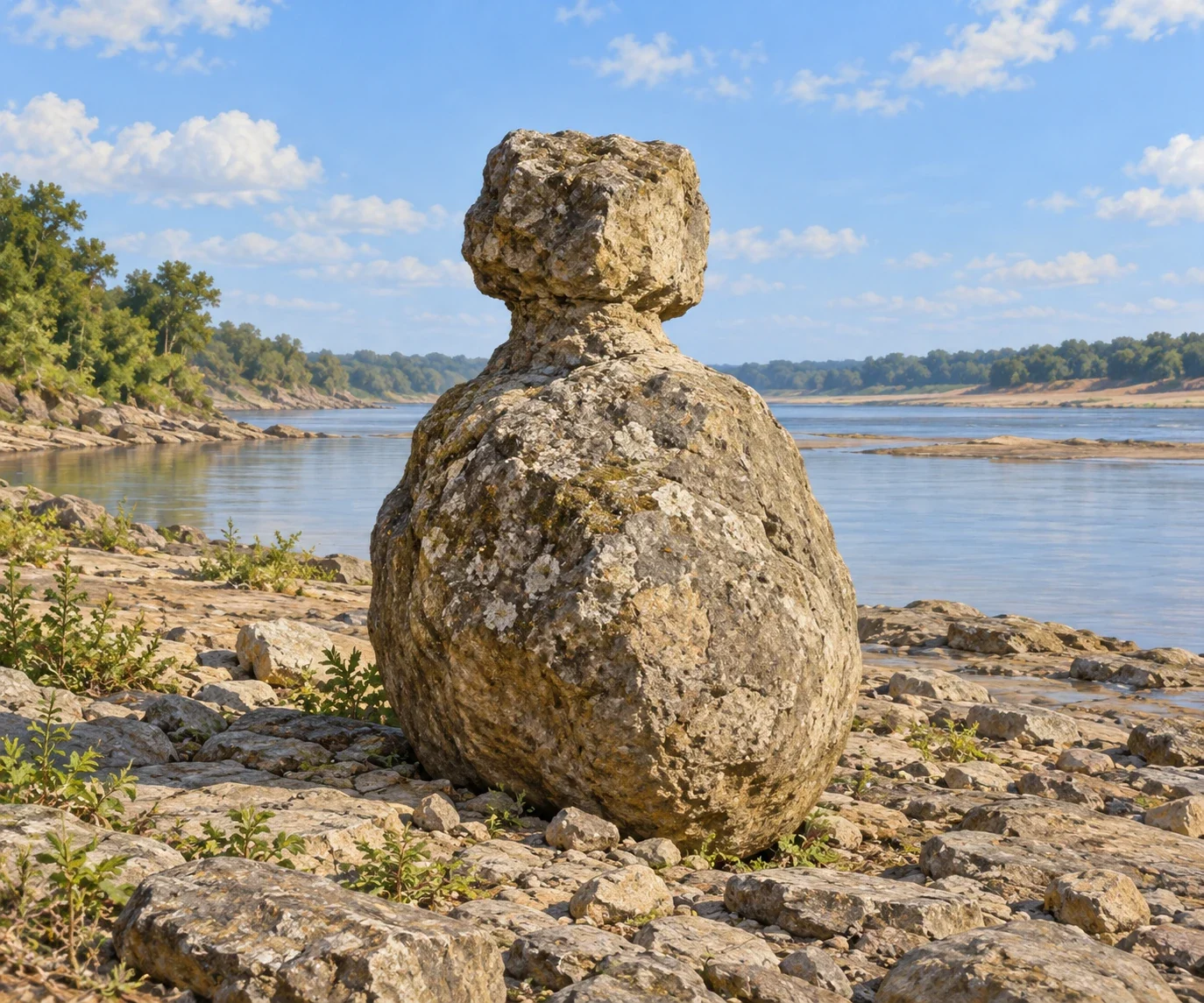
An interpretation of the body-and-head-like Itá-Guaimí stone; rock details and riverbank arrangement are imagined from Ambrosetti’s description.
Original interpretive illustration of the specified historical witness; unspecified details are imagined, not documentary proof of an actual being or site.
Overview
Ambrosetti first describes a physical object rather than a carved image: an almost ovoid stone, thick through most of its body, with a constricted upper portion supporting a smaller, nearly square part. To him it resembles a large body and head. He places it among beach rocks exposed by low water on the Upper Paraná, identifying nearby ports and stream mouths. His description supplies neither a recognisable face nor separate human arms, legs or clothing. The recorded stone shape should therefore not be illustrated as an authenticated statue or a detailed human figure.
The narrative explains the stone as a disobedient girl whose mother sends her to fetch water. Carrying a vessel on her head and muttering complaints, she reaches the shore, where the divine figure called Pupá in the text transforms her into stone. Ambrosetti proposes a Jesuit influence and compares the moral with the story of Lot’s wife. Those origin claims are his conjecture, not independently established transmission history. He then reports that some travellers, especially Guayaná people, avoided touching the stone or speaking loudly before it because its anger would bring a severe storm. The transformation tale and the reported storm belief remain distinct evidence within the same entry; neither demonstrates an observed supernatural event.
Origins & earliest records
PartI, chapterIII, sectionV describes a particular stone exposed during low river water in August, then records its transformation legend and a belief attributed especially to Guayaná travellers. Ambrosetti locates it on the Paraguayan bank. This supports a Paraguay association for this witness, not exclusive ownership of the wider motif or a verified present-day location survey. The individual storyteller is unnamed.
Records & interpretation
Complete sectionV, La Piedra Ita-Guaimí (Piedra vieja), printed pp.118–119. Native PDF120–121 actually viewed from the opening geographic description through the warning and next-section boundary.
Selected bibliography
Documented works and useful reading. This is not a list of every appearance.
- 01
Supersticiones y leyendas: Región misionera–Valles Calchaquíes–Las Pampas
Buenos Aires: La Cultura Argentina. Original Spanish scan already cached; title/date and selected original pages actually inspected.
Family & connections
A source-supported family tree or inspiration record has not yet been compiled for this profile. Related reading below indicates a connection in subject matter, not a proven lineage or creative influence.
References
Sources supporting this profile. Linked pages have their own scope and editorial standards.
- Historical collected Spanish narrative and regional commentary; original scanned pagesAmbrosetti1917 — original regional collection, complete selected section and notesResearch access: 2026-10-21
Image credits
AI-generatedAn interpretation of the body-and-head-like Itá-Guaimí stone; rock details and riverbank arrangement are imagined from Ambrosetti’s description.
Original interpretive illustration of the specified historical witness; unspecified details are imagined, not documentary proof of an actual being or site.