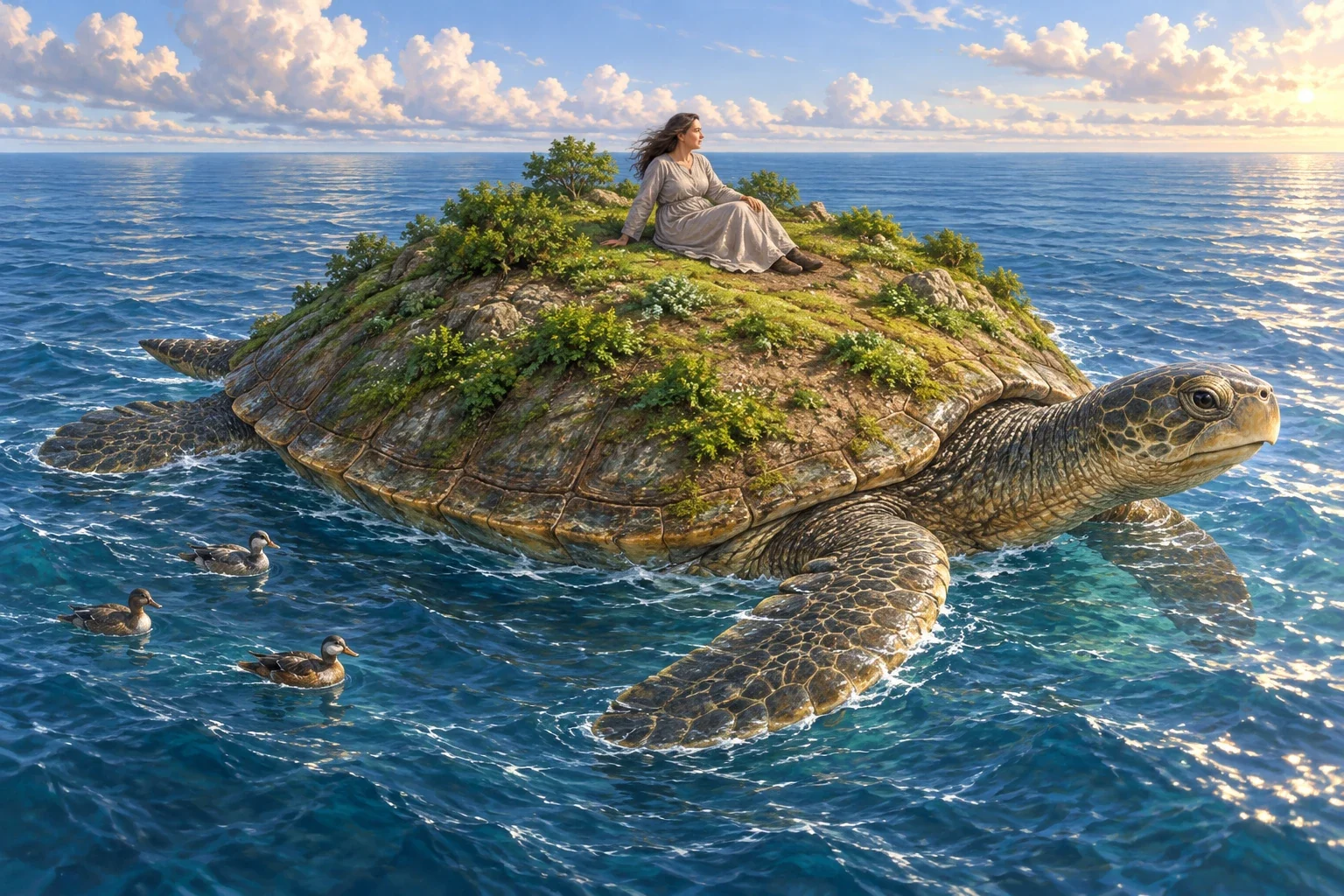
AI-generated interpretation of Smith’s island-forming tortoise account; undescribed details are imagined.
Woman’s face and plain clothing, turtle anatomy and flippers, shell pattern, plant types, emerging ground, scale, water and lighting are imagined. Not a real species identification, authenticated historical picture or community costume portrait. Full frame preserved; WebP compression only.
Overview
Smith’s account begins with deep water covering the earth, birds occupying the air and powerful beings inhabiting the waters. When a woman falls from the sky, huge ducks gather and catch her on their overlapping wings. The aquatic beings then deliberate over a lasting refuge. A giant tortoise alone can undertake the burden and volunteers to hold her on his back. As he increases in size he becomes a large island, making rescue and the formation of habitable ground parts of the same sequence.
The woman subsequently bears twins. Smith describes one as a good spirit who produces useful plants, including maize, fruit and tobacco, and the other as an evil spirit responsible for weeds and vermin. Meanwhile the world continues to increase in size. Its occasional quakings are attributed to the tortoise stretching or contracting his muscles. The foundation therefore remains alive and active within the narrative, rather than becoming an inert support whose later movements are irrelevant to the people above it.
A later part of the same account introduces Sky Holder, whom the source names separately from the tortoise. He brings six human pairs from within the great island and places them in different locations. Smith attributes the subsequent explanation to Tuscarora tellers: one pair remains near the Mohawk River, others by a large stone or on a high hill, while the Tuscaroras receive a Roanoke River location. The account also records competing claims about which people Sky Holder especially favoured. This preserves disagreement within the collected narrative instead of presenting one superiority claim as historical fact.
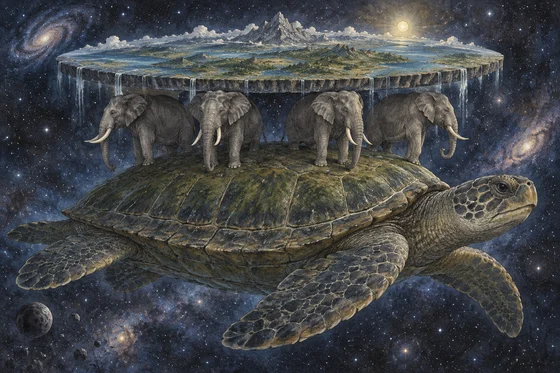
Smith labels the overall account Iroquois and introduces it with her judgment that its good-and-evil framework is modern in origin. That is the collector’s interpretation, not an independently established beginning for the tortoise motif. No individual narrator is named for the opening rescue. The selected tortoise grows into an island and explains quaking through bodily movement; the passage supplies neither a layer of supporting elephants nor a journey among stars. Its particular narrative remains distinct from other communities’ creation accounts and from later literary cosmic turtles.
Origins & earliest records
Erminnie A. Smith, Myths of the Iroquois, Chapter IV, Origin of the Human Race, printed p. 76, in the Bureau of American Ethnology’s Second Annual Report, published 1883. The source’s collective label and later explicit Tuscarora attribution are distinguished.
Records & interpretation
Complete selected account read from Smith’s opening origin judgment through the six-pair localizations and closing clan explanation, ending before the separate Formation of the Turtle Clan account. The opening tortoise narrative has no named individual teller here.
Selected bibliography
Documented works and useful reading. This is not a list of every appearance.
- 01
Myths of the Iroquois, Chapter IV: Origin of the Human Race, p. 76
Second Annual Report of the Bureau of Ethnology, 1880–1881, pp. 47–116. Complete selected account, with collector interpretation and Tuscarora attribution preserved.
Family, evolution & connections
Great A'Tuin
Smith’s selected account has a giant tortoise receive a falling woman and grow into a large island; the living foundation continues moving beneath the expanding world. This provides a bounded world-support motif comparison with the separately catalogued fictional turtle. The accounts remain distinct, and no specific Pratchett creator source is established.
References
Sources supporting this profile. Linked pages have their own scope and editorial standards.
- Historical collected cosmological accountSmith 1883: complete Origin of the Human Race accountResearch access: 2026-10-24
Image credits
AI-generated narrative interpretationAI-generated interpretation of Smith’s island-forming tortoise account; undescribed details are imagined.
Woman’s face and plain clothing, turtle anatomy and flippers, shell pattern, plant types, emerging ground, scale, water and lighting are imagined. Not a real species identification, authenticated historical picture or community costume portrait. Full frame preserved; WebP compression only.