
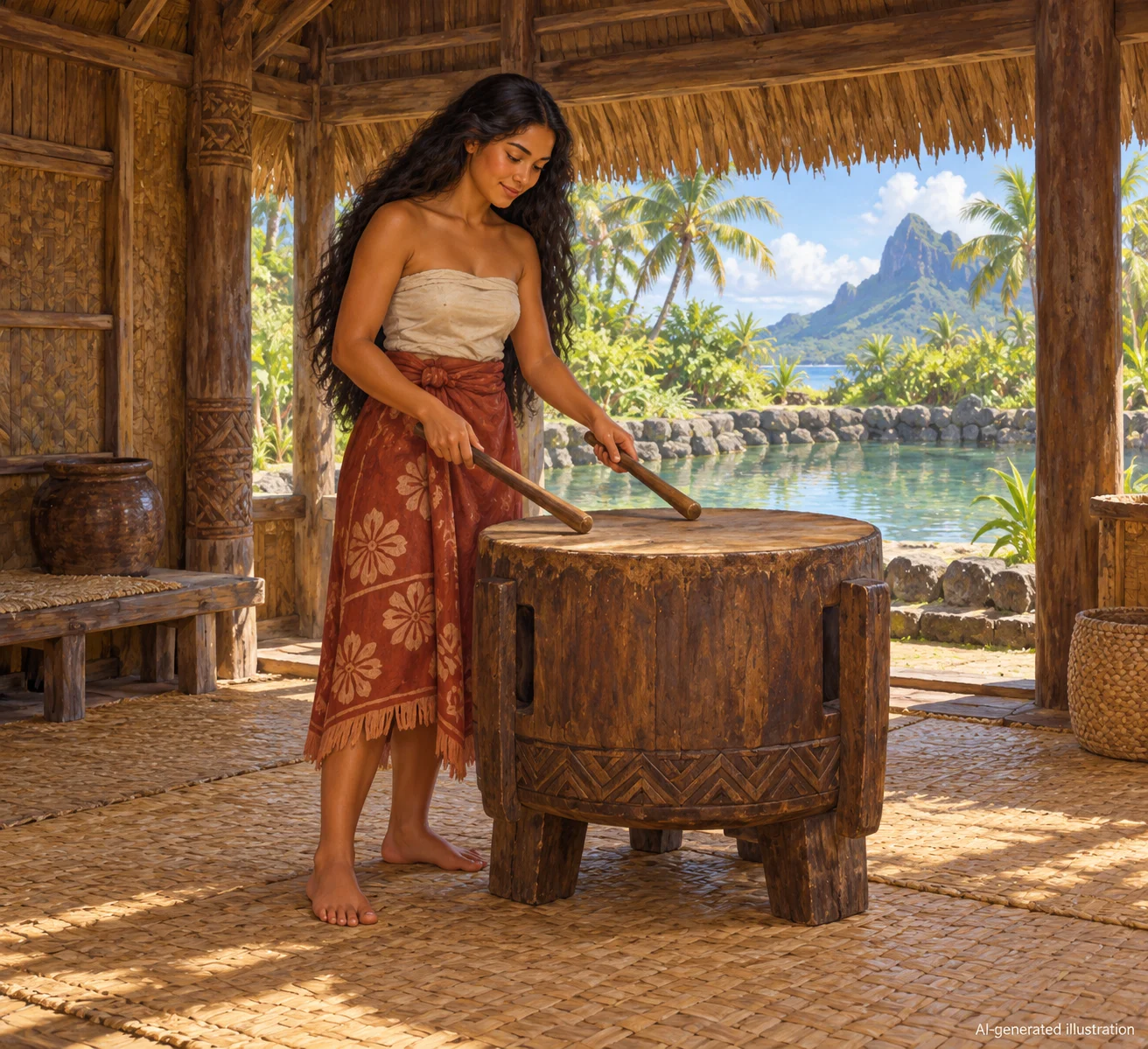
An imagined Ina tests the wooden drum in Tinirau’s empty dwelling.
Ina, Daughter of Ngaetua — an imagined scene from Gill’s historical collected narrative. Human appearance, garments and setting are explicitly imagined narrative choices, not authenticated anatomy, costume or ethnographic reconstruction.
Overview
Ina is the only daughter of Vaitooringa and Ngaetua, with brothers Tangikuku and Rupe. Left to air her parents’ ornaments in sunlight, she is watched by Ngana, who darkens the sky before approaching. He then persuades her to let him try the ornaments on indoors, gains even the guarded headdress and escapes through a small opening. Her parents return furious and beat her. A divine presence enters her and announces her departure for Tinirau’s Sacred Isle. Escaping towards the shore, she injures Tangikuku so that he cannot report where she has gone. The heroine is neither merely passive nor consistently gentle: the journey begins amid deception, family violence and her own harmful action.
Ina first tries several small fish as mounts. Their failure to support her becomes an account of stripes, dark colouring and the sole’s displaced eye, explained through her angry blows. A shark then carries her into deeper water. Its fin opens one coconut, but her attempt to crack another on its head causes it to dive and abandon her. Tekea the Great takes over, protecting her from groups of hostile sharks until she reaches the island. These are particular narrated changes and encounters, not zoological explanations endorsed by the profile. Ina’s resourcefulness and anger both shape the voyage.
On the Sacred Isle she finds salt-water fish ponds and Tinirau’s empty dwelling. A wooden drum and its sticks attract her attention. When she plays, the sound reaches Tinirau at No-land-at-all. He returns, she hides, and a second performance brings him back to find her; she becomes his wife and later bears Koro and Ature. Rupe finds her by entering a small bird and travelling across the sea. His report brings their mother on another bird journey, with fine cloth and provisions. The visit ends in reconciliation and festivities before the visitors return home. Gill identifies the Sacred Isle with an islet in the harbour at Ngatangiia, Rarotonga, and No-land-at-all with a mainland residence. He explicitly calls this heroine Ina daughter of Ngaetua to distinguish her from four other Inas descended from Kui-the-Blind.
Origins & earliest records
Ina’s Voyage to the Sacred Isle and its notes appear on pp. 88–95 of Gill’s 1876 volume, followed by a Song of Ina attributed to Tuka’s contribution to a fête around 1814. Publication and attributed performance dates do not establish the tale’s first origin.
Records & interpretation
The complete voyage, closing locality and identity notes, and full following song were directly read. Gill’s interpretations of shark worship and tattoo origins remain his explanations. The introduction credits Tereavai and Sadaraka for substantial assistance to the collection as a whole, without assigning this exact narrative to a named individual informant.
Selected bibliography
Documented works and useful reading. This is not a list of every appearance.
- 01
Myths and Songs from the South Pacific
Complete Ina voyage pp. 88–95 and following song pp. 95–96; preface and introductory remarks.
Family & connections
A source-supported family tree or inspiration record has not yet been compiled for this profile. Related reading below indicates a connection in subject matter, not a proven lineage or creative influence.
References
Sources supporting this profile. Linked pages have their own scope and editorial standards.
- Primary historical collected witnessGill 1876: complete Ina daughter of Ngaetua voyage and songResearch access: 2026-10-18
Image credits
Original literary interpretation. Human appearance, garments, artifact forms and staging are illustrative choices, not authenticated anatomy, traditional costume or archaeological reconstruction.An imagined Ina tests the wooden drum in Tinirau’s empty dwelling.
Ina, Daughter of Ngaetua — an imagined scene from Gill’s historical collected narrative. Human appearance, garments and setting are explicitly imagined narrative choices, not authenticated anatomy, costume or ethnographic reconstruction.