
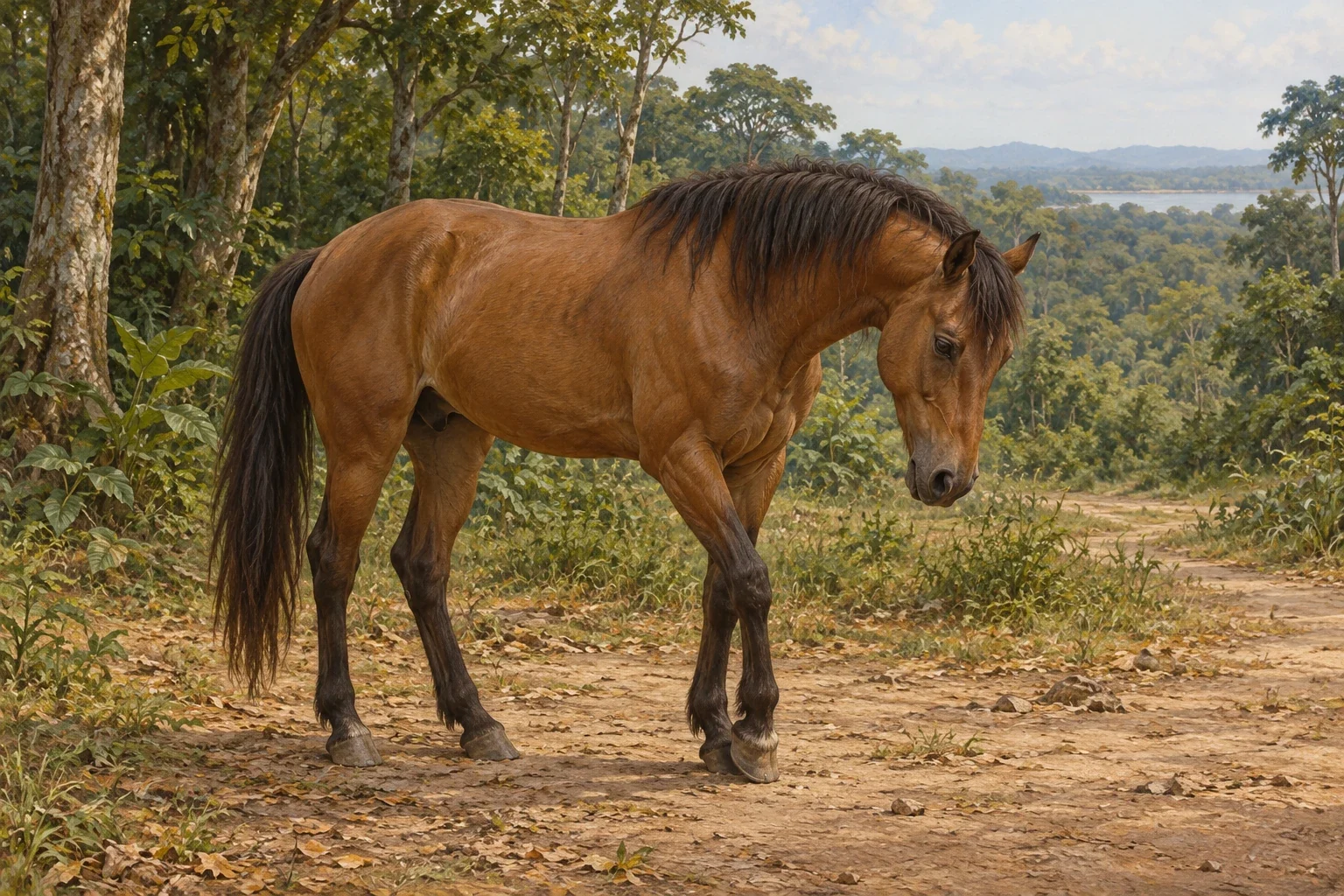
Portrayal of Ilâmbe’s Rescuing Horse (Nassau’s Version).
Portrayal selects the chosen horse alone before the journey, with lowered head and ordinary horse anatomy. A quiet resting stance suggests the reported slight lameness without inventing an injury. Coat, breed-like features and proportions are imagined; no rider, transformation, ritual object, wound or resurrection scene.
Overview
In the Mpongwe tale “Leopard of the Fine Skin,” Ilâmbe rejects suitors with any blemish and accepts Leopard after a sorcerer has given him an apparently flawless human body. Her father supplies a bridal horse from a pair kept in his house. He tells her to choose the duller-looking one, which lowers its eyes and walks a little lame, rather than the brighter animal. The cast calls the rescuer Kabala, a magic horse, while the narrative uses Kabala for both available horses. The label is retained without assuming that it is a uniquely personal name. Its breed, colour, exact size and cause of lameness are not specified.
The horse carries Ilâmbe and her husband on their outward journey. It understands what Ilâmbe does not: the husband repeatedly resumes leopard form to hunt, and later consumes her servants. Horse waits before speaking, then explains their disappearance and warns that she will be next. It instructs her to prepare three gourds containing ground-nuts, gourd-seeds and water. When the husband leaves again, the two flee together. As Leopard gains on them, Horse tells Ilâmbe to scatter the nuts and then the seeds, which delay the pursuer while he eats. Finally the thrown water becomes a deep wide river that separates them from him.
Their escape is not complete at the river. Horse proposes shelter in a nearby town where women are forbidden. It first changes Ilâmbe’s face and dress to a man’s appearance; when suspicions arise and communal bathing is proposed, it changes her bodily into a man for the short remainder of their stay. These are separate stages in the text, not an ordinary disguise alone. Horse then directs Ilâmbe to shoot it, burn its cut-up remains and scatter its ashes outside the gate before dawn. Following those instructions restores both the living horse and Ilâmbe’s female form, with her already mounted for departure.
They reach her father that afternoon and report the experience, especially through Horse’s account. The ending places responsibility on Ilâmbe’s insistence about her husband’s skin, a judgment voiced within the historical narrative. It does not make the horse’s original dull appearance a hidden wound, turn it into the transformed husband, or give it wings. Its effective protection combines knowledge, speech, flight, transformation and restoration, with the father’s earlier choice vindicated by events. The story belongs to Nassau’s Mpongwe section, whose foreword reports narration in Mpongwe by an unnamed man and woman at Libreville, followed by his English rendition.
Origins & earliest records
Nassau, Where Animals Talk (1912), Part First, tale15, Leopard of the Fine Skin, printed pp. 68-76. Collection and translation chain follows the complete section foreword, not an independently consulted original-language text.
Records & interpretation
Complete selected English tale, cast list, prefatory note and ending read, with complete general preface and both relevant section forewords. Retained original HTML decoded strictly with its declared ISO-8859-1 encoding; no original-page image or source artwork inspection claim.
Selected bibliography
Documented works and useful reading. This is not a list of every appearance.
- 01
Where Animals Talk: West African Folk Lore Tales
Part First, tale15, Leopard of the Fine Skin, pp. 68-76; complete selected narrative and note with general preface and section transmission context.
Family & connections
A source-supported family tree or inspiration record has not yet been compiled for this profile. Related reading below indicates a connection in subject matter, not a proven lineage or creative influence.
References
Sources supporting this profile. Linked pages have their own scope and editorial standards.
- Primary historical collected folklore in English translationNassau, retained original historical collection transcriptionResearch access: 2026-10-10
Image credits
AI-generatedPortrayal of Ilâmbe’s Rescuing Horse (Nassau’s Version).
Portrayal selects the chosen horse alone before the journey, with lowered head and ordinary horse anatomy. A quiet resting stance suggests the reported slight lameness without inventing an injury. Coat, breed-like features and proportions are imagined; no rider, transformation, ritual object, wound or resurrection scene.