
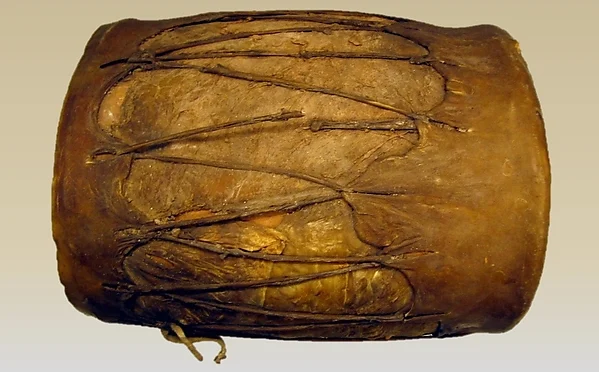
Nineteenth-century wood-and-skin drum catalogued as Hopi by The Metropolitan Museum of Art, accession 89.4.628
The Met catalogues this wood-and-skin drum as Hopi, from nineteenth-century northeastern Arizona. This historical museum object supplies material context; its photograph does not establish a particular ceremony, the identity of an individual maker, or the practices of every contemporary Hopi community.
Overview
The Hopi Tribe identifies itself as a sovereign nation in northeastern Arizona, with twelve villages associated with three mesas. Its public introduction describes Hopitutskwa as the people’s homeland and frames farming, humility and respect for resources through a covenant with Maasaw. This is the Tribe’s own account of responsibility and belonging. It is not a claim that Hopi people are confined to an unchanging past or that each individual follows an identical occupation. The introduction expressly affirms cultural, linguistic and religious continuity amid outside influences.
The Hopi Cultural Preservation Office explains that representing cultural interests requires participation by villages, clans and religious societies as well as tribal government. Its account of traditional knowledge emphasizes speaking and listening: stories teach on several levels, and listeners understand more as their experience grows. Consequently, an account’s purpose may extend beyond a chronological list of events. The office also documents objections to stories, designs, recordings and ceremonial images being reproduced without appropriate permission. Public availability and authority to reproduce every aspect of cultural knowledge are therefore distinct matters within this community’s own explanation.
Contemporary education joins language and culture with other kinds of learning. The Tribe’s education department describes provision from preschool through further education, including adult training, disability-related support, a public library, a bookmobile and a mobile computer laboratory. Language and cultural knowledge are meant to enter schooling alongside modern technology. These services demonstrate institutional activity without implying that one school pathway defines Hopi identity or citizenship.
The Hopi Foundation offers another community-organized example. Local Hopi founders established it in 1985 and incorporated it in 1987. Its history describes projects proposed and shaped by village participants, including farming, youth development, cultural work and community capacity. It serves Hopi and Tewa communities and others; an organization’s service population is not a declaration that those identities are interchangeable.
For further reading, Becoming Hopi: A History brings together Hopi contributors and other researchers under editors Wesley Bernardini, Stewart B. Koyiyumptewa, Gregson Schachner and Leigh Kuwanwisiwma. The publisher describes a collaborative treatment of oral tradition, archaeology and documentary history, with migrations and changing communities central to the account. Its catalogue is used here as bibliography, not as evidence that the complete volume has been read.
History & identity
The Tribe’s public homeland account and responsibilities are attributed separately from archaeological interpretations and modern institutional dates.
Sources & representation
Complete official welcome, cultural-preservation and education page bodies; complete Foundation history and mission; publisher catalogue and award notice. No linked legal documents or complete book inspected.
Selected bibliography
Documented works and useful reading. This is not a list of every appearance.
- 01
Becoming Hopi: A History
Publisher dates ebook July 2021 and paperback June 2023; bibliographic reference only.
Language & cultural connections
Source-supported language and cultural connections have not yet been compiled for this profile.
References
Sources supporting this profile. Linked pages have their own scope and editorial standards.
- Tribal governmentHopi Tribe: welcomeResearch access: 2026-10-05
- Tribal cultural officeHopi Cultural Preservation OfficeResearch access: 2026-10-05
- Tribal governmentHopi education departmentResearch access: 2026-10-05
- Community organizationHopi Foundation: history and missionResearch access: 2026-10-05
- PublisherBecoming Hopi: publisher catalogueResearch access: 2026-10-05
Image credits
Contextual cultural object photographNineteenth-century wood-and-skin drum catalogued as Hopi by The Metropolitan Museum of Art, accession 89.4.628
The Met catalogues this wood-and-skin drum as Hopi, from nineteenth-century northeastern Arizona. This historical museum object supplies material context; its photograph does not establish a particular ceremony, the identity of an individual maker, or the practices of every contemporary Hopi community.