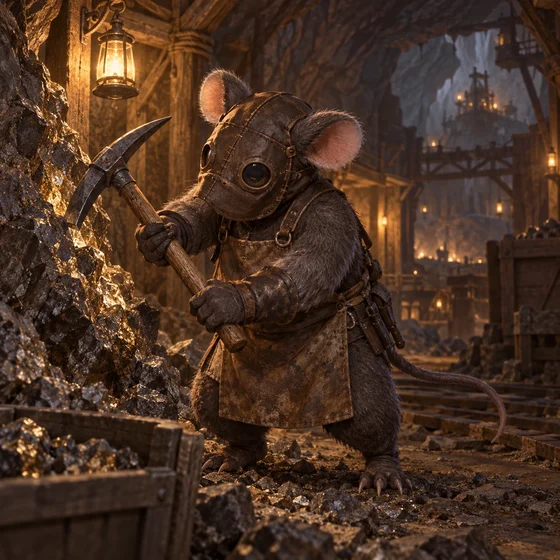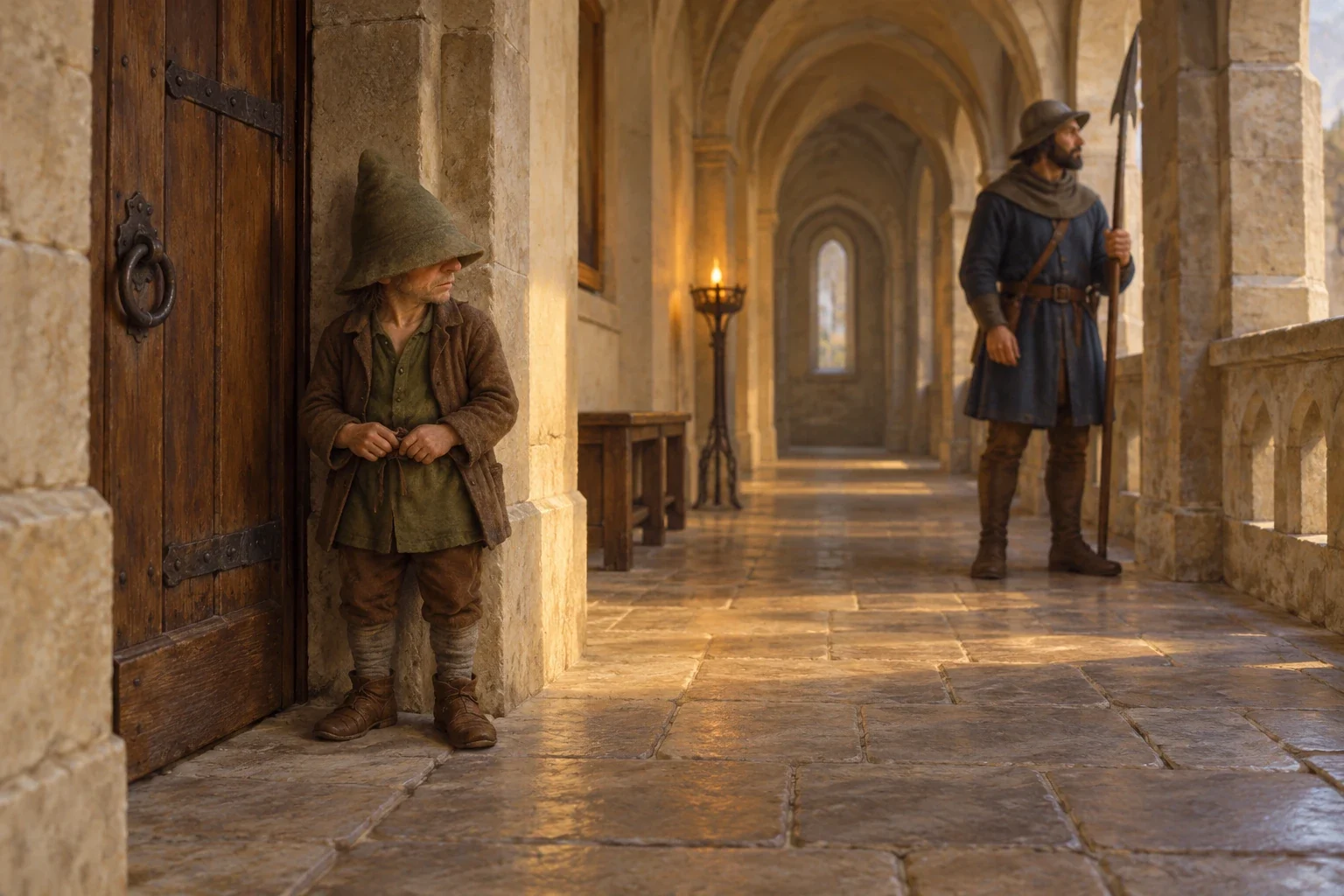
AI-generated narrative interpretation of Hödeken’s household watchfulness in Keightley’s account; figure, clothing and palace setting are imagined.
Only the low felt hat, household association and watchfulness follow the selected account. Small stature, humanlike anatomy, clothes, guard, halberd, light and architecture are artistic inventions. No game anatomy, source artwork or authenticated palace reconstruction used.
Overview
Hödeken is a named household spirit in Thomas Keightley’s The Fairy Mythology, where the account explicitly calls him a Kobold or house-spirit. He lives in the bishop of Hildesheim’s palace. His name is explained through a little felt hat worn low over his face, and Hütchen is given as an alternative. The spirit offers useful services: he warns the bishop and others about coming events and prevents watchmen from sleeping at their posts. The account therefore begins with a helper attached to a particular household and its responsibilities, rather than an underground mining population.
That assistance has a dangerous limit. A kitchen boy throws dirt and foul water at Hödeken. When the spirit complains, the head cook mocks him instead of intervening. Hödeken then kills the sleeping boy. His conflict with the cook escalates through contamination of food and an attack that sends the cook from a bridge into the moat. The frightened inhabitants fear further destruction, including a fire in the town and palace, and the bishop eventually has the spirit exorcised and banished. The text’s initial description of an obliging being does not erase these violent acts.
A separate anecdote concerns a travelling husband who asks Hödeken to watch his wife. When she invites lovers into her chamber, the spirit drives them away by taking frightening forms or invisibly throwing them out of bed. After the husband returns, Hödeken announces that the task has exhausted him and refuses to repeat it, comparing it unfavourably with guarding all the swine in Saxony. The wife’s plotting and the husband’s honour are presented through the narrator’s moralising language. The episode documents an attributed tale of household surveillance and supernatural coercion, rather than an account of harmless domestic labour.
This profile follows the complete short Hödeken account on pages 255–256 of Keightley’s 1892 printing. The adjacent general Kobold introduction supplies editorial classification, while its equation of several regional household beings remains the compiler’s comparison. No date for an actual palace haunting, independent witness verification or fixed anatomy is established. Final Fantasy XIV’s separately documented Kobolds share the category-name, but this particular household tale does not establish the games’ creator route, molelike body, metallurgy or devotion to Titan.
Origins & earliest records
The complete Hödeken account in Keightley’s The Fairy Mythology, selected 1892 printing, pp. 255–256. The general Kobolds introduction is adjacent editorial context, not proof of one universal tradition.
Records & interpretation
Complete named short account and full adjacent Kobolds introduction read. Cached whole volume retained by reference; whole volume not claimed read.
Selected bibliography
Documented works and useful reading. This is not a list of every appearance.
- 01
The Fairy Mythology — Hödeken, pp. 255–256; Kobolds introduction, pp. 239–240
Complete named tale and complete introductory section read; no historical source image reused.
Family, evolution & connections
Kobold (Final Fantasy)
Final Fantasy XIV’s Kobolds inhabit tunnels under O’Ghomoro in northern Vylbrand. Keightley labels Hödeken a Kobold or house-spirit in a particular Hildesheim household account. This supplies a source-specific comparison for the shared category-name, not a claim that the developer consulted Keightley or derived the game people’s anatomy, mining culture or Titan relationship from this tale.
References
Sources supporting this profile. Linked pages have their own scope and editorial standards.
- Historical collected narrative in EnglishKeightley 1892 — Hödeken and Kobolds introductory contextResearch access: 2026-10-24
Image credits
AI-generated narrative interpretationAI-generated narrative interpretation of Hödeken’s household watchfulness in Keightley’s account; figure, clothing and palace setting are imagined.
Only the low felt hat, household association and watchfulness follow the selected account. Small stature, humanlike anatomy, clothes, guard, halberd, light and architecture are artistic inventions. No game anatomy, source artwork or authenticated palace reconstruction used.