
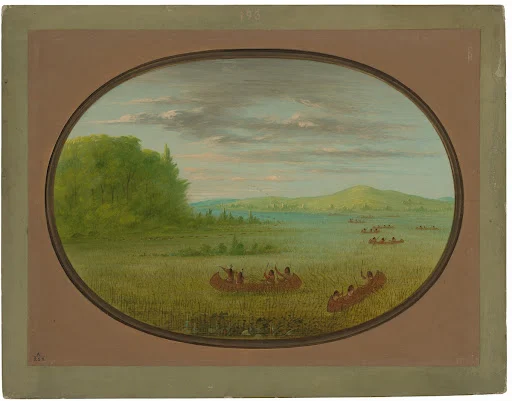
George Catlin’s 1861–1869 painting Gathering Wild Rice — Winnebago, showing canoe parties in a marsh identified in his catalogue as the Fox River, Wisconsin
Catlin’s later Cartoon Collection painting depicts canoe parties gathering wild rice. His catalogue locates the scene on Wisconsin’s Fox River and uses the historical name Winnebago. It is an outside artist’s nineteenth-century representation associated with Ho-Chunk history, not a documentary photograph or a portrayal of the contemporary Ho-Chunk Nation’s government and membership. The complete painted card and its original border are retained.
Overview
The Ho-Chunk Nation describes its traditional lands across what are now Wisconsin, Minnesota, Iowa, Missouri and Illinois. Its statement of enduring presence belongs to its own oral historical understanding; it is not reduced here to a precise archaeological age. The government's account distinguishes a traditional chief-and-clan system from a constitutional structure comprising executive, legislative, judicial and general-council branches. The constitutional dates 1963 and 1994 mark political frameworks rather than the origin of the people.
Representation extends beyond Wisconsin: the official description identifies three legislative districts within the state and a fourth for people outside it. This is a useful reminder that community membership cannot be read simply from residence. Language work also requires precise institutional attribution. HoChunk Renaissance identifies itself with the Winnebago Tribal community in Nebraska and describes services for members on and off its reservation. Its publications and classes should therefore retain that attribution, rather than automatically being assigned to the Wisconsin Nation's government.
Within the Wisconsin Nation's educational services, Hoocak Ee Cooni Waziperes Hocira states a mission of teaching very young children to understand and speak Hoocak. The stated age range runs from four-month-old infants through four-year-old preschool children. This describes the centre's educational purpose, not a count of fluent children or proof that every family uses the same learning pathway. The Nation's online dictionary provides another form of access: its help page explains searches in both English and Ho-Chunk, alphabet browsing and audio controls. Recordings are available as learning tools; their pronunciation has not been independently assessed here.
The Culture and Community Education division combines several different kinds of learning. Its Indigenous Arts and Sciences program connects environmental-science experiences with cultural context for high-school students. Wazooki Hosto, described as Family Gathers, brings together the division, Heritage Preservation and the Ho-Chunk Museum for arts learning across generations. The same public page advertises an introductory civics course covering such subjects as clans, constitutional government, removals and storytelling, with a spring 2026 launch still expressed prospectively. That wording documents the program's announced scope, not confirmation that every advertised session occurred. These institutional examples show contemporary choices about education without defining a single experience shared by all Ho-Chunk people.
Artist Truman Lowe offered an individual perspective in a 2010 interview with Jess Righthand. He connected his installation with memories of his mother wrapping valued belongings, while explicitly limiting his own spiritual expertise. His account presents contemporary art as an active contribution to history, rather than an anonymous expression automatically shared by every Ho-Chunk person.
History & identity
Community accounts affirm enduring relationships with traditional lands; governmental and educational institutions have separately documented histories.
Sources & representation
Complete official About and Culture and Community Education bodies, complete early-childhood mission page and dictionary help, plus the Nebraska program About body for institutional distinction. No full constitution, dictionary corpus or recordings examined.
Selected bibliography
Documented works and useful reading. This is not a list of every appearance.
- 01
Ho-Chunk Online Dictionary
Help page inspected for search and audio features; not a complete dictionary reading.
- 02
Artist Truman Lowe Talks About His Work in Vantage Point
Smithsonian Magazine,30September2010.
Language & cultural connections
These connections link languages or specific cultural works and institutions; they do not establish biological ancestry or ethnic identity.
Indigenous Arts and Sciences program
The Nation describes environmental science for high-school students in a cultural context. This is an educational initiative, not an inherited trait.
Located primary passages
Specific passages supporting details in this entry, grouped by their published witness.
Artist Truman Lowe Talks About His Work in Vantage Point
Smithsonian Magazine,30September2010.
- Lowe characterises his installation as a continuation and departure within his own practice. He explicitly limits his authority concerning spirituality and treats contemporary Native art as documentation of a particular time. His reflections connect personal history, visual expression and museum collecting without making his individual interpretation a rule for all Ho-Chunk people.
Complete four-question written interview; continuity-of-work and exhibition answers.
No exhibition visit, artwork-image inspection or linked work reading claimed; ritual and burial detail not reproduced. Institutional role is historical.
References
Sources supporting this profile. Linked pages have their own scope and editorial standards.
- Community-authoredAbout the Ho-Chunk NationResearch access: 2026-10-05
- Community-authoredCulture and Community EducationResearch access: 2026-10-05
- Community-authoredEe Cooni learning centreResearch access: 2026-10-05
- Community-authoredOnline dictionary helpResearch access: 2026-10-05
- Community-authoredHoChunk Renaissance programResearch access: 2026-10-05
- Primary interviewTruman Lowe interview, Jess Righthand, 2010Research access: 2026-10-05
Image credits
Historical cultural scene interpreted by an outside artistGeorge Catlin’s 1861–1869 painting Gathering Wild Rice — Winnebago, showing canoe parties in a marsh identified in his catalogue as the Fox River, Wisconsin
Catlin’s later Cartoon Collection painting depicts canoe parties gathering wild rice. His catalogue locates the scene on Wisconsin’s Fox River and uses the historical name Winnebago. It is an outside artist’s nineteenth-century representation associated with Ho-Chunk history, not a documentary photograph or a portrayal of the contemporary Ho-Chunk Nation’s government and membership. The complete painted card and its original border are retained.