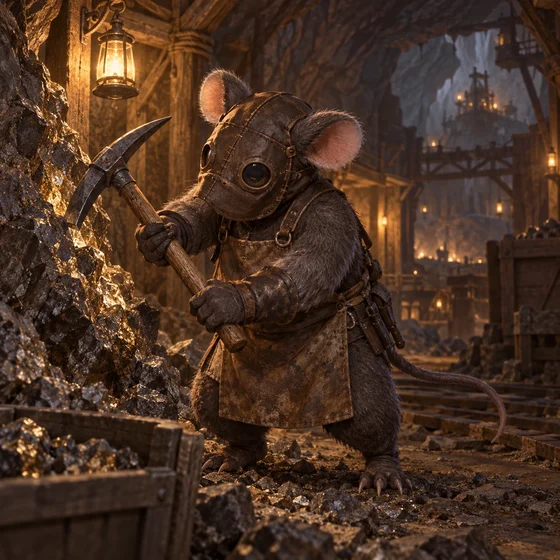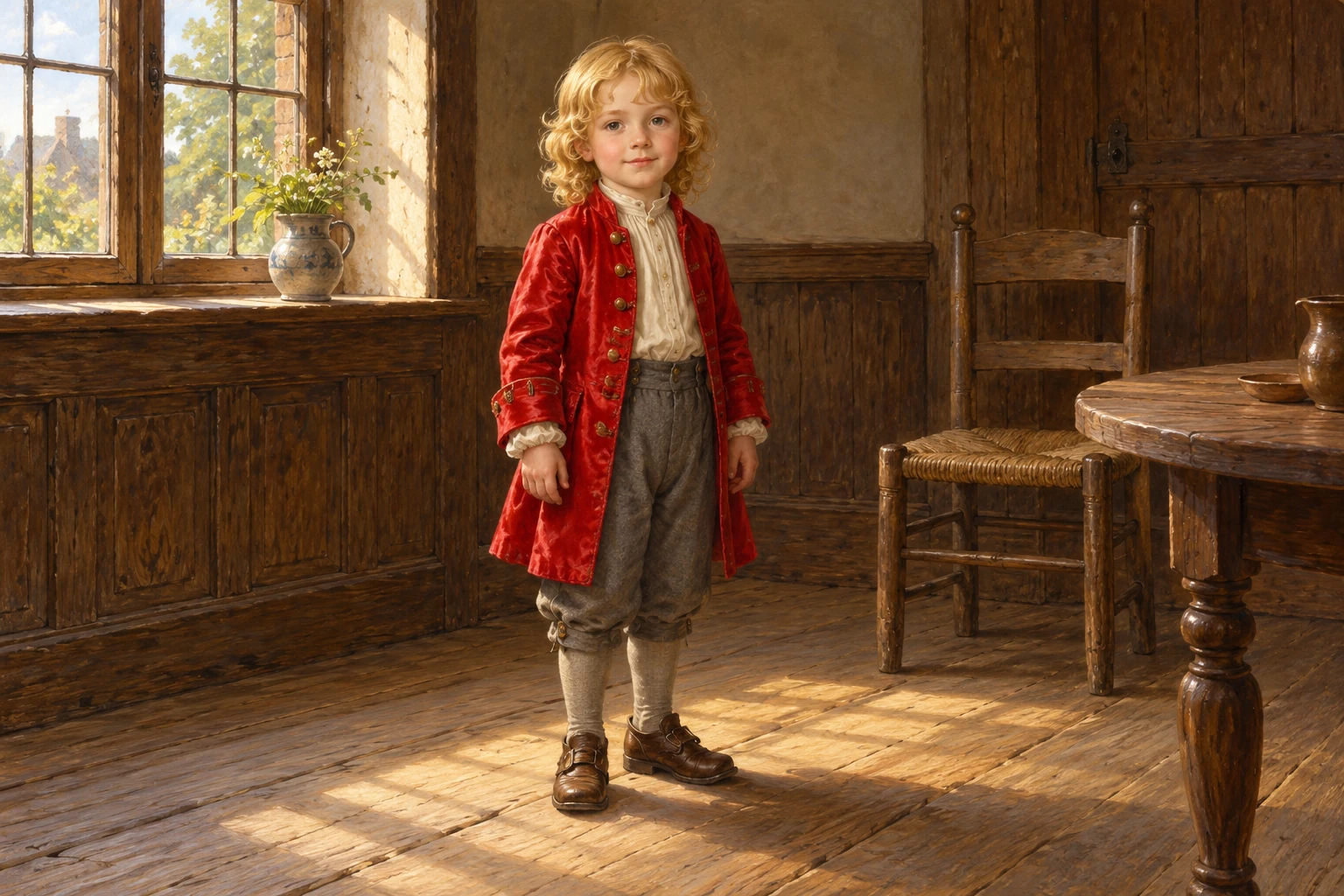
AI-generated interpretation of Hinzelmann’s child manifestation described in Keightley’s playroom episode. Yellow curls and a red silk coat follow that description; face, pose, other garments, furnishings and building details are imagined. This is not a portrait of a verified historical child or a Final Fantasy design.
The account reports several different manifestations. This image selects one quiet childlike appearance and does not establish a permanent body for every kobold.
Overview
Keightley’s account places Hinzelmann at the old castle of Hudemühlen in Lüneburg, near the Aller. It dates the beginning of his disturbances to 1584: knocking is followed by a voice conversing with servants and then with the household’s master. The speaker gives the additional name Lüring and describes himself as an exile from companions in the Bohemian forest. These are the spirit’s explanations within the narrative, not independently established origins. His friendly conversation and singing gradually make an invisible presence familiar, but objections and attempts to escape continue.
When the frightened master travels to Hanover, a white feather accompanies the carriage. A missing gold chain then causes an accusation against the inn’s servants. Hinzelmann speaks to the traveller, tells him to look beneath his pillow, and explains that he himself was the feather. The recovered chain does not solve the master’s deeper problem: leaving home has not left the companion behind. Hinzelmann urges him to return to his own estate, and the master decides to do so rather than keep retreating.
Back at Hudemühlen, the spirit’s work supports the household while also giving him authority within it. Dishes left overnight are found cleaned and arranged; lost utensils are located; horses are carefully groomed and thrive. Servants receive reminders about their duties, and negligence can bring blows. His own small room contains a patterned straw chair, a round table and a bed bearing only a slight depression. Milk with wheaten bread is regularly supplied. At the household table, he demands a place and resents being forgotten. Food vanishes from the plate but is later found beneath benches or in a corner, so apparent eating is not straightforward evidence of ordinary nourishment.
The efforts to catch or expel him produce further uncertainty about his form. Armed men strike at empty air before a marten-like figure escapes; another encounter presents a snake on a bed. A visitor who tries to trap the voice inside wine-jugs is mocked for mistaking the vessel for the spirit. Hinzelmann also claims Christian standing and reacts angrily to being called a devil. When asked about Kobolds and knocking spirits, he denies belonging to them. Keightley nevertheless introduces his history as an example of Kobolds. The compiler’s classification and the character’s refusal remain distinct statements rather than a settled taxonomy.
The account includes several visible manifestations without making any one of them his constant body. A childlike shadow and briefly felt cold hand are reported by the master. In a separate playroom encounter, a maid sees a small boy with yellow curls falling to his shoulders and a red silk coat among the children; he leaves and disappears when she tries to observe him closely. Other episodes involve intimidation, unwanted interference with courtship and warnings of misfortune. Household help therefore coexists with coercion and demands for recognition, rather than proving universal benevolence.
Before leaving, Hinzelmann gives a plaited little cross, a patterned straw hat and a pearl-decorated leather glove. The cross’s material is uncertain in the transmitted wording. He ties the family’s future fortune to keeping the objects together and recommends entrusting them to Anne and Catherine. The story follows their later dispersal with different degrees of certainty, including an unknown fate for the cross. His departure is placed after four years, from 1584 to 1588, and he promises a possible future return. Keightley’s closing note proposes ventriloquism and human contrivance as explanations for house-spirit feats. That skeptical comment belongs beside the narrated wonders; neither the dates nor the claimed objects are independently authenticated here.
Origins & earliest records
The selected witness is Thomas Keightley’s The Fairy Mythology, George Bell & Sons 1892 revised and enlarged edition. His Kobold framing attributes the Hinzelmann account to an abridgement in Grimm’s Deutsche Sagen of a longer work by the minister Feldmann. Those upstream texts and their exact editions have not been independently collated; the primary reading here is Keightley’s historical English compilation.
Records & interpretation
The complete Hinzelmann subsection, pp. 240–254, with preceding Kobold framing and notes 286–291 was read. Dates, voices, appearances and claimed gifts remain attributed narrative statements. The classification dispute and Keightley’s final naturalistic explanation are retained.
Selected bibliography
Documented works and useful reading. This is not a list of every appearance.
- 01
The Fairy Mythology, 1892: Kobold framing and complete Hinzelmann account, pp. 239–254, notes 286–291
Complete selected account, including departure, gift history, classification dispute and skeptical final note. No independent German-source reading claimed.
Family, evolution & connections
Kobold (Final Fantasy)
Keightley places Hinzelmann’s Hudemühlen history under Kobolds, while the spirit himself denies belonging to that category. The account describes household service, demands for respect, elusive appearances and a departure with gifts. This provides one disputed historical use of the Kobold classification beside the later fictional name. It does not settle a universal creature identity, transfer the household events or anatomy to the game, or establish that its creators consulted this account.
References
Sources supporting this profile. Linked pages have their own scope and editorial standards.
- Primary historical English compilationKeightley 1892, Hinzelmann at Hudemühlen, complete account and notes 286–291Research access: 2026-10-25
Image credits
Modern interpretation of a historical narrativeAI-generated interpretation of Hinzelmann’s child manifestation described in Keightley’s playroom episode. Yellow curls and a red silk coat follow that description; face, pose, other garments, furnishings and building details are imagined. This is not a portrait of a verified historical child or a Final Fantasy design.
The account reports several different manifestations. This image selects one quiet childlike appearance and does not establish a permanent body for every kobold.