
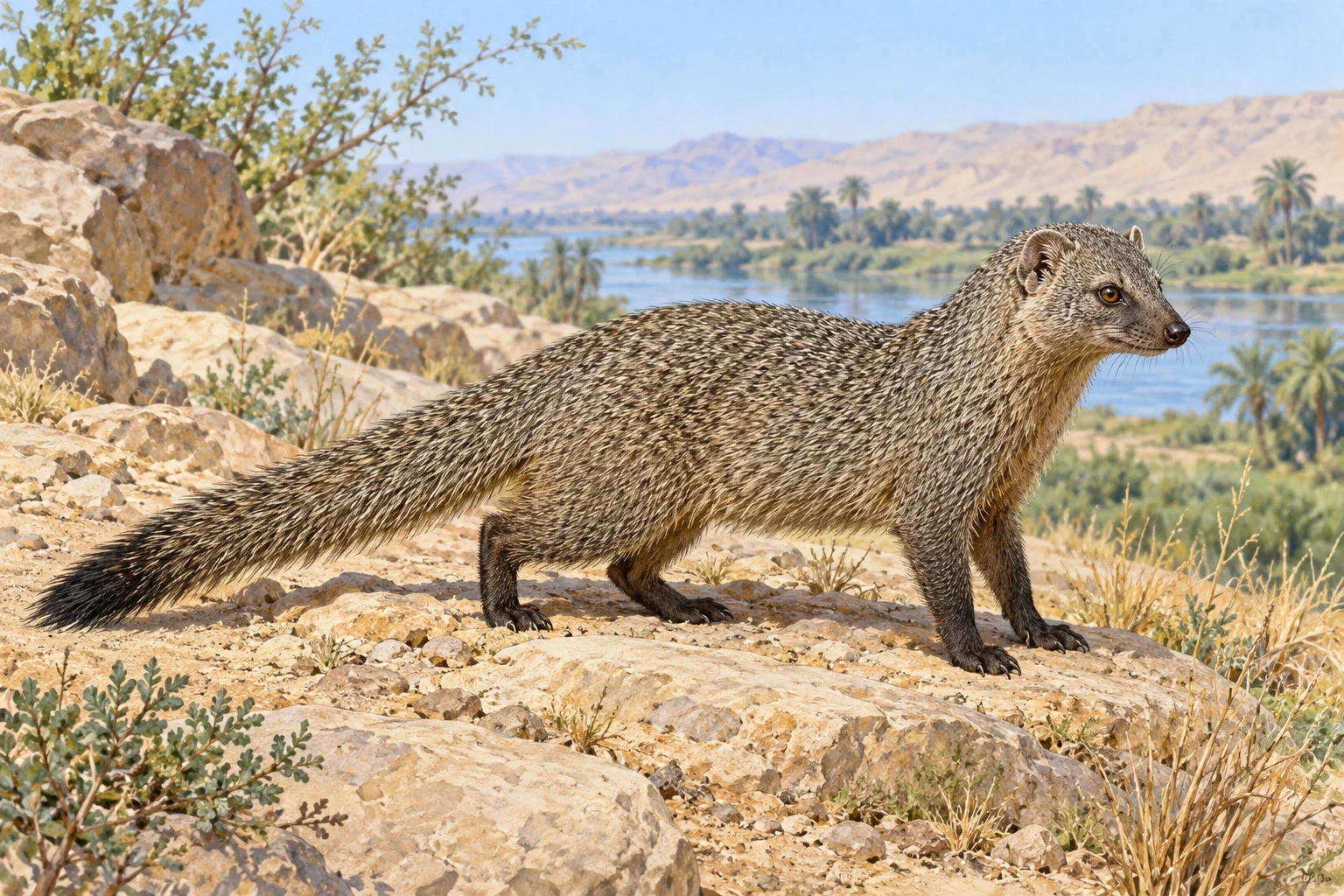
AI-generated natural-history study.
Interpretive portrait; no authenticated specimen claim.
Overview
The Egyptian mongoose has a low, elongated body, short legs and a pointed dark muzzle beneath small rounded ears. The University of Évora museum describes coarse grey-brown fur, a long tapering tail with a darker terminal tuft, and five clawed toes on each foot.
The museum’s Portuguese account places this diurnal mammal in Mediterranean wooded pasture, dense scrub and vegetated margins of waterways and wetlands. It excavates burrows with underground galleries. This is regional habitat evidence: the species also has a broad African distribution, and the Portuguese description should not be mistaken for its entire ecological range.
Zootier-Lexikon describes a ground-dwelling forager taking small mammals, reptiles, invertebrates and bird eggs, alongside fruit, other plant material and carrion. Its compiled account reports one to four young after sixty to eighty-eight days of gestation, with weaning at four to eight weeks. These figures remain attributed to that compilation. Adults may occur alone, in pairs or in mother-and-young groups; this natural-history profile does not depict the mythical ichneumon.
Origins & earliest records
Scrub and waterside vegetation
Evidence & interpretation
Institutional text and native photographs.
Selected bibliography
Documented works and useful reading. This is not a list of every appearance.
- 01
- 02
Family & connections
A source-supported family tree or inspiration record has not yet been compiled for this profile. Related reading below indicates a connection in subject matter, not a proven lineage or creative influence.
Look for a taxonomic record and classified relativesReferences
Sources supporting this profile. Linked pages have their own scope and editorial standards.
- University museum species account, PortugueseHerpestes ichneumonResearch access: 2026-10-23
- Expert zoo compilation, GermanIchneumonResearch access: 2026-10-23
Image credits
AI-generated interpretive illustrationAI-generated natural-history study.
Interpretive portrait; no authenticated specimen claim.