
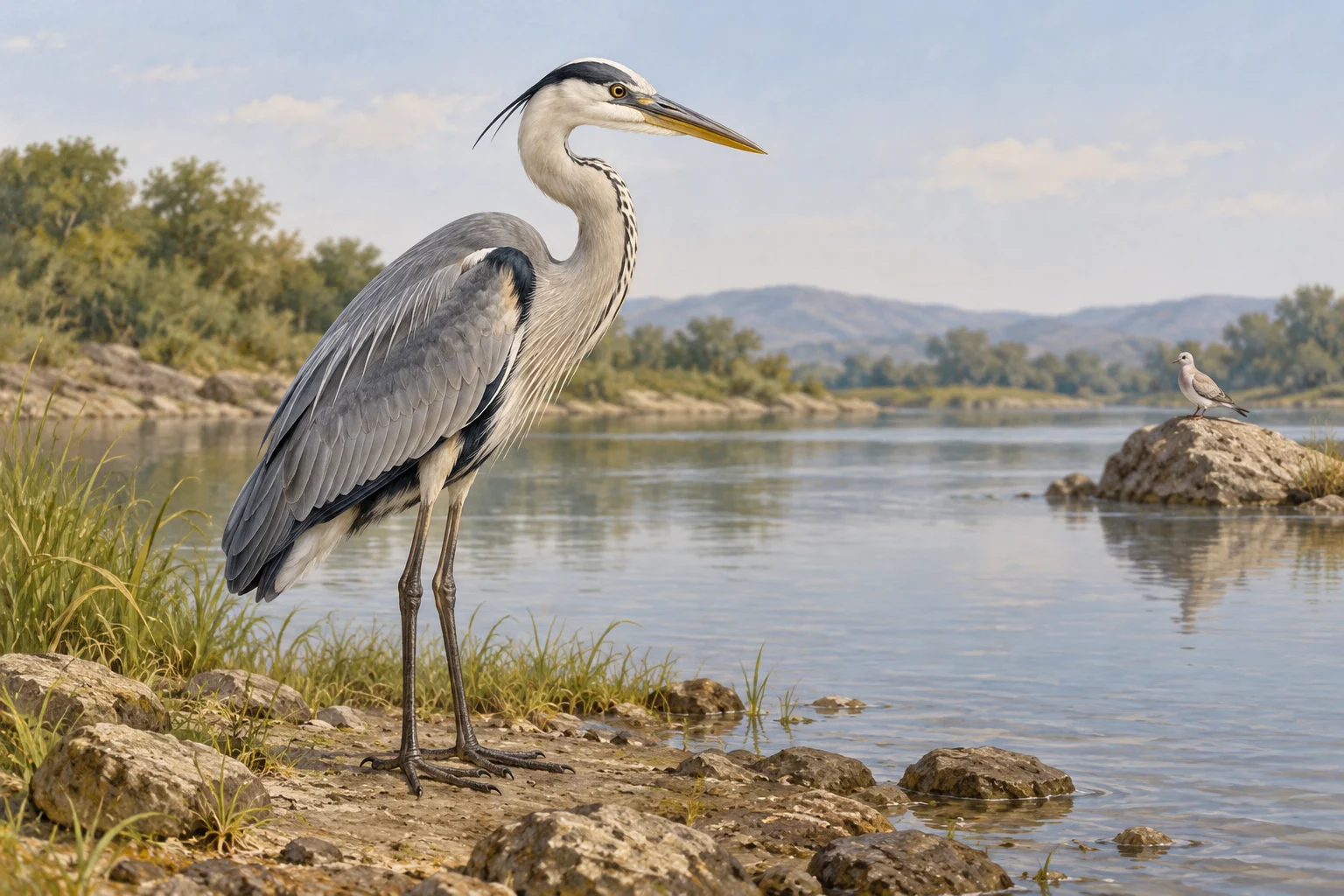
AI interpretation of the heron’s literary bent-neck marker using natural posture; exact species and waterbank unspecified.
Original AI interpretation of a particular historical literary witness. Species, colours, proportions, landscape and enclosure imagined; no authenticated community iconography, modern national origin or independently verified animal husbandry claimed.
Overview
In The Dove and the Heron, a jackal repeatedly demands the dove’s young and threatens to fly up to her rocky nesting place if she refuses. The dove yields until the heron asks why she is crying. On hearing her account, he points out that jackals cannot fly and advises her to give away no more children. The dove follows that advice but tells the returning jackal who taught her to resist. The jackal announces that he will catch the heron.
At the waterside, the jackal asks the heron how he stands when wind blows from one direction, then how he stands in rain and a storm. The bird demonstrates by turning and bending his neck. The jackal strikes it and breaks it in the middle. The final sentence explains the heron’s bent neck through that attack; it does not narrate his later recovery or explicitly state a death. This is the fable’s explanation of a bodily feature, not an anatomical finding. The source identifies neither a personal name nor a particular heron species.
Origins & earliest records
Bleek identifies a Nama-language original in G. Krönlein’s manuscript, pp. 13–14, in Sir George Grey’s library. His preface associates Krönlein’s collecting with Beerseba in Great Namaqualand; it does not identify an individual teller or establish the fictional waterbank’s location.
Records & interpretation
Complete 1864 English witness, original printed pp. 21–22, including source attribution and ending; native pages checked directly. Underlying Nama manuscript or Alexander’s 1838 book not independently collated in this lane.
Selected bibliography
Documented works and useful reading. This is not a list of every appearance.
- 01
Reynard the Fox in South Africa; or, Hottentot Fables and Tales
Complete selected tale and full prefatory mediation retained. Native UCT scan confirms original printed pagination, which differs from normalized digital page labels.
Family & connections
A source-supported family tree or inspiration record has not yet been compiled for this profile. Related reading below indicates a connection in subject matter, not a proven lineage or creative influence.
References
Sources supporting this profile. Linked pages have their own scope and editorial standards.
- Original historical English collection with explicit earlier-source attributionBleek 1864, complete selected tale, printed pp. 21–22Research access: 2026-10-18
Image credits
AI-generatedAI interpretation of the heron’s literary bent-neck marker using natural posture; exact species and waterbank unspecified.
Original AI interpretation of a particular historical literary witness. Species, colours, proportions, landscape and enclosure imagined; no authenticated community iconography, modern national origin or independently verified animal husbandry claimed.