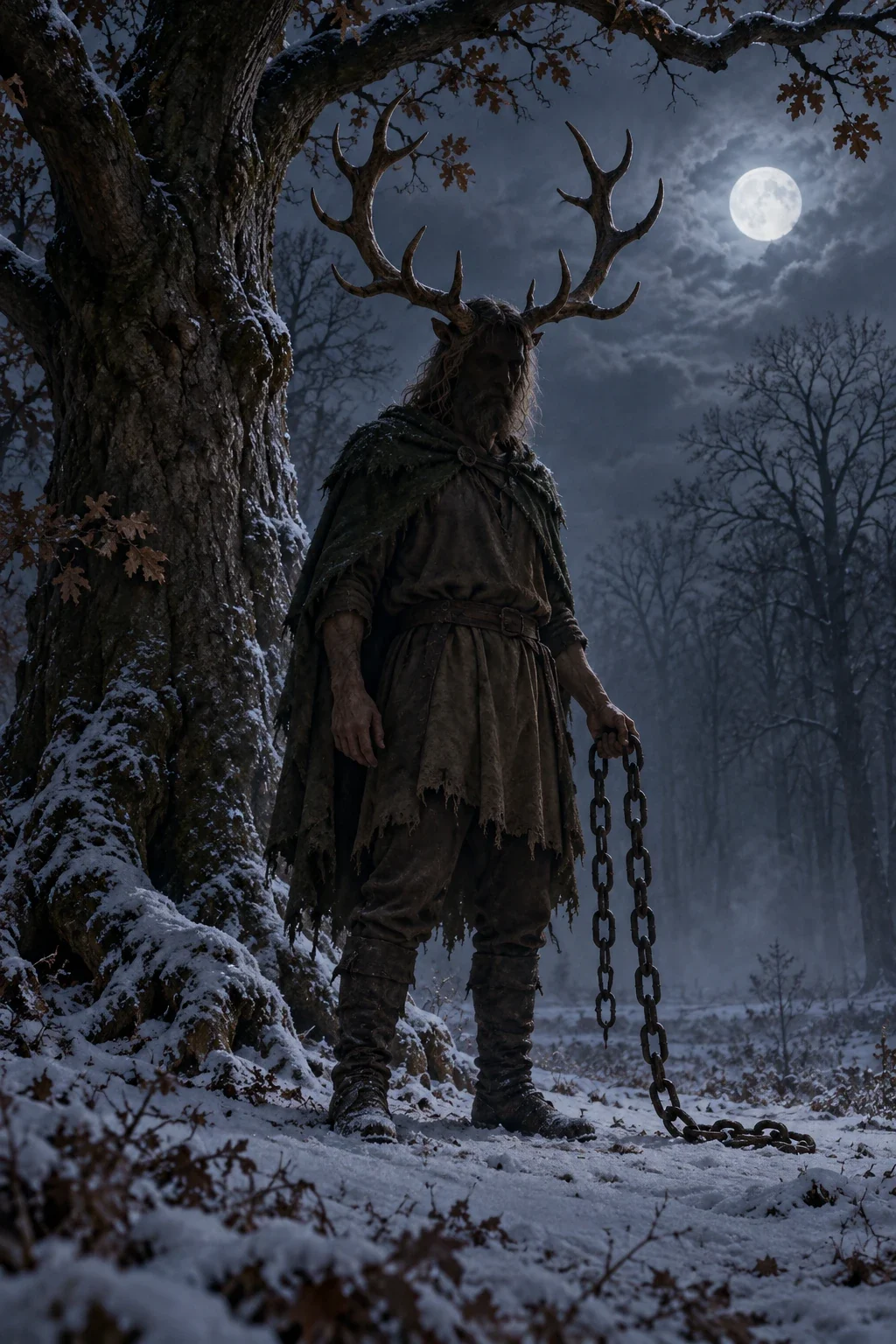
AI-generated interpretation of the horned keeper reported in Shakespeare’s Windsor tale; figure, clothing and exact oak are imagined.
Reported legend in Shakespeare’s selected scenes, not an authenticated sighting or Falstaff’s staged disguise. Face, clothing, horn form and exact tree are artistic interpretation; no game artwork used.
Overview
Herne the Hunter appears as a reported local spirit in Shakespeare’s The Merry Wives of Windsor, rather than as an independently appearing character. In Act IV, scene 4, Mistress Page recounts a tale about a former keeper in Windsor Forest. During winter, at midnight, he is said to circle an oak wearing great, ragged horns. She attributes to him the blighting of the tree, the taking of cattle, the production of blood instead of milk and the terrifying shaking of a chain. These are the reported powers of the tale, not observations established by the play’s action.
The speakers also expose the uncertainty of that report. Mistress Page says earlier people transmitted it as truth while describing their belief sceptically. Page answers that many still fear passing the oak at night. Their exchange documents the place that the story occupies within the comedy: a frightening local reputation that can be used by people who do not simply endorse it. It supplies no independently verified keeper’s biography, date of death or account of how he acquired the horns.
The wives turn this reputation into a deliberate trap. Mistress Ford proposes that Falstaff meet them by the oak disguised as Herne, with huge horns. Other participants will dress as fairies, frighten and punish him, then reveal the deception. Act V, scene 5 carries out the performance: the selected text brings Falstaff on wearing a buck’s head, lets him invoke Herne, and later has him remove the headpiece. He admits that guilt and surprise led him to believe the supposed fairies. The impersonation is therefore a staged human use of the legend, not evidence that Herne bodily enters the scene.
This profile is limited to that selected Shakespearean account and its dramatic framing. The horns, oak and chain support a recognisable woodland image, but they do not establish an animal skull for a face, a wooden body, control of roots or animals, or descent from a named ancient deity. Later creative reception is considered in the separately documented Leshen record. A modern production’s design choices cannot supply missing historical evidence for the Windsor tale.
Origins & earliest records
A reported Windsor tale presented through Mistress Page’s speech in Shakespeare’s comedy; no claim that the selected text proves a pre-Shakespearean oral chronology.
Records & interpretation
Complete Act IV scene4 and Act V scene5 read, with all dialogue and scene-ending actions. Whole play retained for provenance but not claimed read in full. Complete Folger textual introduction read separately.
Selected bibliography
Documented works and useful reading. This is not a list of every appearance.
- 01
The Merry Wives of Windsor — Act IV scene4 and Act V scene5
Public-domain original dramatic language via PG1517; a modern electronic witness, not an independently collated early printing.
Family, evolution & connections
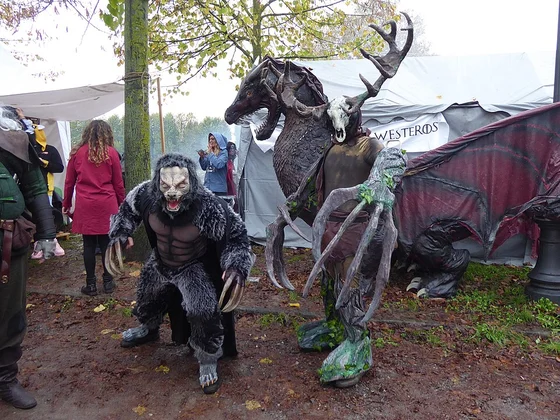
Leshen (The Witcher)
Leshen (The Witcher): Slavic legends and Herne informed the design; its skull is described as moose or elk. Passage independently read through a third-party text mirror.
References
Sources supporting this profile. Linked pages have their own scope and editorial standards.
- Primary dramatic witnessShakespeare — The Merry Wives of Windsor, complete selected scenesResearch access: 2026-10-23
- Scholarly editorial contextFolger — An Introduction to This TextResearch access: 2026-10-23
Image credits
AI-generated narrative interpretationAI-generated interpretation of the horned keeper reported in Shakespeare’s Windsor tale; figure, clothing and exact oak are imagined.
Reported legend in Shakespeare’s selected scenes, not an authenticated sighting or Falstaff’s staged disguise. Face, clothing, horn form and exact tree are artistic interpretation; no game artwork used.