
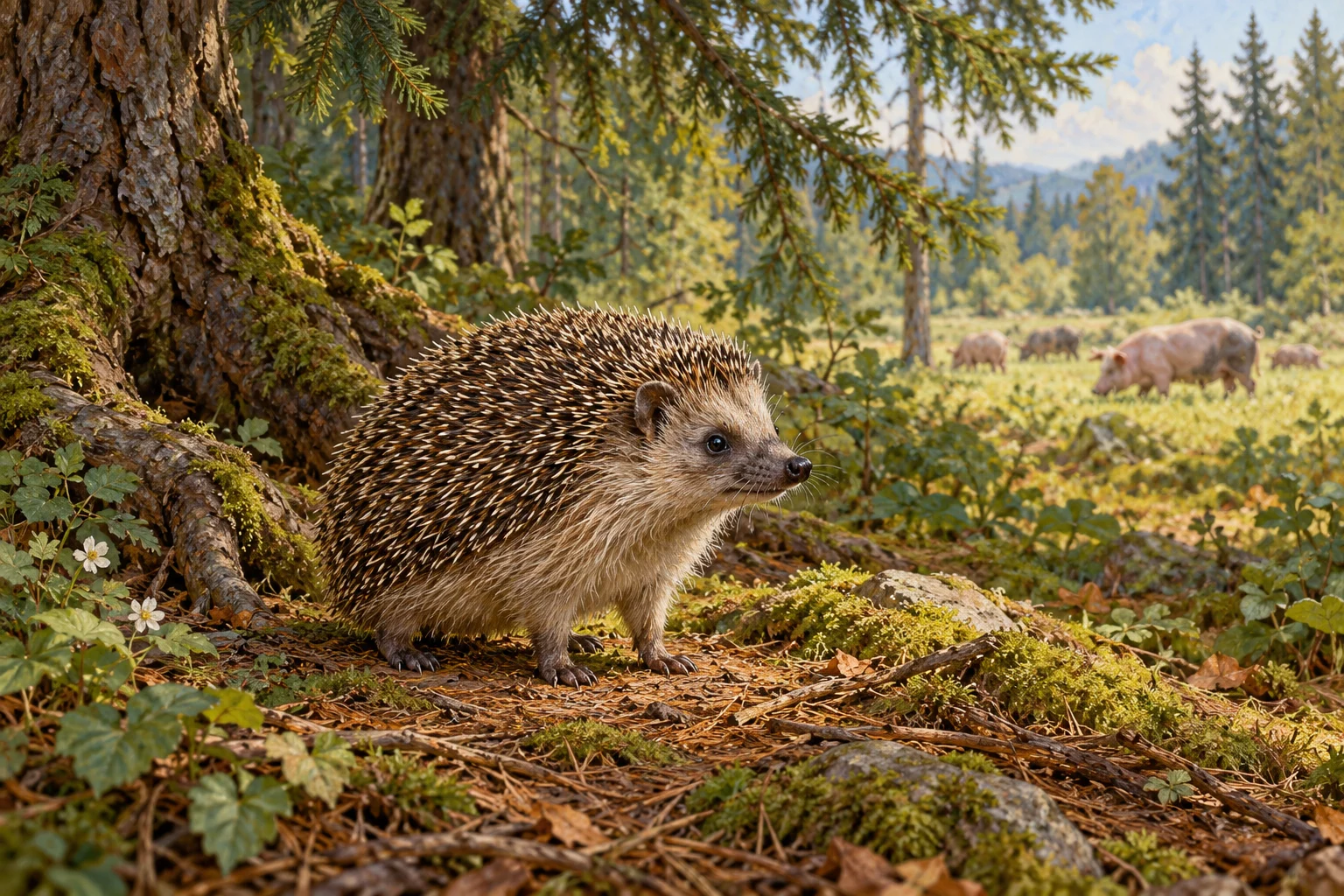
Godlewa’s hedgehog herder beside a spruce; individual appearance and forest setting imagined.
Original narrative illustration; detailed appearance and staging imagined, not an authenticated cultural record.
Overview
A childless man finds a hedgehog in the forest and takes him home. The animal volunteers to herd his sow, despite the man’s doubt that such a small creature can manage the task. He keeps her in the forest for three years, during which the pigs multiply into a great herd. An officer, a prince and finally a king each become lost while hunting. Each encounters the hedgehog beside a spruce and promises him a daughter in return for guidance out of the forest. After helping them, he returns to his pigs and eventually brings the flourishing herd home to the delighted man.
The hedgehog then has the man feed a rooster and rides it to claim the promised brides. From the officer and the prince he obtains horses and a carriage filled with money, but on each homeward journey he lets the woman choose to return to her father. He keeps the money and repeats the visit. With the king’s daughter, the story does not repeat that question: he brings her home and a wedding follows. The man buys an estate, and the couple live with him for many years before dying. No human transformation is narrated. Wollner expressly distinguishes this wholly animal hedgehog from the hybrid and later disenchanted figure in Grimm’s related tale.
Origins & earliest records
Collected by Karl Brugman in the Godlewa area in 1880 and published in 1882. Original Lithuanian tale 19 carries narrator code A, identified as an unnamed young man of Pojess, east of Godlewa. The retained narrative is Brugman’s complete German translation III 3, with his translation preface and Wilhelm Wollner’s comparative note. The regional introduction explicitly reports openness to collecting there; the separate Prussian song collection is not conflated with this narrator.
Records & interpretation
Complete German III 3, printed pp.355–357, through the couple’s long life and death; original Lithuanian 19 narrator binding and complete comparative note pp.523–524 retained. Native title, attribution and selected narrative pages visually inspected.
Selected bibliography
Documented works and useful reading. This is not a list of every appearance.
- 01
Litauische Volkslieder und Märchen aus dem preussischen und dem russischen Litauen
Original Strassburg: Karl J. Trübner edition; Godlewa collection of August–September 1880, German translations in PartIII.
Family & connections
A source-supported family tree or inspiration record has not yet been compiled for this profile. Related reading below indicates a connection in subject matter, not a proven lineage or creative influence.
References
Sources supporting this profile. Linked pages have their own scope and editorial standards.
- Original historical German translation of a collected Lithuanian narrativeBrugman 1882: complete German tale, collector attribution and comparative noteResearch access: 2026-10-18
Image credits
AI-generatedGodlewa’s hedgehog herder beside a spruce; individual appearance and forest setting imagined.
Original narrative illustration; detailed appearance and staging imagined, not an authenticated cultural record.