
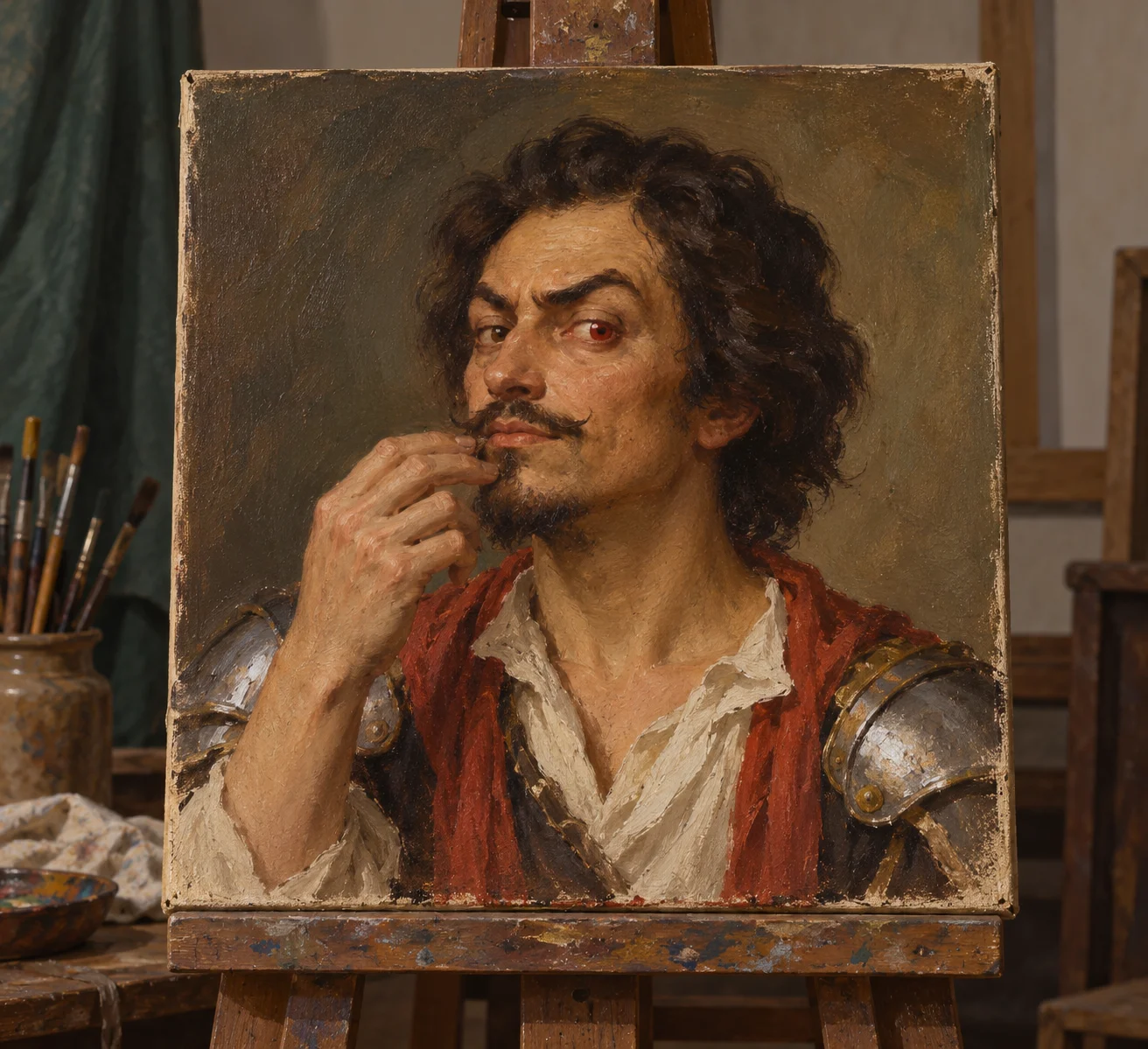
The red fabric is an imagined costume detail, not an enacted revision to a scarlet robe in the story.
Overview
Harringay begins with a painted head of an Italian organ-grinder whom he had posed looking upward. Dissatisfied with a merely lifeless portrait, he retouches its mouth, eyes and expression while considering changing titles and costumes. The figure acquires a sneer and increasingly sinister animation. An accidental application of vermilion turns one eye fiery; when Harringay strikes the painting with red paint, the figure closes its eyes and wipes its face with a hand. It then speaks, claiming that the painter’s lack of a clear purpose invited its arrival. What follows is a contest conducted through a painted face and its gestures, not an account of a figure stepping bodily out of the canvas.
The speaker attacks Harringay’s uncertain methods and offers artistic achievement in exchange for his soul. Harringay refuses both the bargain and the unsolicited criticism, attacking with more red paint while the figure tries to wipe it away. When the palette is exhausted he brings a tin of Hedge Sparrow’s Egg Tint enamel. The tempter raises its offer from two masterpieces to further masterpieces, but the painter continues until the canvas is uniformly pale green. A final mouth and red eye disappear beneath the covering, and the last stirring subsides. The narrator repeatedly limits the event to Harringay’s testimony: a small canvas, twenty-four by twenty, survives as evidence of repainting, while his promised masterpieces never materialize. The story therefore presents a claimed demonic encounter with an ironic frame, rather than independently proving the portrait’s supernatural life.
First appearances & development
H. G. Wells’s authored English fiction in The Stolen Bacillus and Other Incidents, retained Methuen, London title dated 1895. The acknowledgment names periodicals collectively without assigning this tale to a particular one. The consulted historical body is reused unchanged; no adaptation, independently collected tradition or real specimen establishes this account.
Canon & continuity
The complete forty-seven-paragraph narrative, repeated qualifications of Harringay’s testimony and final account of the enamelled canvas establish the scope. Proposed working titles are not treated as confirmed identities of the painted visitor.
Selected bibliography
Documented works and useful reading. This is not a list of every appearance.
- 01
The Stolen Bacillus and Other Incidents
Selected tale: The Temptation of Harringay.
Family & connections
A source-supported family tree or inspiration record has not yet been compiled for this profile. Related reading below indicates a connection in subject matter, not a proven lineage or creative influence.
References
Sources supporting this profile. Linked pages have their own scope and editorial standards.
- Primary historical authored fictionWells — complete selected tale, dated title and acknowledgmentResearch access: 2026-10-18
Image credits
AI-generatedThe red fabric is an imagined costume detail, not an enacted revision to a scarlet robe in the story.