
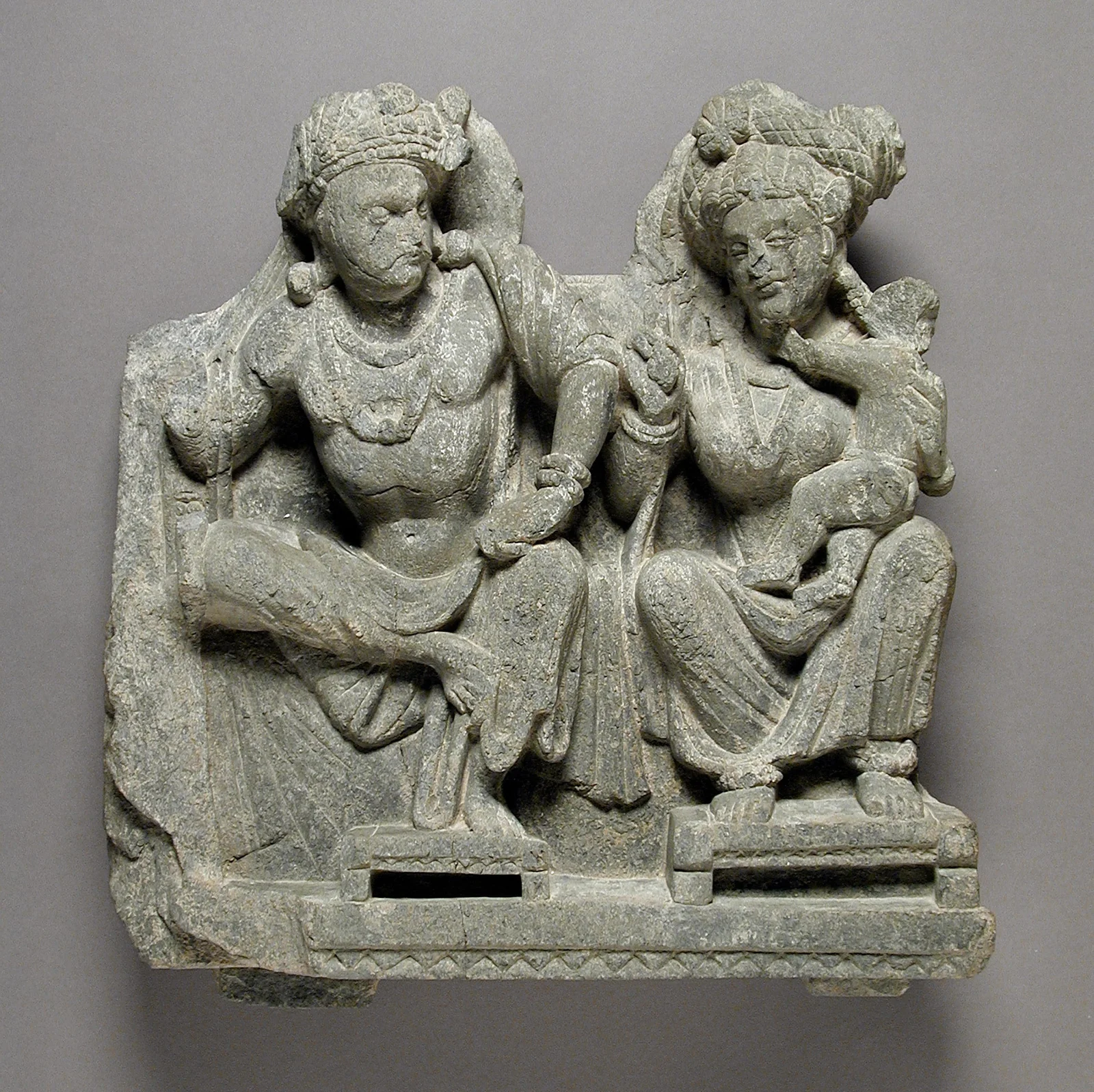
Grey schist relief of seated Panchika at left, wearing a turban and moustache, and Hariti at right with a child embracing her neck; both have halos, draped garments and individual footstools.
Gandhara, ca.100–150. Panchika and Hariti appear together as protective deities, with a child on Hariti’s knee. The damaged objects once held in their hands are not all securely identified; the museum qualifies the proposed cup and pomegranate.
Overview
LACMA’s record for the Gandharan couple Pañcika and Hārītī describes her as a former ogress and queen of yakshis who became a protective mother goddess through the Buddha’s intervention. Its gray-schist sculpture M.83.66, dated about100–150, shows her with a child beside Pañcika. The curator distinguishes surviving attributes from proposed lost ones: a pomegranate is a suggested reconstruction. This establishes a particular regional representation, not a uniform appearance or the beginning of all Hārītī traditions.
Ashmolean curator Shailendra Bhandare compares protective mother images from Gandhara and Mathura, including a cornucopia-bearing treatment associated with abundance and a Mathura mother surrounded by children. Several details remain interpretations: a worn figure at her feet is probably Ganesha, and a cup may contain a remedy. Those proposals are not securely readable attributes shared by every image. The account describes religious protection against childhood illness, without establishing medical efficacy.
Hearn’s1894 pilgrimage account records a Japanese shrine of Kishibojin, whom his note identifies with Hārītī. His brief legend specifically says that she devoured her own children before the Buddha’s teaching changed her into their protector. That wording remains his version rather than being silently replaced by another account. He describes a mother figure holding an infant and a lotus, with many small votive children’s garments hanging before the shrine. The observed offerings and narrated conversion are different kinds of evidence.
The Met’s terracotta Men Brajut, accession2009.321, is a later regional witness from East Java, dated to the fourteenth or fifteenth century. The catalogue identifies it as a Javanese guise of Hārītī and explains its open top as provision for a wooden post. Its proposed use at the base of a pavilion pillar is an architectural interpretation. Together these witnesses retain regional differences in name, imagery and setting rather than imposing a single timeless form.
Origins & earliest records
Source-specific Japanese narrative and, where specified, South/Southeast Asian custodial witnesses.
Records & interpretation
Complete English chapter and notes read; named custodial accounts read where cited.
Selected bibliography
Documented works and useful reading. This is not a list of every appearance.
- 01
The Tutelary Couple Panchika and Hariti
M.83.66; surviving and reconstructed details distinguished.
- 02
Pandemics and Protection
Complete article and Hārītī discussion; uncertain readings retained.
- 03
Glimpses of Unfamiliar Japan, First Series
IV, A Pilgrimage to Enoshima, §20 and note7; complete chapter read.
- 04
The Mother Goddess Men Brajut (Hariti)
2009.321; proposed pavilion-pillar function.
Family & connections
A source-supported family tree or inspiration record has not yet been compiled for this profile. Related reading below indicates a connection in subject matter, not a proven lineage or creative influence.
Primary records and illustrations
Glimpses of Unfamiliar Japan; named custodial records where listed
FirstSeries1894; museum records accessed2026-10-05. IV §20/note7; LACMA M.83.66; Met2009.321; Ashmolean article
Cache hearn-glimpses1-enoshima.txt complete24sections+7notes; hariti-lacma45104 /hariti-ashmolean.html/.txt. Met full returned web record read, local requests cache attempt429 and not retried. No image inspection claimed.
References
Sources supporting this profile. Linked pages have their own scope and editorial standards.
- Historical narrative or custodial object interpretationThe Tutelary Couple Panchika and HaritiResearch access: 2026-10-05
- Historical narrative or custodial object interpretationPandemics and ProtectionResearch access: 2026-10-05
- Historical narrative or custodial object interpretationGlimpses of Unfamiliar Japan, First SeriesResearch access: 2026-10-05
- Historical narrative or custodial object interpretationThe Mother Goddess Men Brajut (Hariti)Research access: 2026-10-05
Image credits
Historical sculpture photographGrey schist relief of seated Panchika at left, wearing a turban and moustache, and Hariti at right with a child embracing her neck; both have halos, draped garments and individual footstools.
Gandhara, ca.100–150. Panchika and Hariti appear together as protective deities, with a child on Hariti’s knee. The damaged objects once held in their hands are not all securely identified; the museum qualifies the proposed cup and pomegranate.