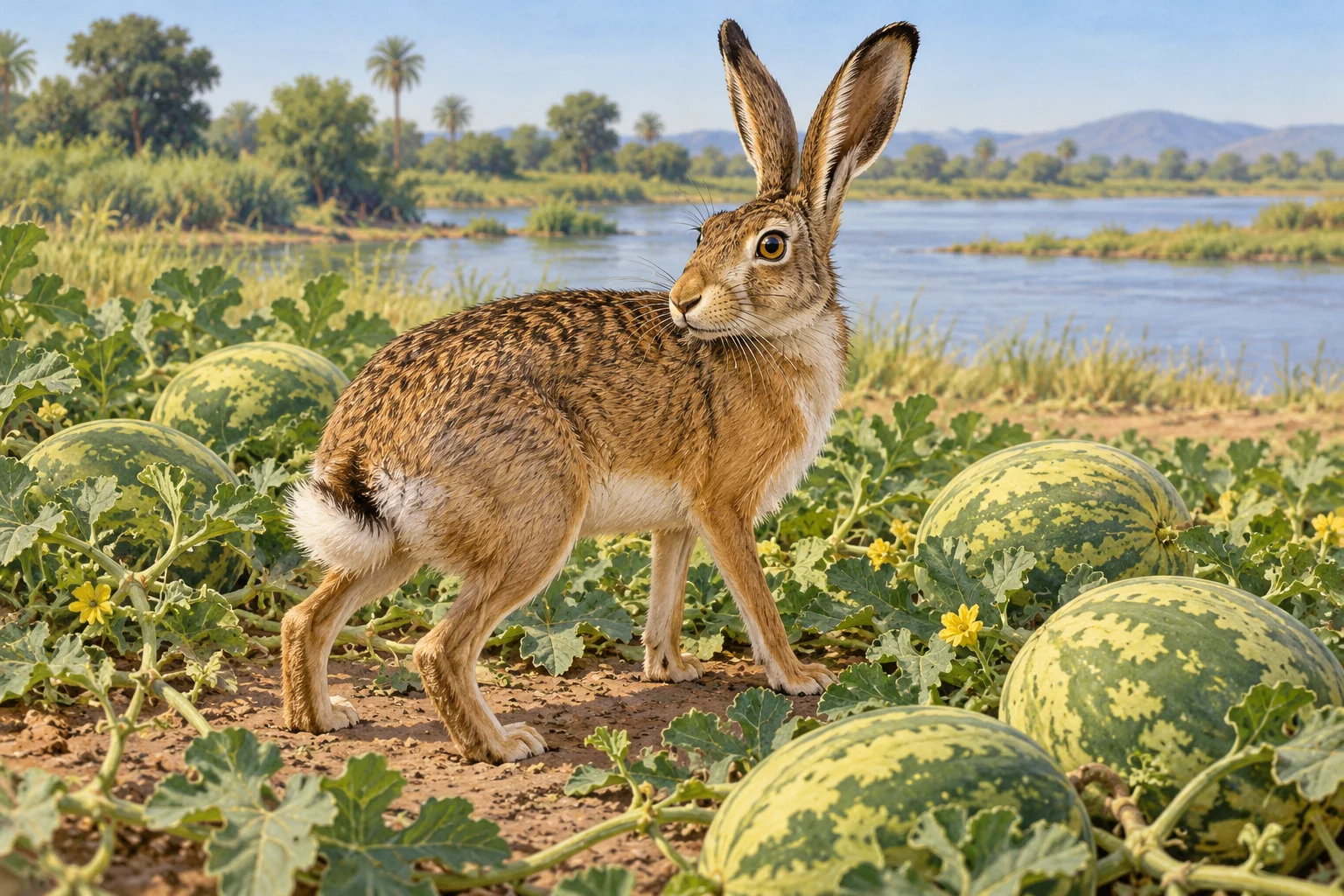
The Hare in his melon plot; animal appearance and landscape imagined.
Original narrative illustration; animal form and setting interpreted, not a documentary species or ethnographic image.
Overview
In Animal Story 80, the Hare enters a king’s town, eats beans and fills a bag with the remainder. A camel, a horse and a cow fail or refuse to carry the heavy load. The Hare admits to a lion that the beans were stolen and persuades him to try, but he too gives up. A cock finally carries the bag home, bruising his back. The Hare applies crushed leaves to the injury. A large fruit-bearing tree then grows from the cock’s back, with the English translation explaining that seeds had entered the wound. Trying to knock down the fruit, the Hare throws a stone that falls into a river and becomes an island. He plants vegetables and melons there.
A traveller asks for food, but the Hare refuses, saying that he has only just arrived. He subsequently sees many melons and cuts one. The knife disappears inside it and then cuts off his head. The Hare enters the melon and finds living people within. After coming out, he sees his head carrying firewood; it ignores his repeated calls until he strikes it and it returns to its place. Westermann separately prints a comparison translated from Reinisch’s Nuba-language collection, involving a human protagonist, and suggests a possible Arab origin for the opening of the Hare’s tale. That comparison and conjecture remain editorial material rather than additional episodes or a proven origin of this Shilluk-language witness.
Origins & earliest records
Animal Story 80 in Diedrich Westermann’s 1912 Shilluk-language collection and accompanying English translation; the individual narrator is not named in the selected text.
Records & interpretation
Complete story through the head’s return, pp. 193–195; separately bracketed comparison through p. 196 and note 58 on p. 200 retained.
Selected bibliography
Documented works and useful reading. This is not a list of every appearance.
- 01
The Shilluk People, Their Language and Folklore
Second Part, XI Animal Stories, no. 80: The Hare, pp. 193–196; note 58, p. 200.
Family & connections
A source-supported family tree or inspiration record has not yet been compiled for this profile. Related reading below indicates a connection in subject matter, not a proven lineage or creative influence.
References
Sources supporting this profile. Linked pages have their own scope and editorial standards.
- Primary collected Shilluk text and original English translationThe Shilluk People, Their Language and Folklore: The HareResearch access: 2026-10-18
Image credits
AI-generatedThe Hare in his melon plot; animal appearance and landscape imagined.
Original narrative illustration; animal form and setting interpreted, not a documentary species or ethnographic image.