
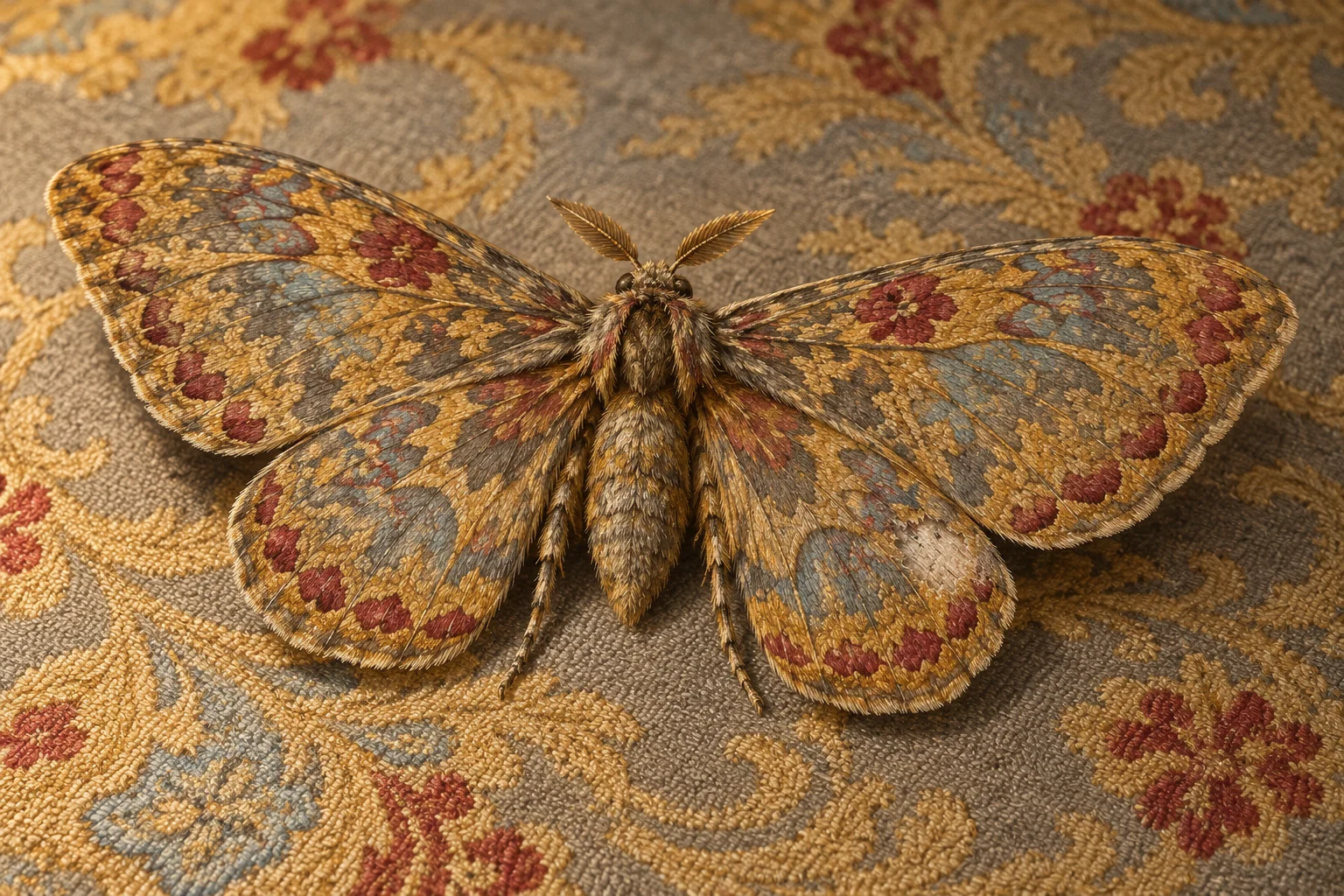
Hapley’s Moth (Wells) — independent literary interpretation with reconstructed unspecified details.
Overview
The moth appears after the entomologist Hapley has spent years attacking Professor Pawkins and is trying unsuccessfully to occupy himself after Pawkins’s death. While working at a microscope in Kent, he sees a large moth or butterfly with its wings spread in butterfly fashion. It seems to match the tapestry tablecloth’s grey ground and pattern of gold, crimson and pale blue, yet is unknown to him. Something in its head and body suggests Pawkins, as an earlier chess piece had done. Later, by candlelight, Hapley distinguishes a hairy body, short feathery antennae, jointed legs and a patch where the down is rubbed from a wing. Its apparent solidity does not establish its existence for anyone else.
Hapley repeatedly pursues the insect, hearing it strike objects and feeling it against his face. He damages his equipment while trying to catch it, alarms his landlady and finds that the vicar sees nothing where he points. An apparent sighting on a wall proves to be lichen, but the continuing appearances resist his efforts to dismiss them. Chasing it near chalk pits, he falls and breaks his leg; during the ensuing confinement he reports it crawling over his face. The ending leaves him in a padded room, still troubled by a moth no one else can see. The asylum doctor calls it a hallucination, whereas Hapley says it is Pawkins’s ghost and a unique specimen worth catching. That unresolved clash belongs to the fictional account; neither a new insect species nor the rival’s actual supernatural return is confirmed.
First appearances & development
H. G. Wells’s authored English fiction in The Stolen Bacillus and Other Incidents, retained Methuen, London title dated 1895. The collection’s acknowledgment names several periodicals collectively without assigning this particular tale to one. This account follows the complete historical narrative, not a later adaptation or a verified clinical report.
Canon & continuity
The complete rivalry framework, all fifty-six indexed paragraphs including embedded notes, and the final contrasting explanations establish this account. Historical diagnoses and treatment judgments remain attributed to the story rather than presented as current health guidance.
Selected bibliography
Documented works and useful reading. This is not a list of every appearance.
- 01
The Stolen Bacillus and Other Incidents
Selected tale: A Moth—Genus Novo.
Family & connections
A source-supported family tree or inspiration record has not yet been compiled for this profile. Related reading below indicates a connection in subject matter, not a proven lineage or creative influence.
References
Sources supporting this profile. Linked pages have their own scope and editorial standards.
- Primary historical authored fictionWells — dated title, complete acknowledgment and selected original taleResearch access: 2026-10-18
Image credits
AI-generatedHapley’s Moth (Wells) — independent literary interpretation with reconstructed unspecified details.