
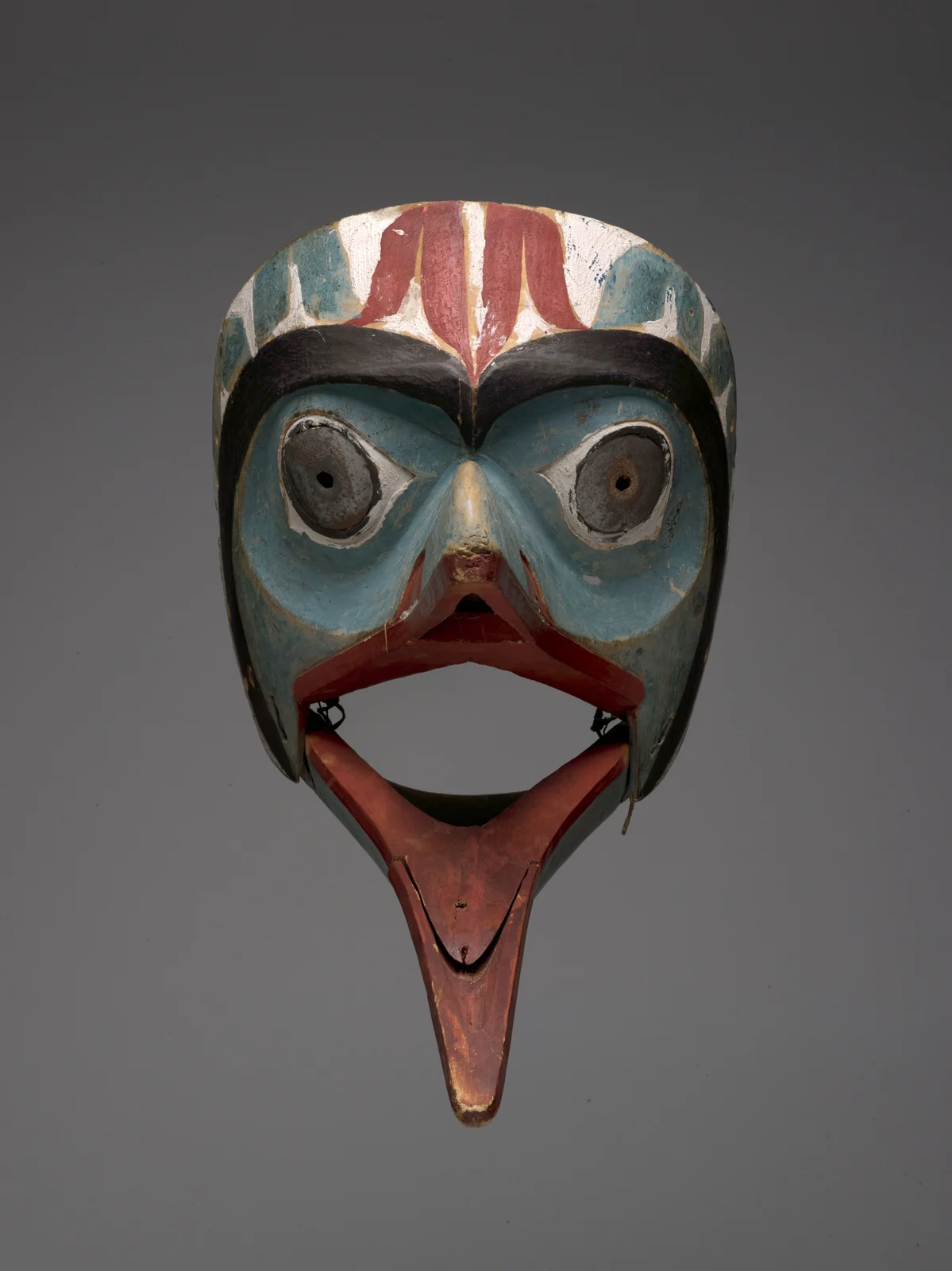
Front view of a carved bird mask with blue eye fields, black brows, red and white forehead designs, round eye holes and a long hinged red lower beak.
Bird mask made before 1882, catalogued by Princeton under both Haisla and Tsimshian. Its recorded collection place is Alaska. These catalogue associations do not identify a particular Haisla maker, community or contemporary practice.
Overview
The Haisla Nation identifies its people, x̄á’isla, with Kitamaat Village and the surrounding lands and waters of the Kitimat region. Its history describes seasonal movement, fishing and trade, including the importance of oolichan. It also recognizes members living in other towns and cities: residence in one village is not the boundary of belonging. The account connects colonial restrictions on Feasts and land access with attacks on governance, while describing subsequent industrial pressures. These are the nation’s historical interpretations; the selected webpage does not substitute for independent examination of every cited archival document.
The Culture and Heritage Department links language education with cultural camps, historical archives and support for elders. Its public programme description includes learning across age groups, school activities, workshops and community events. Archives encompass documents, oral histories and other cultural resources, while elders’ services include opportunities for social participation and cultural mentoring. These are institutional responsibilities and stated aims. They do not demonstrate that every participant reaches fluency, that all historical materials are publicly accessible, or that elders share one uniform body of knowledge. The linked language recordings and resources have not been directly examined here.
The nation’s language-survey page names both x̄á’islak̓ala and x̄enáksialak̓ala. It explains a three-part effort to understand language exposure, attitudes and learners’ interests and resources. Rather than presenting a completed speaker count, the page invites members to help shape future classes and materials. This matters because language work includes listening to people with different experiences and capacities, not simply measuring them against one assumed standard. Only the public explanation has been read: private responses and the linked questionnaires have not been accessed, and no findings are inferred from the invitation.
The public introduction to duu’duks’wa ci’mo’ca’, the comprehensive community plan, describes a long-term framework informed by members’ priorities. It explicitly considers people living at home and away, connecting housing, cultural and language work, health, economic opportunities and environmental stewardship. This presents culture as part of contemporary community decisions rather than an isolated historical category. The page directs members to a login portal for the underlying documents. Those restricted materials were not accessed, and this profile does not claim that the plan’s priorities have all been implemented or independently evaluated.
History & identity
Nation-authored historical and programme accounts; membership, residence and language experience remain distinct.
Sources & representation
Complete history, department and survey explanations plus public planning introduction read. No member-portal documents, private survey responses or recordings inspected.
Selected bibliography
Documented works and useful reading. This is not a list of every appearance.
- 01
Haisla History
Haisla Nation public account
Language & cultural connections
These connections link languages or specific cultural works and institutions; they do not establish biological ancestry or ethnic identity.
Culture & Heritage Department
The department describes language education, archival preservation and elder services for the Nation.
References
Sources supporting this profile. Linked pages have their own scope and editorial standards.
- Haisla Nation public accountCulture & Heritage DepartmentResearch access: 2026-10-06
- Haisla Nation public accountHaisla Language SurveysResearch access: 2026-10-06
- Haisla Nation public accountComprehensive Community PlanResearch access: 2026-10-06
Image credits
Museum photograph of a historical Northern Northwest Coast bird mask with multiple catalogue cultural attributionsFront view of a carved bird mask with blue eye fields, black brows, red and white forehead designs, round eye holes and a long hinged red lower beak.
Bird mask made before 1882, catalogued by Princeton under both Haisla and Tsimshian. Its recorded collection place is Alaska. These catalogue associations do not identify a particular Haisla maker, community or contemporary practice.