
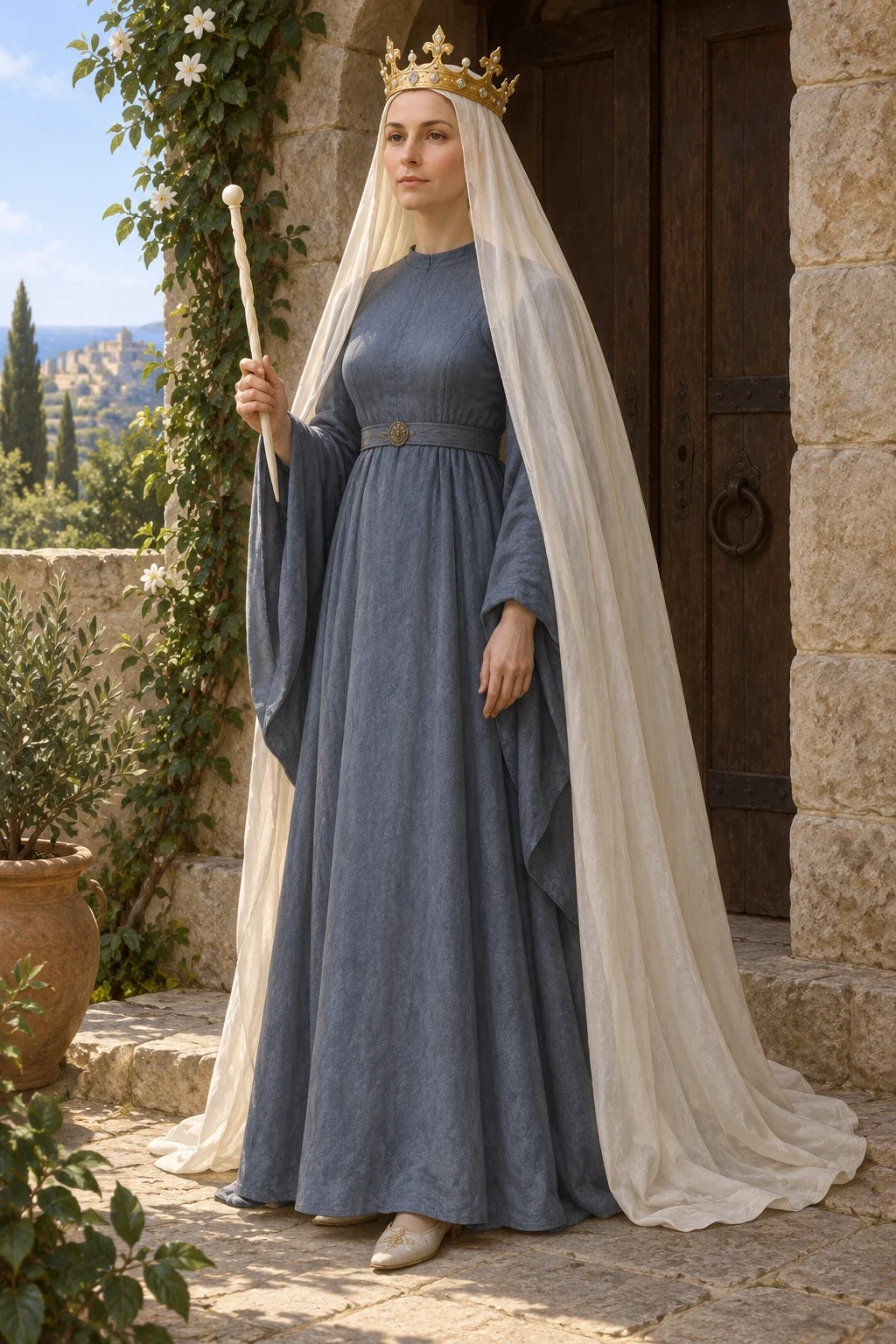
AI narrative interpretation of the hair-bargain sorceress in Stumme’s “Goldähre.”
Face, blue dress, crown construction, shoes, veil construction and doorway setting are imagined. The image illustrates the legible sorceress description and does not reconstruct the damaged heroine epilogue or a historical Maltese costume.
Overview
The unnamed sorceress appears in the seventh tale of Stumme’s 1904 German translation of Maltese narratives. This particular tale belongs to the opening group transmitted through a manuscript, rather than to the later group dictated freely from memory. Stumme reports that an educated woman recorded those manuscript tales from older women in Valletta, while also warning that she may have shaped them under the influence of European fairy-tale books.
In the story, Goldähre is a small girl whose golden hair trails along the ground. The narrator praises her appearance but criticizes her habits. While she sits on a threshold, a beautiful woman approaches wearing a golden crown set with diamonds and pearls, a veil reaching to her feet, and carrying an ivory staff. These details belong to the sorceress; the exceptionally long golden hair belongs to Goldähre.
The woman calls the staff a magic wand and offers to lend it under a precise condition: whenever Goldähre fulfills a wish, the woman may take one of her hairs. She explains that she is bald and would like to make a wig from the girl’s hair. The narrative does not give the sorceress a personal name, royal title, fixed age or wider genealogy.
Goldähre accepts the wand and transforms her family’s house into a marble palace, her plain cotton dress into silk and velvet, and her father’s cart and donkey into a splendid carriage and white horses. These transformations are performed by the girl using the borrowed wand. The bargain costs her a hair each time, until she conceals her baldness beneath a thick veil and regrets the exchange.
When the sorceress returns, she does not simply reverse the arrangement or offer another purchase. She explains that Goldähre can regain her hair by earning it through good works. The girl responds with charity, gives away her wealth, returns to useful work in her parents’ household and cares for her siblings. The sorceress thus supplies both the initial temptation and the conditions for restoration, rather than acting solely as a benefactor or an attacking monster.
The scan preserves the narrative sequence through the heroine’s improved conduct and final epilogue, but a physical obstruction covers a few words near the bottom of printed page 26. The profile rests on the sorceress’s fully legible appearances and dialogue, and does not reconstruct those lost words. The German translation’s Maltese companion text has not been independently collated.
This profile follows the unnamed sorceress in Stumme’s manuscript-mediated “Goldähre,” preserving the anonymous recorder’s privacy and the translator’s editorial qualifications. It does not identify her with every Maltese fairy or supply the scan’s missing epilogue words.
Origins & earliest records
Tale VII, “Goldähre,” printed pp. 25–26 in Hans Stumme’s Maltesische Märchen, Gedichte und Rätsel in deutscher Übersetzung (Leipzig: J. C. Hinrichs, 1904).
Records & interpretation
The sorceress’s entrance, described crown, veil and ivory wand, stated hair bargain and later charitable-restoration instructions are legible in native printed pp. 25–26. A few words in the heroine’s final epilogue are physically obscured in this scan; they are not reconstructed.
Selected bibliography
Documented works and useful reading. This is not a list of every appearance.
- 01
Maltesische Märchen, Gedichte und Rätsel in deutscher Übersetzung: VII. Goldähre
Native printed pp. 25–26 support both sorceress appearances and dialogue. The scan has a physical lacuna in the heroine’s final epilogue, retained as an explicit witness limitation.
Family & connections
A source-supported family tree or inspiration record has not yet been compiled for this profile. Related reading below indicates a connection in subject matter, not a proven lineage or creative influence.
References
Sources supporting this profile. Linked pages have their own scope and editorial standards.
- Primary historical translation with manuscript and editorial mediationStumme 1904 original German edition, Tale VII and complete introductionResearch access: 2026-10-21
Image credits
AI-generatedAI narrative interpretation of the hair-bargain sorceress in Stumme’s “Goldähre.”
Face, blue dress, crown construction, shoes, veil construction and doorway setting are imagined. The image illustrates the legible sorceress description and does not reconstruct the damaged heroine epilogue or a historical Maltese costume.