
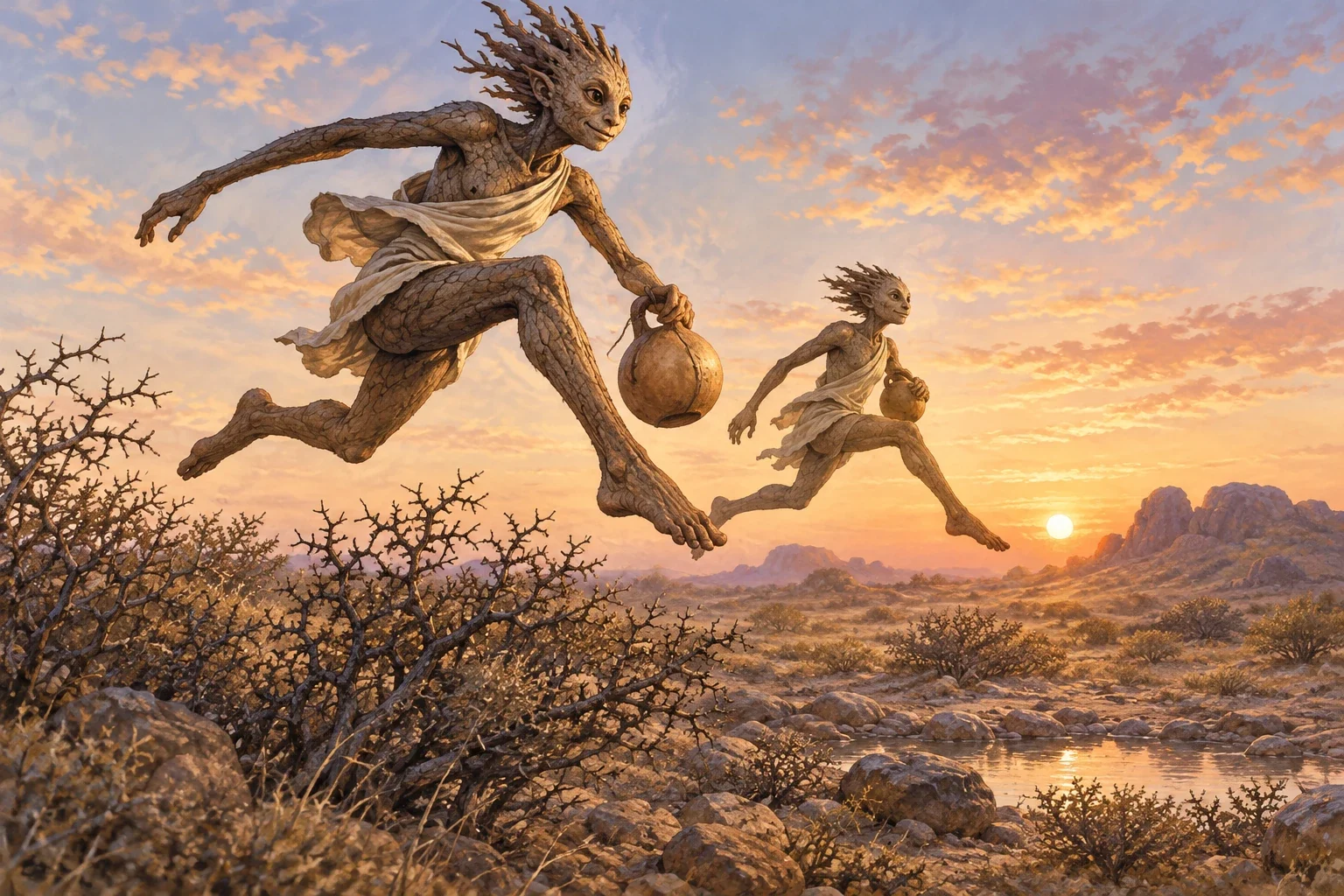
Hai-uri (Bush-jumpers) - AI-generated imagined folklore illustration.
AI-generated imagined illustration of Hai-uri (Bush-jumpers) based on the selected textual witness; not historical or ethnographic evidence.
Overview
In tale VII a young woman marries into the Hai-uri people. The women of her new settlement fetch water by easily jumping over bushes rather than walking between them. A footnote identifies them as beings of legend and explains their unusual movement. The selected passage does not describe them as a half-body or one-legged creature.
The women warn her husband that his marriage to someone unable to jump could endanger him during pursuit. He inflicts a disabling injury on his wife and sends her away with two giraffe skins and thorns. She and her daughter travel together. When a lion follows them, they delay it with the skins and thorns, then call to an ancestral rock for passage. The rock admits them but traps the pursuing lion.
Back home the woman receives replacement lower-leg bones from a calf, rests and eventually walks successfully. The story’s bodily injury, flight and healing concern the human bride, not a missing limb used to define the whole Hai-uri people. A source-led account must preserve that distinction.
Schultze prints a Nama transcription beside a German translation and explanatory linguistic glosses. His edition’s colonial terminology should not be treated as a contemporary community self-description. This profile concerns the named legendary group in one tale; it does not generalize the narrated violence into a claim about actual Nama households.
Origins & earliest records
Schultze 1907, tale VII, printed pp.403–406; collection from 1903–1905 travel, oral beginning unestablished.
Records & interpretation
Complete German translation of VII, Das Mädchen, das in die Busch-Springer heiratet, including leaping footnote and final healing, inspected in original-edition OCR.
Selected bibliography
Documented works and useful reading. This is not a list of every appearance.
- 01
Aus Namaland und Kalahari
Tale VII pp.403–406. Physical form of beings not fixed beyond the selected actions; illustration explicitly imagined.
Family & connections
A source-supported family tree or inspiration record has not yet been compiled for this profile. Related reading below indicates a connection in subject matter, not a proven lineage or creative influence.
References
Sources supporting this profile. Linked pages have their own scope and editorial standards.
- Located primary narrative or institutional scholarly interpretationAus Namaland und KalahariResearch access: 2026-10-10
Image credits
AI-generated imagined folklore illustrationHai-uri (Bush-jumpers) - AI-generated imagined folklore illustration.
AI-generated imagined illustration of Hai-uri (Bush-jumpers) based on the selected textual witness; not historical or ethnographic evidence.