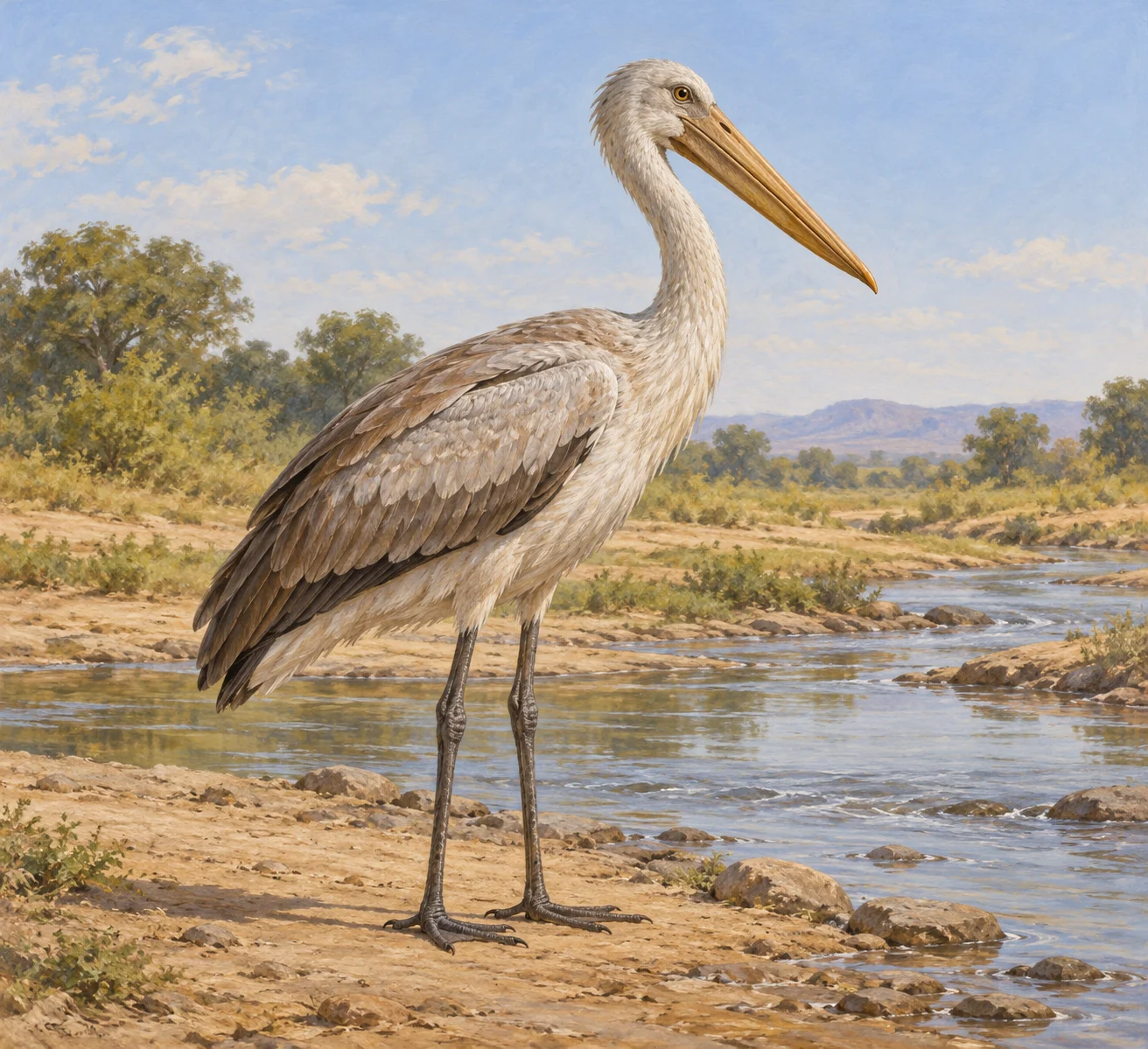
Gutsigan beside the brook; the uncertain stork-like identification and colouring are interpreted.
Original contextual illustration; tentative animal identification, species, colours, proportions and setting interpreted, not authenticated Kanuri iconography or modern national origin.
Overview
The bird called gutsigan in Koelle’s Kanuri text is translated as a stork in the fable’s English heading. After hatching young in a tree, she cannot find food for them and asks an unspecified friend for a device. The friend tells her to visit a brook, find its toads and return to lie motionless beside the water. Her first visit makes the toads hide beneath the surface. The next morning she approaches unseen, stretches out her legs, wings and mouth, shuts her eyes and pretends to be dead. A toad discovers the apparent corpse and summons the others.
After consulting their elders, the toads drag the bird away from their settlement, singing as they pull. Once they are far from safety, she opens her eyes, pursues them and swallows them one by one. She returns to her young and empties the contents of her bag before them, appeasing their hunger. She later thanks the friend who taught the trick. The ending connects the event with toads falling silent when someone approaches their brook. Koelle’s vocabulary qualifies the identification: gutsigan is a bird resembling a stork but larger, perhaps a kind of pelican. The tale’s bag is therefore retained without inventing a biological explanation or certain species.
Origins & earliest records
Part III, Fables, in Koelle’s African Native Literature. Complete Kanuri text pp. 36–38; English translation pp. 156–158. The preface describes dictation from interpreters during Sierra Leone research but does not individually identify a teller for this fable.
Records & interpretation
Complete original and translation retained; all English narrative pages 156–158 and corresponding original beginnings/endings viewed. Relevant vocabulary entry checked against its original page.
Selected bibliography
Documented works and useful reading. This is not a list of every appearance.
- 01
African Native Literature, or Proverbs, Tales, Fables, & Historical Fragments in the Kanuri or Bornu Language
Part III: original pp. 36–38, translation pp. 156–158; complete preface and lexical qualification retained.
Family & connections
A source-supported family tree or inspiration record has not yet been compiled for this profile. Related reading below indicates a connection in subject matter, not a proven lineage or creative influence.
References
Sources supporting this profile. Linked pages have their own scope and editorial standards.
- Original historical Kanuri/English collectionKoelle 1854: original, complete English fable and lexical qualificationResearch access: 2026-10-18
Image credits
AI-generatedGutsigan beside the brook; the uncertain stork-like identification and colouring are interpreted.
Original contextual illustration; tentative animal identification, species, colours, proportions and setting interpreted, not authenticated Kanuri iconography or modern national origin.