
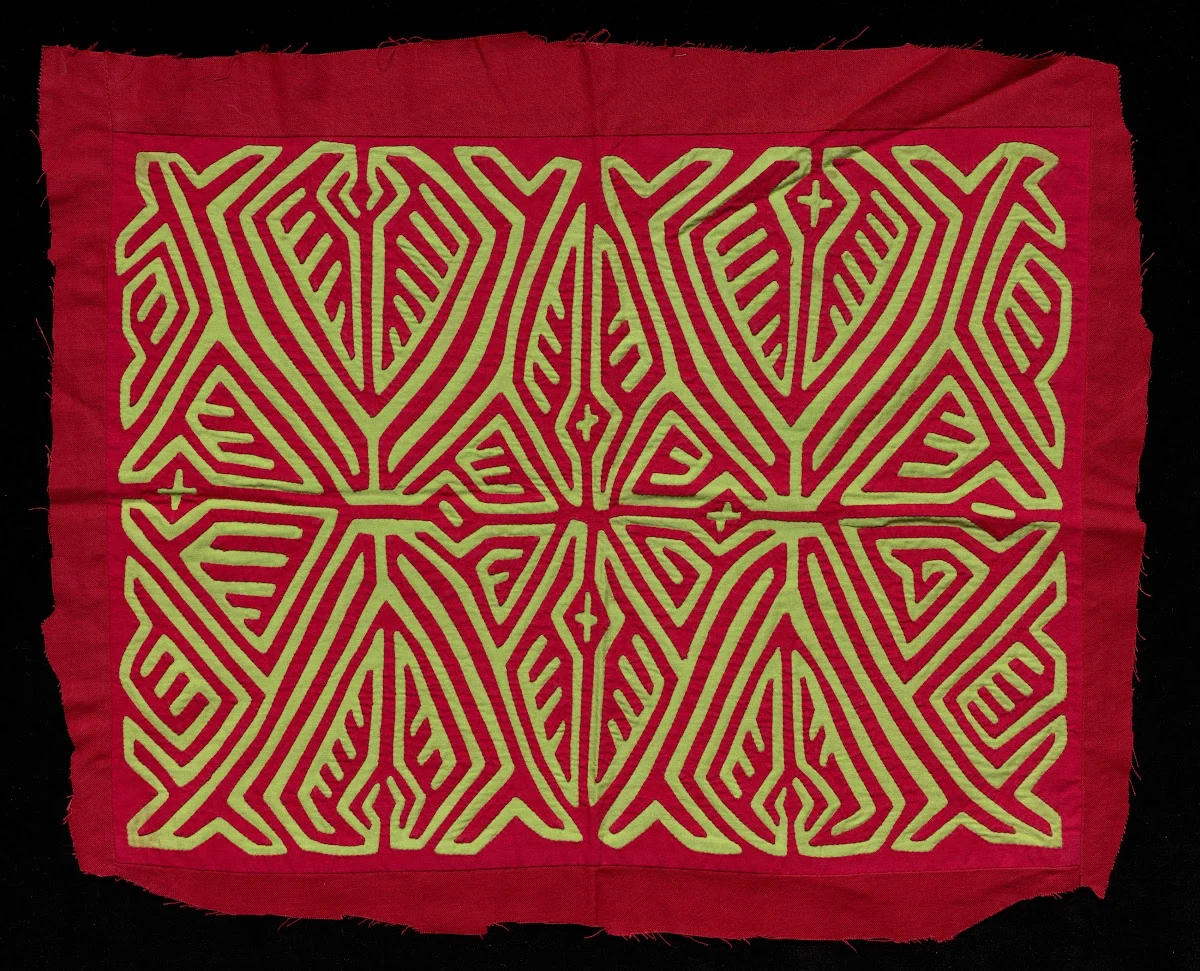
Labyrinth mola panel attributed to Guna makers of Gunayala, Panama, before 1960: red and green cotton reverse appliqué, Cleveland Museum of Art 2021.153
This cotton panel is attributed to Guna makers of Gunayala and dated before 1960. Its interlocking maze design uses reverse appliqué and appliqué; panels of this kind were sewn into blouses called molas. The photograph shows one historical textile in a museum collection, rather than a universal clothing style or representative appearance of contemporary Guna people.
Overview
Guna, also called Gunadule, communities live in Panama and Colombia. A 2017 statement by the OREWA council of authorities, published by ONIC, describes a binational cultural congress at Arquía in Colombia’s Chocó department. Delegations from Panama joined their hosts for traditional singing and exchanges of knowledge. Jorge Cárdenas Osorio of Arquía emphasized the opportunity to reunite with relatives across the border. This is a dated account of a particular gathering, but it demonstrates why a national boundary cannot by itself describe the people’s family and cultural connections.
Gunayala’s own institutional account distinguishes a cultural and spiritual congress from the other principal regional governing body. It identifies the Onmaggeddummad Namaggaled as responsible for maintaining and developing cultural knowledge, and dates its reorganization and institutionalization at Gardi Sugdub to 1972. That date concerns an organizational change, not the beginning of Guna culture. The Museo de la Mola separately lists support from congresses associated with Gunayala, Madungandi, Wargandi and Tagarkunyal, as well as the cultural congress. These names should not be collapsed into one settlement or a single undifferentiated administration.
The community’s reading and writing guide calls the language gunagaya or dulegaya and insists that it has its own grammatical structure. Its general principles combine a common written system with recognition of regional differences in speech and reading. Cultural specialists and therapeutic language are identified as important resources for understanding meaning and word structure. Standardization is therefore presented as work undertaken within the language, rather than as evidence that regional speakers lack a language until outsiders write it down.
Community publishing also identifies particular authorities and mediators. A December 2011 announcement for a February 2012 presentation describes an expanded second edition of En defensa de la vida y su armonía, drawing on the teachings of Igwanabiginya, Manidiniwiebinabbi and Inakeliginya, translated and organized by Aiban Wagua. The same notice credits several Guna scholars with renewed literacy materials. The books themselves have not been read here. In another setting, Panama’s Museo de la Mola presents textile works as art, while openly documenting its private-collection origins and support from Guna congresses. Such museum selection complements community testimony; it cannot substitute for the full range of makers’ lives and local knowledge.
History & identity
Cross-border kinship and cultural memory are distinguished from regional congress reorganizations and modern publication dates.
Sources & representation
Complete OREWA 2017 statement and short cultural-congress description; literacy guide general principles; complete December 2011 book announcement; museum purpose, institutional support and collection-history sections. No complete linked book or recording claim.
Selected bibliography
Documented works and useful reading. This is not a list of every appearance.
- 01
En defensa de la vida y su armonía
Expanded second edition announced in December 2011 for presentation in February 2012; bibliographic notice, not full-book reading.
Language & cultural connections
These connections link languages or specific cultural works and institutions; they do not establish biological ancestry or ethnic identity.
Museo de la Mola
Five Guna congresses support the museum’s privately assembled mola exhibitions. Institutional support does not establish community ownership of every displayed object.
References
Sources supporting this profile. Linked pages have their own scope and editorial standards.
- Indigenous organizationOREWA / ONIC: binational congress, 2017Research access: 2026-10-05
- Indigenous institutionGunayala: cultural congressResearch access: 2026-10-05
- Community educationGunayala: literacy principlesResearch access: 2026-10-05
- Community publicationGunayala: publication announcementResearch access: 2026-10-05
- MuseumMuseo de la Mola: purpose and historyResearch access: 2026-10-05
Image credits
Contextual cultural object photographLabyrinth mola panel attributed to Guna makers of Gunayala, Panama, before 1960: red and green cotton reverse appliqué, Cleveland Museum of Art 2021.153
This cotton panel is attributed to Guna makers of Gunayala and dated before 1960. Its interlocking maze design uses reverse appliqué and appliqué; panels of this kind were sewn into blouses called molas. The photograph shows one historical textile in a museum collection, rather than a universal clothing style or representative appearance of contemporary Guna people.