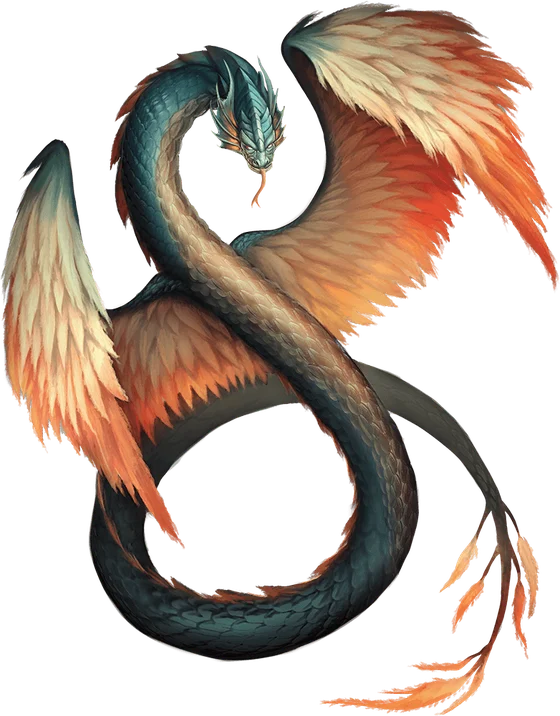
AI-generated interpretation of Gucumatz’s green-feathered serpent description in Spence’s 1908 retelling. Head shape, scales, feather arrangement, posture and luminous setting are imagined. This is not a traditional K’iche’ image, archaeological reconstruction or depiction of a Dungeons & Dragons Couatl.
The selected account names a deity in a council, not a species. It does not prescribe separate wings or a fixed animal anatomy.
Overview
In the opening creation summary of Lewis Spence’s 1908 The Popol Vuh, Gucumatz appears among the chief gods who take counsel. Spence describes him as a serpent covered with green feathers. Hurakan, Xpiyacoc and Xmucane are named alongside him. The account presents a divine council rather than one solitary maker, and the creation of animals follows their deliberation. These details concern a named deity within Spence’s mediated K’iche’ account, not a species of feathered snakes.
Human beings have not yet been made when the gods decide to fashion figures from wood. Those figures fail to show reverence, and the gods resolve to destroy them. Spence then names Hurakan as the power whose will brings the flood. Attacking birds, abused household objects and neglected animals participate in the destruction. Houses, trees and caves refuse the figures refuge. The episode closes by identifying the forest monkeys as their descendants. These events supply the surrounding creation narrative; the text does not assign every destructive act personally to Gucumatz.
Spence explicitly says that his summary uses Brasseur de Bourbourg’s French version and Ximenes’s Spanish version. His English account is therefore a historical retelling through earlier textual mediation, not a direct translation newly collated against a K’iche’ manuscript. This profile retains the council and green-feathered serpent description without adopting Spence’s broader comparative theories or equating Gucumatz with all similarly named Mesoamerican deities. Neither bodily wings nor a fixed zoological anatomy are established by this selected unit.
Origins & earliest records
Lewis Spence, The Popol Vuh: The Mythic and Heroic Sagas of the Kichés of Central America (London: David Nutt, 1908), complete The First Book summary, pp. 9–11, with complete referenced notes; introduction pp. 5–9 identifies his French/Spanish mediation. These dates identify this printed witness, not the beginnings of the K’iche’ tradition.
Records & interpretation
Complete retained creation-summary unit read; introductory source context read. Embedded footnotes retained. Earlier French/Spanish witnesses and K’iche’ manuscript not independently collated.
Selected bibliography
Documented works and useful reading. This is not a list of every appearance.
- 01
The Popol Vuh: The Mythic and Heroic Sagas of the Kichés of Central America
Complete The First Book summary pp. 9–11 and its footnotes; complete introductory source context pp. 5–9. Historical summary using Brasseur’s French and Ximenes’s Spanish versions, not a newly collated K’iche’ text.
Family, evolution & connections
Couatl (Dungeons & Dragons)
Spence’s 1908 opening Popol Vuh summary names Gucumatz as a deity in the gods’ council and describes him as a serpent covered with green feathers. Beside Couatl’s feather-winged serpent depiction, this supports only a qualified shape comparison. It does not equate the deity with the fictional species, establish wings in this historical account, or demonstrate D&D creator consultation.
References
Sources supporting this profile. Linked pages have their own scope and editorial standards.
- Historical mediated retelling of a religious narrativeSpence 1908: complete opening creation summary and stated source mediationResearch access: 2026-10-25
Image credits
Modern interpretation of a historical religious retellingAI-generated interpretation of Gucumatz’s green-feathered serpent description in Spence’s 1908 retelling. Head shape, scales, feather arrangement, posture and luminous setting are imagined. This is not a traditional K’iche’ image, archaeological reconstruction or depiction of a Dungeons & Dragons Couatl.
The selected account names a deity in a council, not a species. It does not prescribe separate wings or a fixed animal anatomy.