
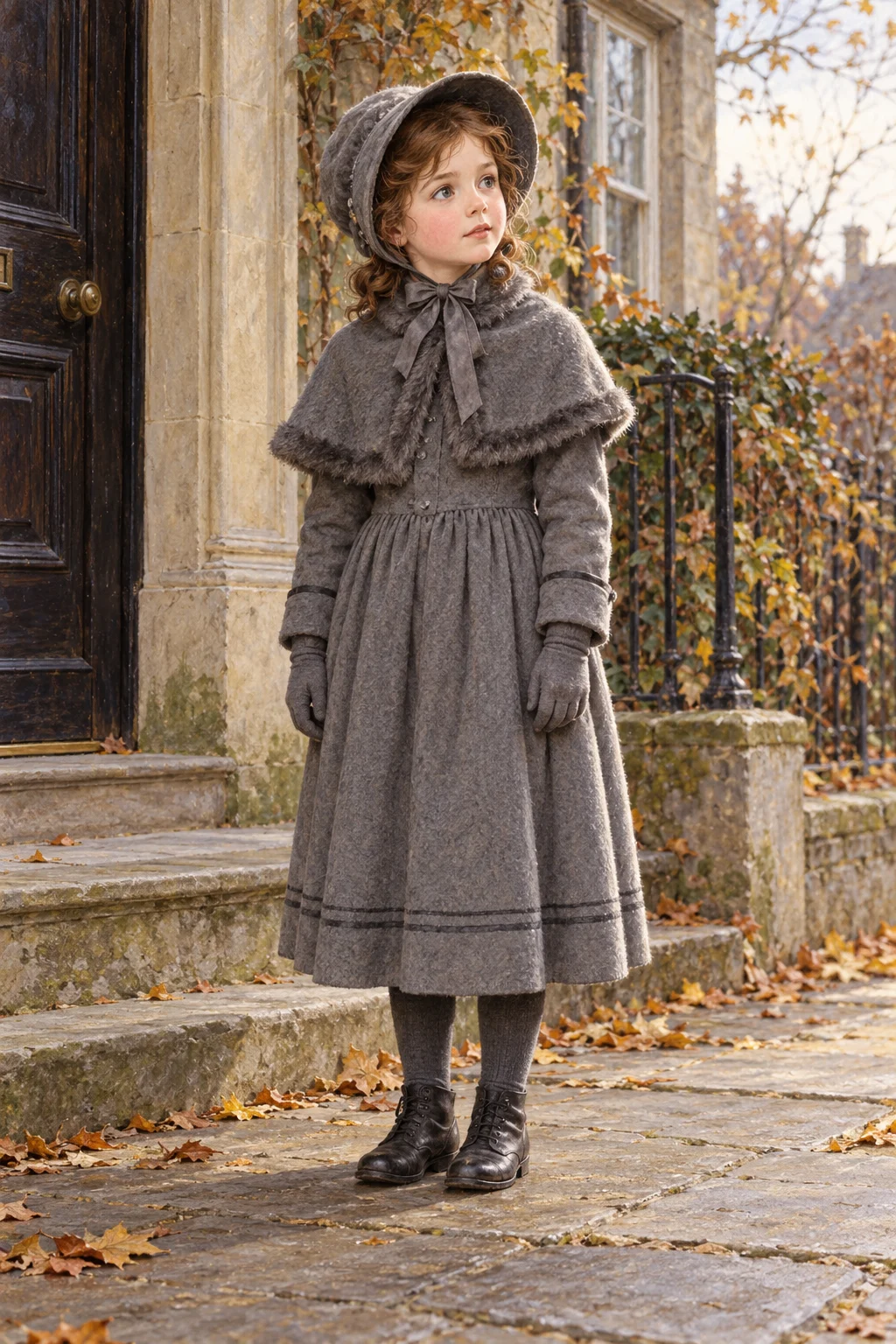
Griselda (Molesworth) — independent literary illustration with reconstructed unspecified details.
Overview
Griselda arrives at her great-aunts’ old house dressed almost entirely in grey: merino frock, beaver bonnet, tippet and gloves, matching her grey eyes. Her round rosy face and bright brown hair break the subdued colour scheme. Missing the lively company of her older brothers, she finds solitary lessons and strict routines frustrating. In a burst of temper she throws a book at the clock’s cuckoo, then fears she has harmed him and distressed her aunts. After she apologizes, the bird speaks to her and begins a series of extraordinary visits. A feather cloak lets her travel through imagined lands, while changes of scale confound her expectations, and a tiny shoe and a scented handkerchief complicate her attempts to dismiss the adventures as dreams. The cabinet’s fanciful country and butterfly-land belong to this authored fantasy; they do not describe actual societies or insect behaviour.
The cuckoo’s pictures also make Griselda reconsider her grandmother Sybilla as a loved young person rather than merely a grandmother with whom she is compared. In the wood she meets five-year-old Phil and, after an initially unfriendly reception, offers to teach him to read. Her anger at her aunt’s hesitation brings another quarrel, but she subsequently apologizes and accepts responsibility. During a later outing the children linger too long and lose their way; Griselda asks the cuckoo for help and insists on taking Phil safely home herself. There she meets his mother, whose kindness offers the understanding companionship she has lacked. In the final dream the cuckoo withdraws because these human friendships can now sustain her. Griselda wakes with tears for him as well as happiness about her new friends; her development does not erase the loss of her magical companion.
First appearances & development
Mrs. Molesworth’s authored English fantasy, consulted in The Cuckoo Clock, Macmillan and Co., London and New York, 1895. Its imagined journeys and household beliefs are literary fiction, not collected folklore or factual accounts of other cultures.
Canon & continuity
The complete eleven-chapter narrative, including its closing farewell, was read with the title, dedication and printer’s imprint. Original source bytes are retained; ISO-8859-1 was decoded as declared and the indexed witnesses were written in UTF-8. No historical illustration was used as visual evidence or input.
Selected bibliography
Documented works and useful reading. This is not a list of every appearance.
- 01
The Cuckoo Clock
Illustrated by Walter Crane. Retained title: Macmillan and Co., London and New York, 1895; dedication: Edinburgh, 1877. The latter is not substituted for this edition’s date.
Family & connections
A source-supported family tree or inspiration record has not yet been compiled for this profile. Related reading below indicates a connection in subject matter, not a proven lineage or creative influence.
References
Sources supporting this profile. Linked pages have their own scope and editorial standards.
- Primary historical English literary fantasyThe Cuckoo Clock — complete eleven chapters, dated title and dedicationResearch access: 2026-10-18
Image credits
AI-generatedGriselda (Molesworth) — independent literary illustration with reconstructed unspecified details.