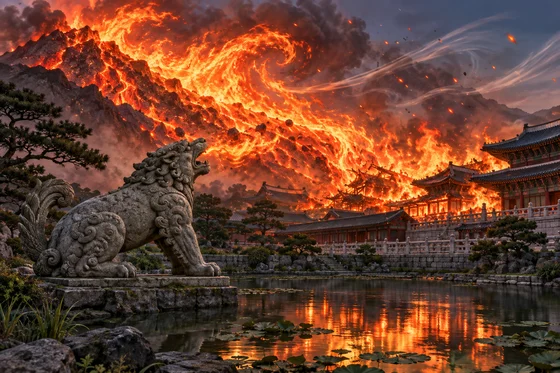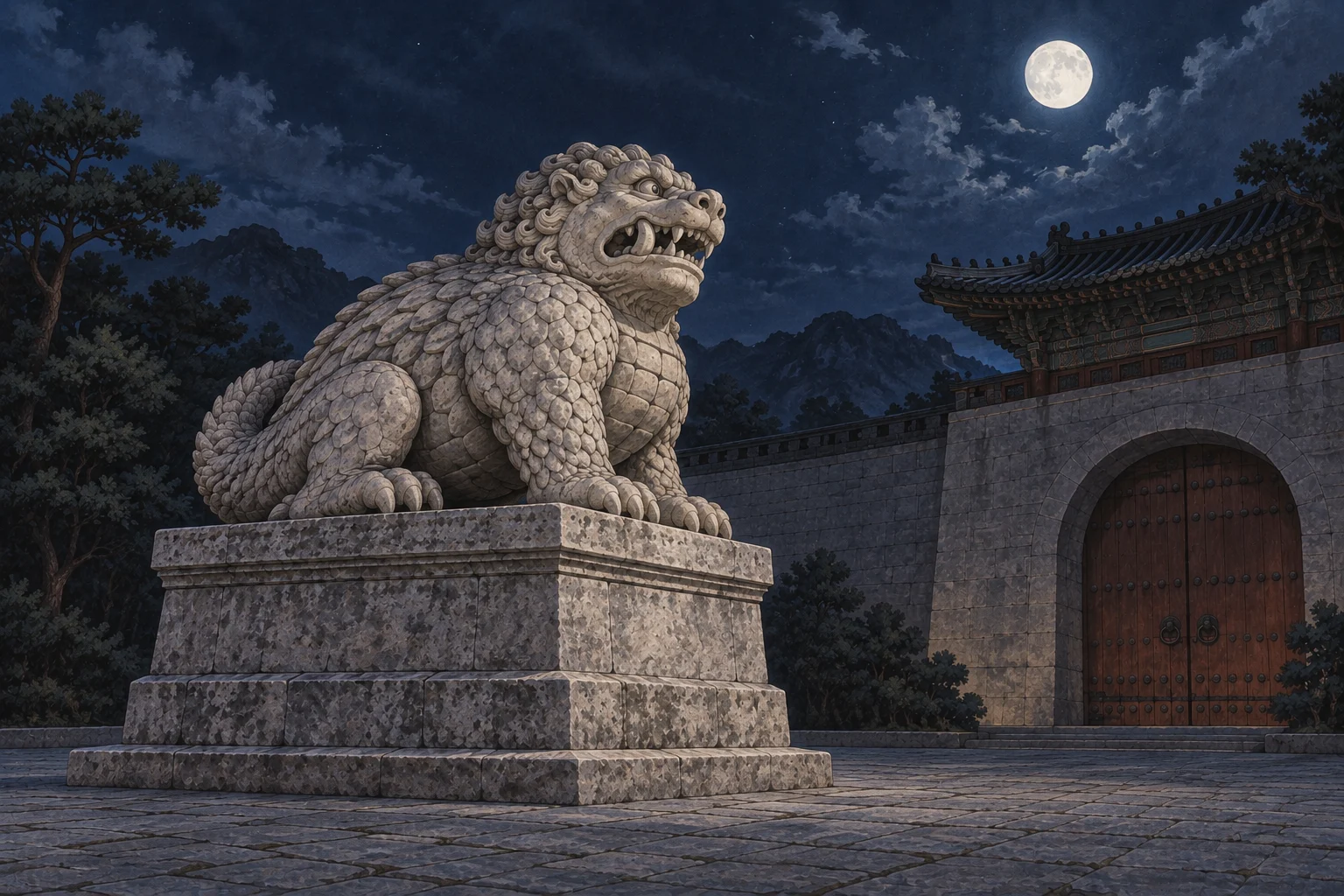
A pale stone monster with scales, curly hair and fangs turns its head on a complete pedestal beside a moonlit gate.
AI-generated interpretation of the white-granite Flame Eater at the palace gate at night in Griffis’s Korean Fairy Tales (copyright 1911 and 1922). Scales, curly hair, fangs and turned head are textual; body shape, gate design and illumination are artistic choices. A literary interpretation of The Great Stone Fire Eater, not a historical guardian photograph. Original composition based on the selected historical prose, with no source artwork copied. Retained edition: William Elliot Griffis, Korean Fairy Tales; New York, Thomas Y. Crowell; copyright 1911 and 1922. Modern interpretation, not historical evidence or a portrait of a present community. Compressed for display.
Overview
After a protective dragon and a deep pond fail to secure the palace completely, a master stonecutter creates a guardian from a great block of white granite. It is set on a high pedestal before the palace gate. When the Fire Spirit approaches, the statue turns its head and licks its lips as though preparing to swallow the intruder.
Griffis describes large fire-resistant scales, curly hair compared with asbestos and a mouth of fangs. The frightened Fire Spirit speculates that the creature is half alligator and half water-tortoise; that comparison is the antagonist’s impression, not a precise species description. The passage does not supply a Korean personal name or horn. Its claim that the palace never burned again belongs to the tale and is not independently verified history.
Origins & earliest records
Korean tale in an English literary retelling
Records & interpretation
Full relevant tale and collection preface directly read.
3D model
An original procedural model made for the Mythscribe World Builder. It is an interpretation based on this entry, not a historical source or a depiction from the records cited here.
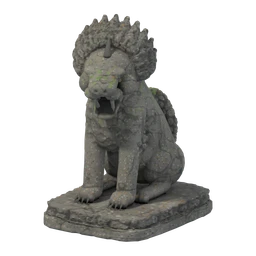
Procedural folklore creature kit · 26,752 triangles · 1.9 MB
Opens mythscribe.cloud in a new tab. Sign-in is required.
Selected bibliography
Documented works and useful reading. This is not a list of every appearance.
- 01
Korean Fairy Tales
The Great Stone Fire Eater, pp. 107–109
Family & connections
A source-supported family tree or inspiration record has not yet been compiled for this profile. Related reading below indicates a connection in subject matter, not a proven lineage or creative influence.
Primary records and illustrations
William Elliot Griffis, Korean Fairy Tales (1922 edition)
English literary collection. The Great Stone Fire Eater, pp. 107–109
Whole chapter and preface read; no named original-language narrator. Figurative comparisons distinguished from literal anatomy, and cultural/geographical assertions not independently adopted.
References
Sources supporting this profile. Linked pages have their own scope and editorial standards.
- Historical tale collectionGriffis, Korean Fairy Tales, The Great Stone Fire Eater, pp. 107–109Research access: 2026-10-05
Image credits
AI-generated interpretationA pale stone monster with scales, curly hair and fangs turns its head on a complete pedestal beside a moonlit gate.
AI-generated interpretation of the white-granite Flame Eater at the palace gate at night in Griffis’s Korean Fairy Tales (copyright 1911 and 1922). Scales, curly hair, fangs and turned head are textual; body shape, gate design and illumination are artistic choices. A literary interpretation of The Great Stone Fire Eater, not a historical guardian photograph. Original composition based on the selected historical prose, with no source artwork copied. Retained edition: William Elliot Griffis, Korean Fairy Tales; New York, Thomas Y. Crowell; copyright 1911 and 1922. Modern interpretation, not historical evidence or a portrait of a present community. Compressed for display.