
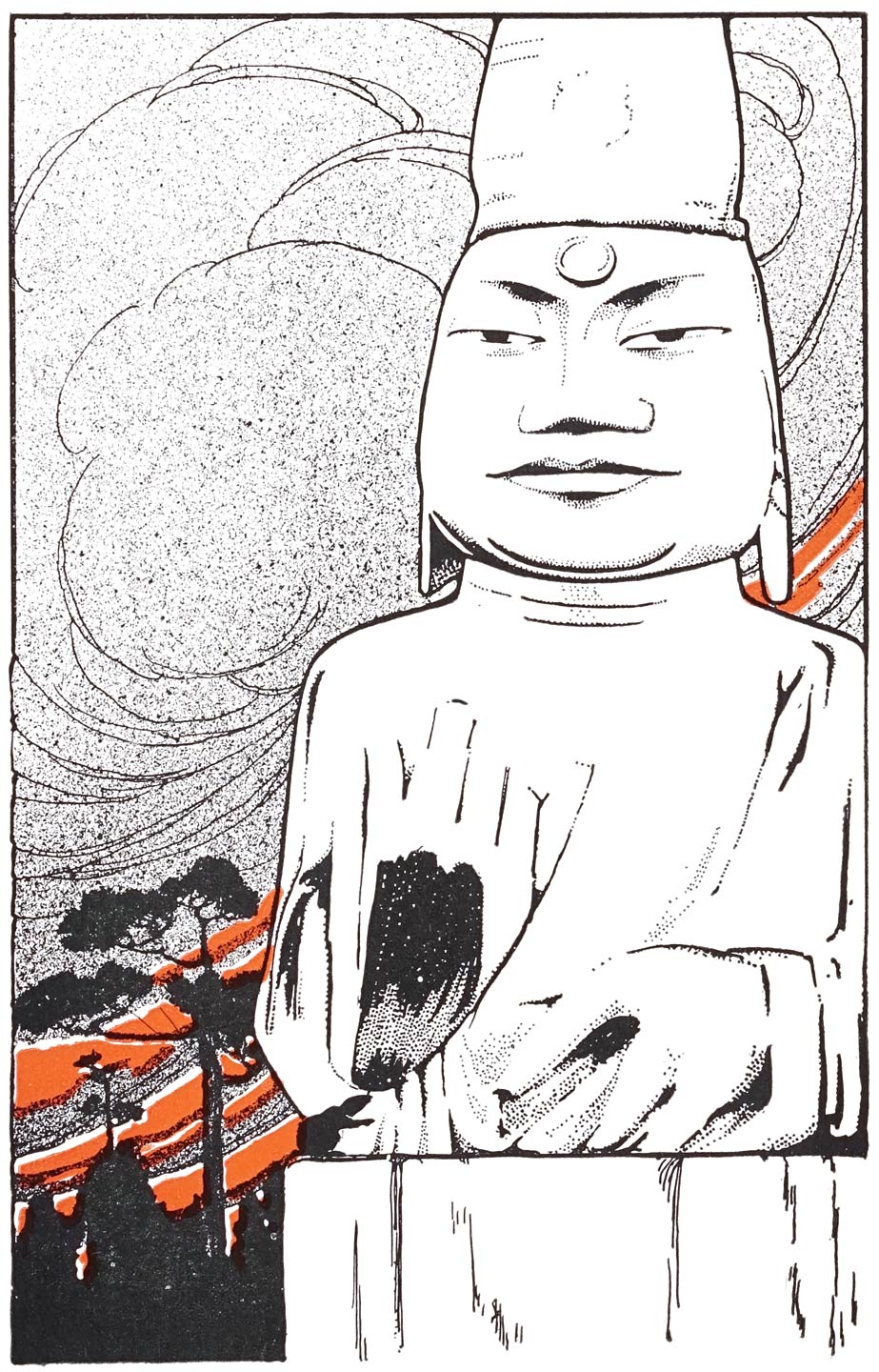
The mole father at the base of Miryek’s colossal image, illustration to A Bridegroom for Miss Mole, 1922
The tiny mole father stands at the image’s base while proposing his daughter as a bride. The artist emphasizes the scale of the speaking stone colossus; neither the daughter nor the eventual mole bridegroom is shown. This illustrates one stage of the father’s search, rather than a portrait of the whole family.
Overview
A mole father living with his wife beneath the great stone Miryek near the river Kingin wants the mightiest possible husband for their daughter. Advised first to approach the sky, he passes through a succession of refusals: sky refers him to sun, sun to cloud, cloud to wind, and wind to the immovable image. Each candidate admits dependence on another power. The daughter is a mole from birth, not a transformed human or another animal.
Miryek finally explains that burrowing moles can undermine his foundation. The father accepts this reversal and marries his daughter to a handsome young mole. The tale gives neither bride nor parents a personal name and describes the groom as the same kind of creature, without stating a closer blood relationship. The celestial candidates are speaking personifications in this literary narrative; their refusals do not establish a universal religious hierarchy.
Origins & earliest records
Korean tale in an English literary retelling
Records & interpretation
Full relevant tale and collection preface directly read.
Selected bibliography
Documented works and useful reading. This is not a list of every appearance.
- 01
Korean Fairy Tales
A Bridegroom for Miss Mole, pp. 53–58
Family & connections
A source-supported family tree or inspiration record has not yet been compiled for this profile. Related reading below indicates a connection in subject matter, not a proven lineage or creative influence.
Primary records and illustrations
William Elliot Griffis, Korean Fairy Tales (1922)
A Bridegroom for Miss Mole. A Bridegroom for Miss Mole, pp. 53–58
Complete chapter directly read; distinct speakers and actions retained. Literary personification and enacted magic distinguished from trickery and the reteller’s cultural generalizations. Original paraphrase of the public-domain-US historical witness.
References
Sources supporting this profile. Linked pages have their own scope and editorial standards.
- Historical English literary retellingGriffis, Korean Fairy Tales (1922), A Bridegroom for Miss Mole, pp. 53–58Research access: 2026-10-05
Image credits
Historical illustrationThe mole father at the base of Miryek’s colossal image, illustration to A Bridegroom for Miss Mole, 1922
The tiny mole father stands at the image’s base while proposing his daughter as a bride. The artist emphasizes the scale of the speaking stone colossus; neither the daughter nor the eventual mole bridegroom is shown. This illustrates one stage of the father’s search, rather than a portrait of the whole family.