
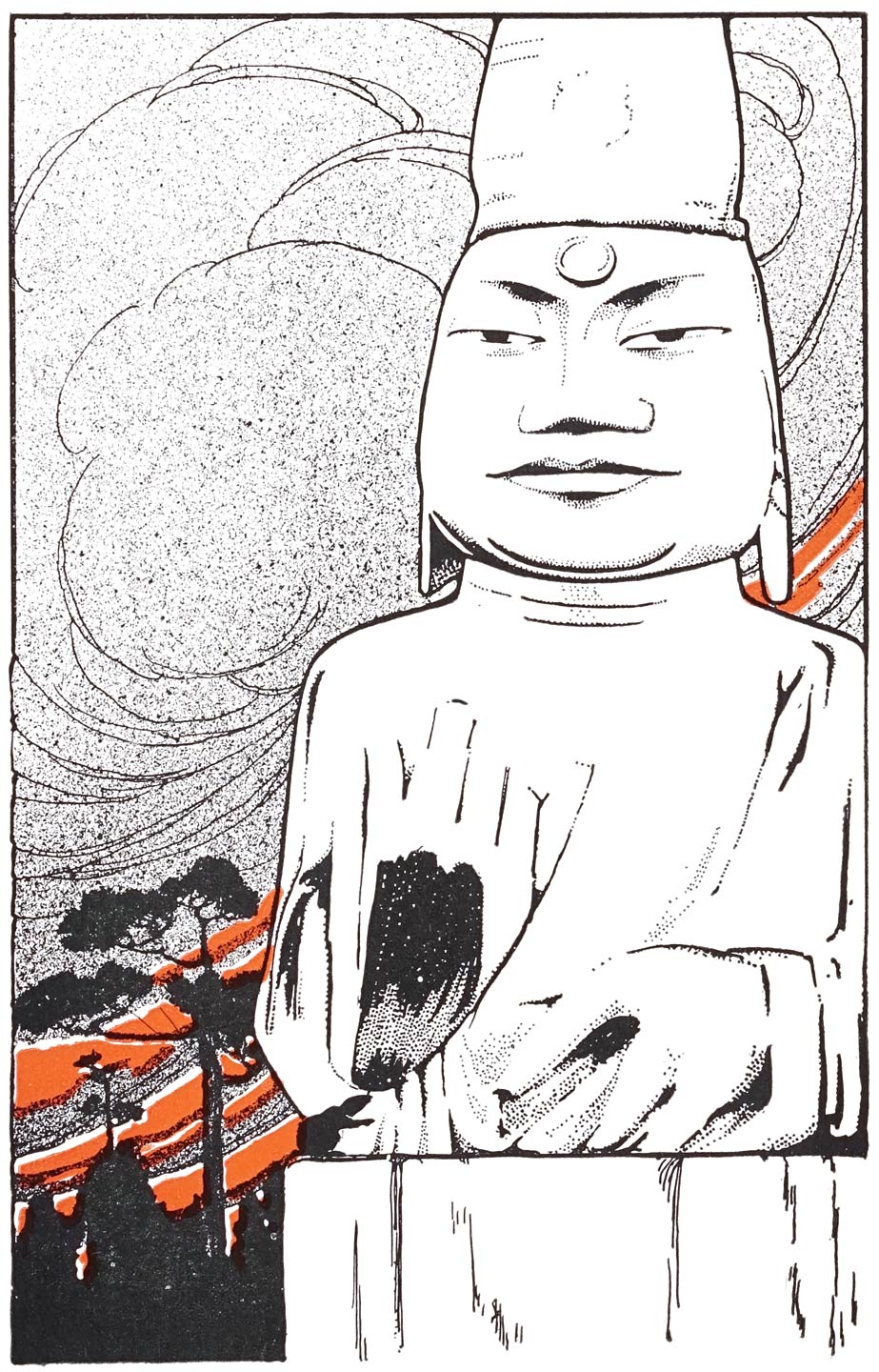
Miryek the speaking stone colossus listening to the mole father, Korean Fairy Tales illustration published 1922
The colossal stone image listens to the mole father. The tiny figure at its base and broad cap emphasize the artist’s interpretation of scale. The tale does not identify a particular surviving monument, and the predicted collapse is not shown.
Overview
Griffis places the stone image called Miryek by the river Kingin, with its base deep underground and a broad granite cap high among storm clouds. Wind refers an ambitious mole father to this apparently invulnerable figure as a suitable husband for his daughter. The image listens, moves its stone lips and agrees that sun, frost and storms cannot move it, but explains that moles can undermine its feet and make it fall.
The image therefore directs the father to seek a mole bridegroom. Its predicted collapse does not happen within the narrated action. Although the title Miryek points beyond this tale to a religious image tradition, the chapter itself does not identify a particular surviving monument or supply a date for its carving; neither is inferred here.
Origins & earliest records
Korean tale in an English literary retelling
Records & interpretation
Full relevant tale and collection preface directly read.
Selected bibliography
Documented works and useful reading. This is not a list of every appearance.
- 01
Korean Fairy Tales
A Bridegroom for Miss Mole, pp. 53–58
Family & connections
A source-supported family tree or inspiration record has not yet been compiled for this profile. Related reading below indicates a connection in subject matter, not a proven lineage or creative influence.
Primary records and illustrations
William Elliot Griffis, Korean Fairy Tales (1922)
A Bridegroom for Miss Mole. A Bridegroom for Miss Mole, pp. 53–58
Complete chapter directly read; distinct speakers and actions retained. Literary personification and enacted magic distinguished from trickery and the reteller’s cultural generalizations. Original paraphrase of the public-domain-US historical witness.
References
Sources supporting this profile. Linked pages have their own scope and editorial standards.
- Historical English literary retellingGriffis, Korean Fairy Tales (1922), A Bridegroom for Miss Mole, pp. 53–58Research access: 2026-10-05
Image credits
Historical illustrationMiryek the speaking stone colossus listening to the mole father, Korean Fairy Tales illustration published 1922
The colossal stone image listens to the mole father. The tiny figure at its base and broad cap emphasize the artist’s interpretation of scale. The tale does not identify a particular surviving monument, and the predicted collapse is not shown.