
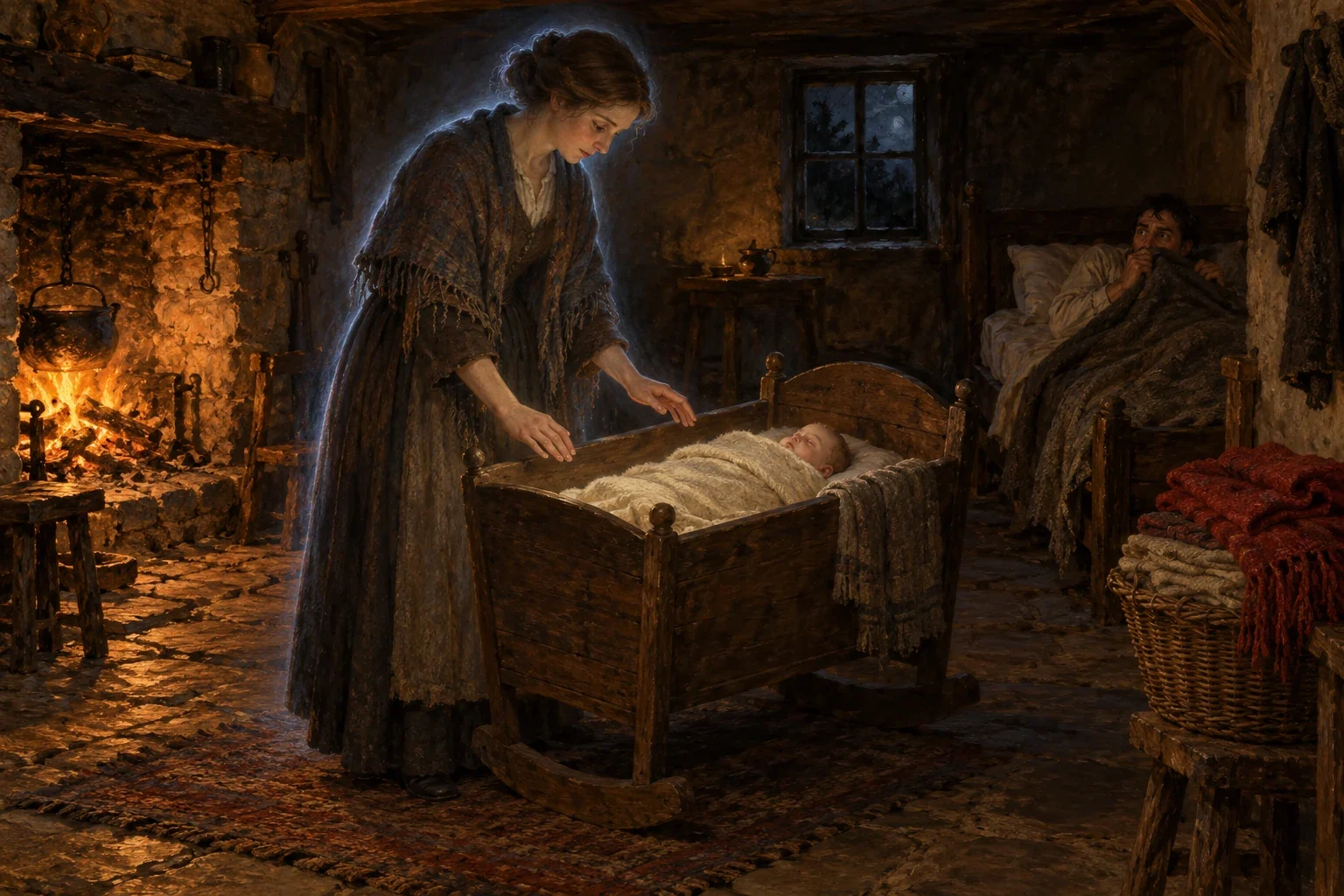
AI-generated interpretation of Grace Connor’s return in Maclintock’s tale. The cradle, mother’s attention and Thady’s fear follow the narrative; the glow, cottage, clothing and basket placement are artistic reconstruction. Two red shawls recall the unfinished commissions without asserting that the source describes them in this first visitation.
AI-generated interpretation of Grace Connor’s return in Maclintock’s tale. The cradle, mother’s attention and Thady’s fear follow the narrative; the glow, cottage, clothing and basket placement are artistic reconstruction. Two red shawls recall the unfinished commissions without asserting that the source describes them in this first visitation.
Overview
Grace Connor is a dead mother who returns to her family in a story credited to Miss Letitia Maclintock. She and her husband Thady live beside a turf bog in Clondevaddock parish. While Thady works in the fields, Grace sells cloth around the countryside and carries neighbours’ commissions to the shops. People trust her honesty and give her small presents for her children. After an illness lasting only a few hours, she dies and is waked and buried.
The night after the funeral, Thady sees Grace cross the firelit room and bend over the cradle. He prays and covers his face; when he looks again, she has vanished. On the next night he brings the infant into his bed, hoping to avoid another visit. Grace still appears and reaches across him to wrap up the child. When he asks what she wants, she tells him to return the baby to the cradle. She also asks him to send her sister Rose to meet her the following evening at the old ruined walls.
Rose keeps the appointment without fear. Grace explains that two customers, Matty Hunter and Jane Taggart, have paid her for red shawls that remain in her basket. A coat bought with old Mosey McCorkell’s money is underneath the other things. She asks Rose to deliver the goods and says farewell, declaring that she can now rest. Rose calls after her, asking about Thady and the children, but the voice and face fade. The ending gives the request and the departure; it does not narrate Rose’s subsequent deliveries.
The account joins continuing care for an infant with the duty to complete entrusted business. It supplies named people and places within its narrative, but no incident date or independently inspected testimony. Yeats includes it among ghost stories. Its attached note16 explains the word for a triangular portion of griddle cake; that domestic detail belongs to Grace’s earlier working life, not an additional supernatural power.
Origins & earliest records
Grace Connor, printed pp130–132; complete narrative and note16. Retained Walter Scott Publishing Co. edition has no printed year.
Records & interpretation
Complete historical narrative, ending, printed attribution and attached apparatus.
Selected bibliography
Documented works and useful reading. This is not a list of every appearance.
- 01
Fairy and Folk Tales of the Irish Peasantry, edited and selected by W. B. Yeats
Grace Connor, printed pp130–132; complete narrative and note16. Retained Walter Scott Publishing Co. edition has no printed year.
Family & connections
A source-supported family tree or inspiration record has not yet been compiled for this profile. Related reading below indicates a connection in subject matter, not a proven lineage or creative influence.
References
Sources supporting this profile. Linked pages have their own scope and editorial standards.
- Historical primary folklore collectionFairy and Folk Tales of the Irish Peasantry, edited and selected by W. B. Yeats — complete selected narrative and apparatusResearch access: 2026-10-27
Image credits
AI-generated illustrationAI-generated interpretation of Grace Connor’s return in Maclintock’s tale. The cradle, mother’s attention and Thady’s fear follow the narrative; the glow, cottage, clothing and basket placement are artistic reconstruction. Two red shawls recall the unfinished commissions without asserting that the source describes them in this first visitation.
AI-generated interpretation of Grace Connor’s return in Maclintock’s tale. The cradle, mother’s attention and Thady’s fear follow the narrative; the glow, cottage, clothing and basket placement are artistic reconstruction. Two red shawls recall the unfinished commissions without asserting that the source describes them in this first visitation.