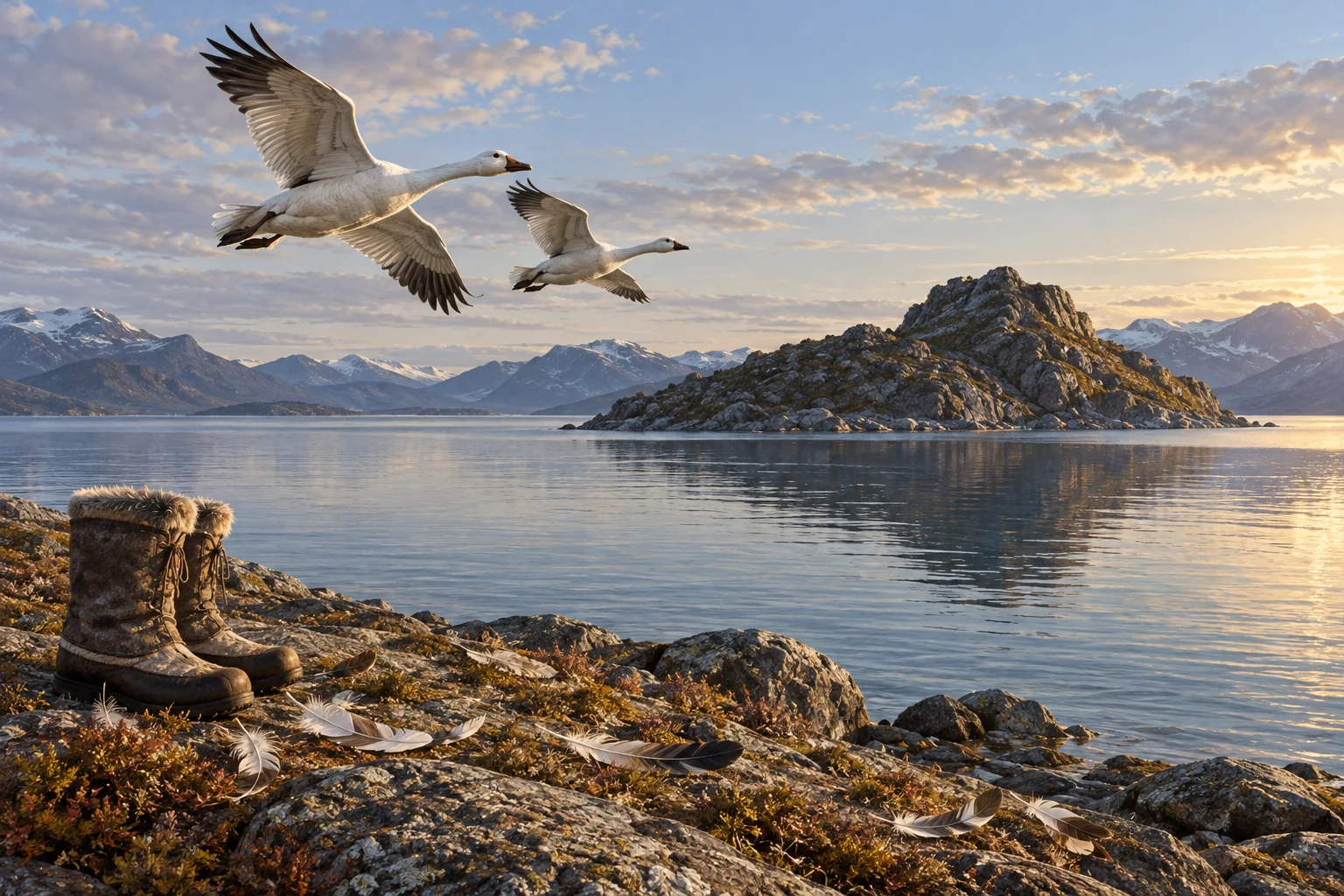
Mother and child geese escaping toward an island above abandoned boots
AI-generated unofficial original narrative interpretation. Mother and child escape scene; landscape and boots design imagined. Not a historical reconstruction or community portrait.
Overview
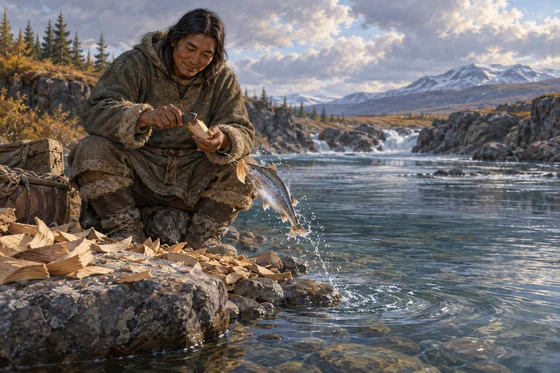
After rejection by a woman in his own community, Ititaujang travels inland to the birds’ country. He steals boots left beside a lake. One goose remains demanding hers, and he makes their return conditional on marriage. Putting them on changes her into a woman. They settle in a coastal village, have a son and live together while he becomes a successful whaler. Her later refusal to handle whale meat is expressed as a difference between her land food and his sea food, together with concern for her white clothing.
She gathers feathers and places them between her own and her son’s fingers. Both become geese and fly away. Ititaujang eventually reaches her island with help from Eχaluqdjung. The child recognizes him, but his mother repeatedly dismisses the warning. When the visitor enters, her new husband orders a box opened. Its feathers attach to the couple and child, turning all three into geese as their house disappears. Ititaujang attacks his departing wife, cutting her abdomen so that eggs fall out. The printed story ends there, without explicitly stating her subsequent fate.
Origins & earliest records
Franz Boas published this account in The Central Eskimo (1888), based on his Canadian Arctic fieldwork and expressly attributed earlier reports. No individual narrator is named for this selected story.
Records & interpretation
Ititaujang, pp.615–618; complete published English story read, including its final attack. Footnote9 identifies editorial abridgment; the separately cited uncut Berlin text has not been read.
3D model
An original procedural model made for the Mythscribe World Builder. It is an interpretation based on this entry, not a historical source or a depiction from the records cited here.

Procedural folklore creature kit · 29,866 triangles · 2.4 MB
Opens mythscribe.cloud in a new tab. Sign-in is required.
Selected bibliography
Documented works and useful reading. This is not a list of every appearance.
- 01
The Central Eskimo
Ititaujang, pp.615–618; complete published English story read, including its final attack. Footnote9 identifies editorial abridgment; the separately cited uncut Berlin text has not been read.
Family & connections
A source-supported family tree or inspiration record has not yet been compiled for this profile. Related reading below indicates a connection in subject matter, not a proven lineage or creative influence.
References
Sources supporting this profile. Linked pages have their own scope and editorial standards.
Image credits
AI-generated interpretationMother and child geese escaping toward an island above abandoned boots
AI-generated unofficial original narrative interpretation. Mother and child escape scene; landscape and boots design imagined. Not a historical reconstruction or community portrait.