
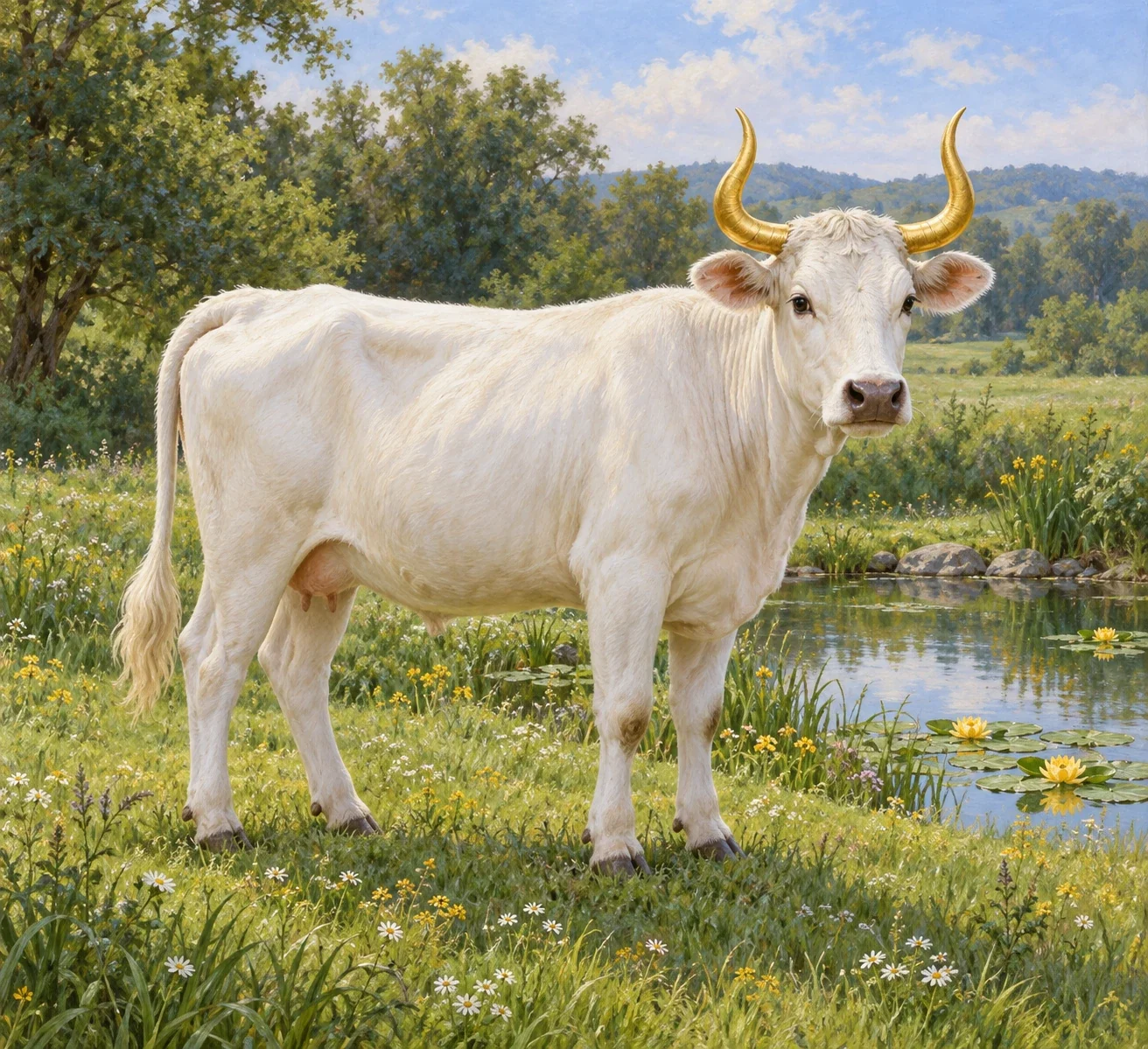
AI interpretation of Wilkins’s white cow with golden horns beside a lily pool.
Overview
The farmer’s cow is described as uniquely valuable in its kingdom, lily-white with gracefully curved horns made of gold. Drusilla tends it in a green meadow with a pool and yellow lilies, returning it to a lean-to stable beside the cottage at night. Its unusually rich milk supports the household: the cream is thick, and the narrator compares the milk’s flavor to the scent of lilies. Customers willingly pay well. The cow is therefore both a picturesque marvel and the family’s livelihood. When Drusilla sleeps on watch after a holiday dance, it disappears despite the raised bars and unbroken stone wall. The king’s search of the kingdom cannot find it, and the failure allows an accusation that Drusilla invented the animal to become a princess.
After the unsuccessful search and Drusilla’s return home a year later, the cow appears at the cottage window eating climbing roses. Two large wicker baskets across its back hold gold coins and jewels. Drusilla and her father embrace it, while it looks at them calmly and resumes eating. A court jeweler checks the horns and confirms that they are gold, not a gilded imitation, so the king accepts Drusilla’s truthfulness. The source supplies no explanation for either disappearance or treasure. Wealth changes the household’s circumstances, but the cow again grazes in its familiar meadow. Its new stable has fine rose-patterned china, dried rose leaves and lace curtains; its figure also becomes the emblem on Lady Drusilla’s coat of arms.
First appearances & development
The title animal of Mary E. Wilkins’s The Cow with Golden Horns, The Pot of Gold and Other Stories (1893), pp.25–40.
Canon & continuity
Mary E. Wilkins’s authored story The Cow with Golden Horns appears in The Pot of Gold and Other Stories, Boston: D. Lothrop Company, 1893, with copyright1892. The complete cached story, pp.25–40, and original title, imprint, contents and illustration list were read. No recovered oral source or historical person is claimed.
Selected bibliography
Documented works and useful reading. This is not a list of every appearance.
- 01
The Pot of Gold and Other Stories
The Cow with Golden Horns, complete pp.25–40; author-created fairy-tale animal, unexplained marvels.
Family & connections
A source-supported family tree or inspiration record has not yet been compiled for this profile. Related reading below indicates a connection in subject matter, not a proven lineage or creative influence.
References
Sources supporting this profile. Linked pages have their own scope and editorial standards.
- Public-domain authored literary narrative; cached complete edition witnessWilkins1893 — complete Cow with Golden Horns story and original book framingResearch access: 2026-10-23
Image credits
AI-generated literary interpretationAI interpretation of Wilkins’s white cow with golden horns beside a lily pool.