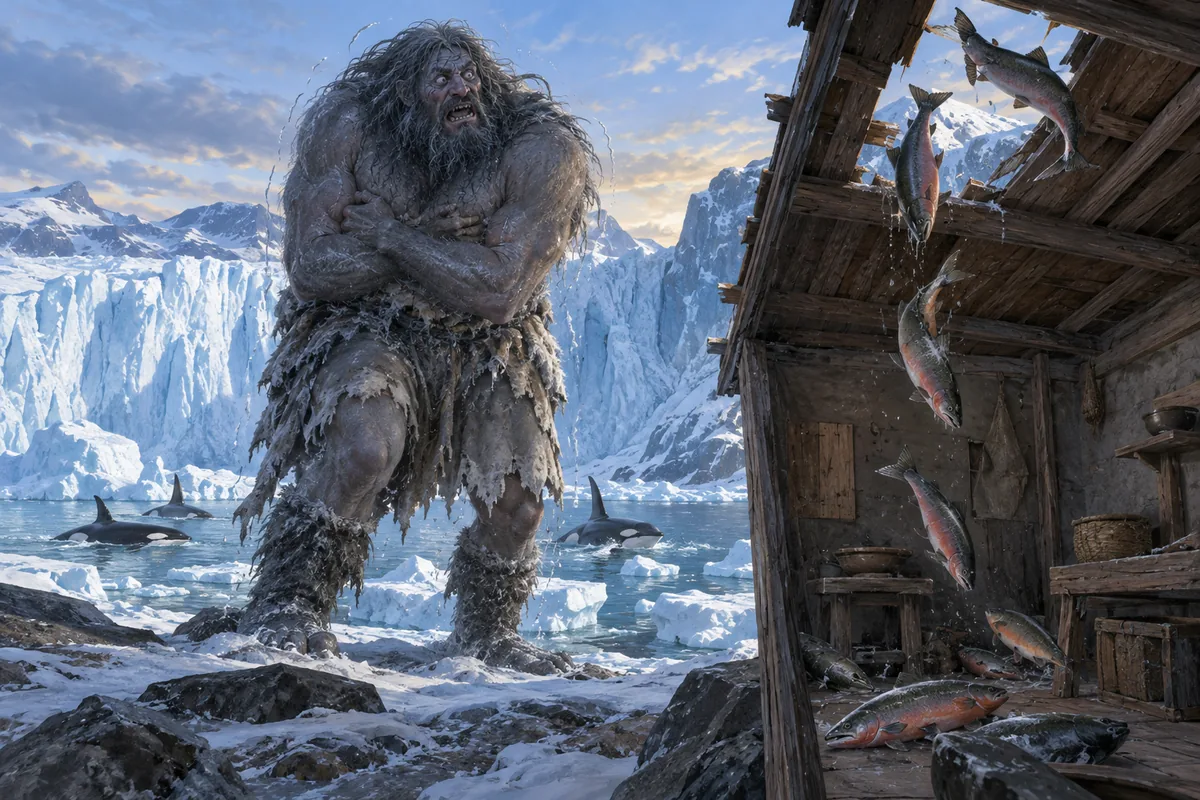
AI interpretation of Glacier giant (Smith Sound). One imaginary trembling giant beside a glacier with large salmon falling through an opening in a simple house roof. No human-skin drum, victim or attack. Fine form, clothes, architecture and landscape invented, no actual Greenlandic person or dwelling claim.
AI-generated unofficial original narrative interpretation. Selected scene: One imaginary trembling giant beside a glacier with large salmon falling through an opening in a simple house roof. No human-skin drum, victim or attack. Fine form, clothes, architecture and landscape invented, no actual Greenlandic person or dwelling claim. Fine anatomy, garments, objects and setting are modern AI imagined visual details, not an historical reconstruction, community portrait, authentic artifact or evidence of living practice.
Overview
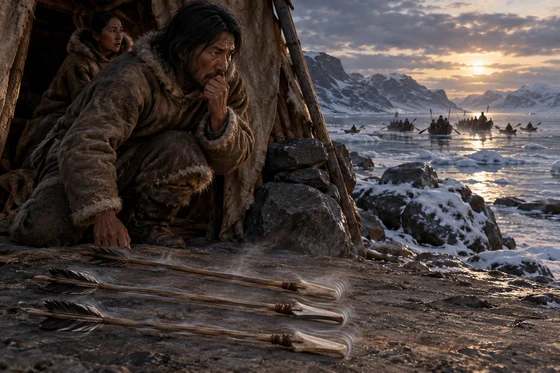
A man searching the coast for his missing son finds a giant beside a glacier. Inside, the host produces a beautiful drum covered with skin from a human belly and is about to present it to the visitor. At the same time, his urge to eat the man makes him tremble. Large salmon fall through an opening in the roof; the visitor is frightened and cannot simply leave.
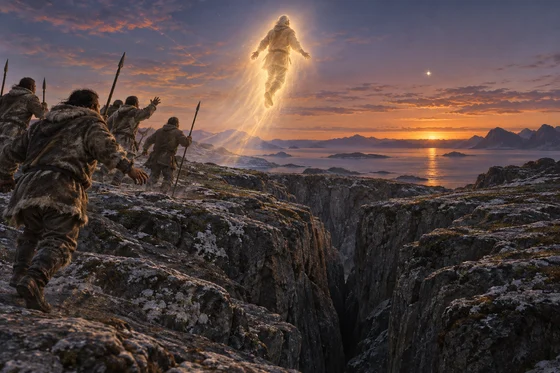
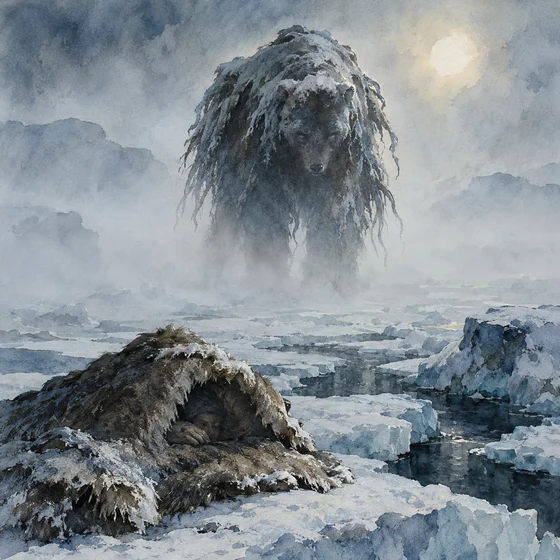
The searching father is himself a powerful wizard. His killer-whale helping spirits emerge, crush the house and kill the giant. This encounter is only the first danger: the father later defeats another ravine-dwelling attacker, ignores a hungry mussel and escapes an older cannibal woman. Only the final stranger possesses the evidence identifying the missing son’s fate. The father kills that stranger and goes home. The glacier giant is therefore not established as the son’s killer, and the narrative does not name him or identify every cannibal on the route as one transformed adversary.
Origins & earliest records
The volume’s final source list assigns this narrative to Polar Inuit of Smith Sound. Knud Rasmussen collected the material; W. Worster edited and translated the 1921 English selection. No individual storyteller is named here. Worster states that he selected and edited versions, including omissions; this is not an unabridged performance transcript.
Records & interpretation
The complete The Man Who Went Out to Search for His Son narrative and final regional source list were inspected. The story begins on printed p. 88.
Selected bibliography
Documented works and useful reading. This is not a list of every appearance.
- 01
Eskimo Folk-Tales
The Man Who Went Out to Search for His Son, begins printed p. 88.
Family & connections
A source-supported family tree or inspiration record has not yet been compiled for this profile. Related reading below indicates a connection in subject matter, not a proven lineage or creative influence.
References
Sources supporting this profile. Linked pages have their own scope and editorial standards.
- Primary textRasmussen/Worster 1921: The Man Who Went Out to Search for His SonResearch access: 2026-10-05
Image credits
AI-generated interpretationAI interpretation of Glacier giant (Smith Sound). One imaginary trembling giant beside a glacier with large salmon falling through an opening in a simple house roof. No human-skin drum, victim or attack. Fine form, clothes, architecture and landscape invented, no actual Greenlandic person or dwelling claim.
AI-generated unofficial original narrative interpretation. Selected scene: One imaginary trembling giant beside a glacier with large salmon falling through an opening in a simple house roof. No human-skin drum, victim or attack. Fine form, clothes, architecture and landscape invented, no actual Greenlandic person or dwelling claim. Fine anatomy, garments, objects and setting are modern AI imagined visual details, not an historical reconstruction, community portrait, authentic artifact or evidence of living practice.