
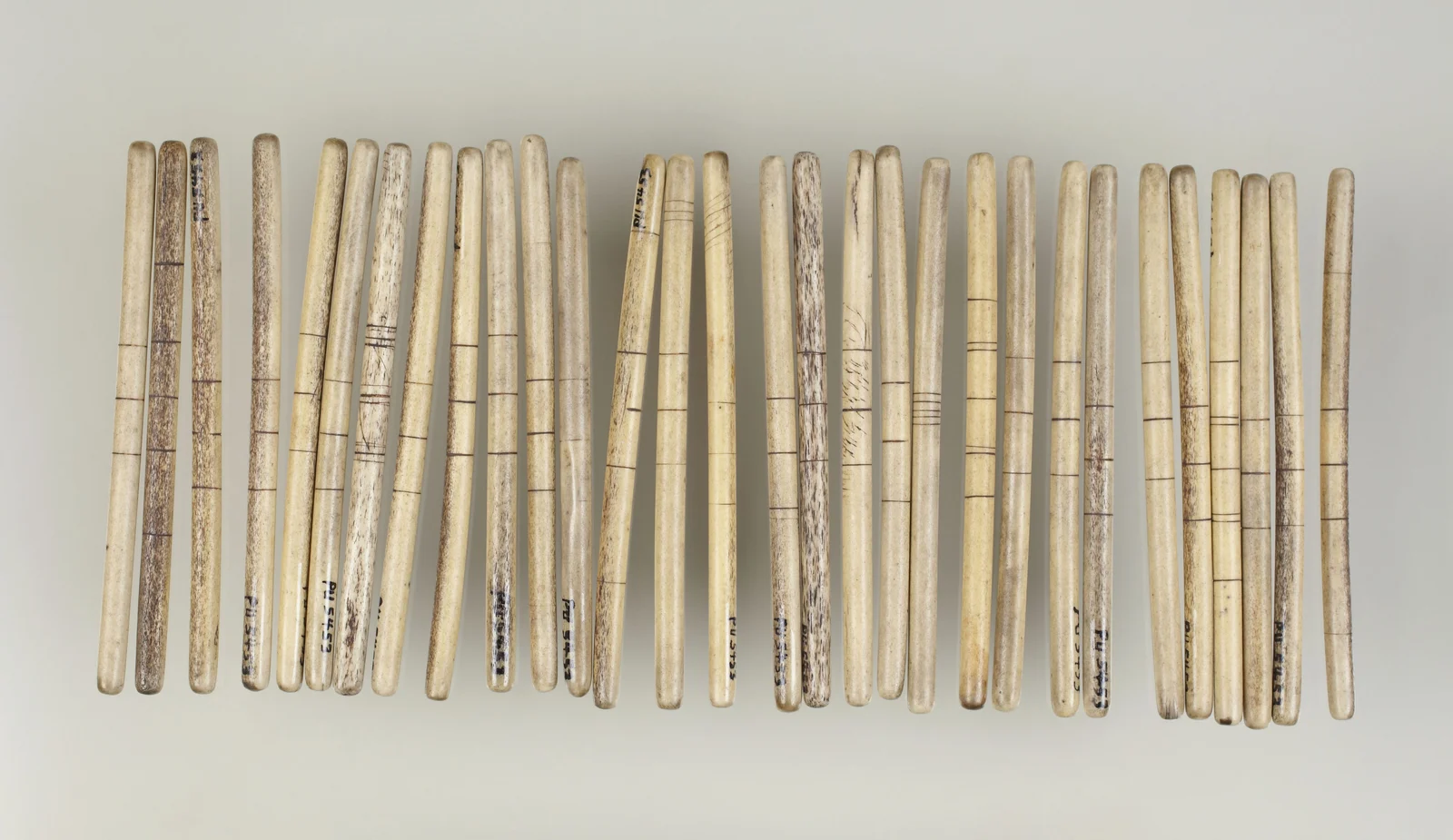
Thirty slender bone game sticks arranged beside one another on a neutral background, with varied incised horizontal markings and visible museum numbers.
Thirty bone gambling sticks, catalogued as Gitxsan and dated before 1885. Princeton records their collection in or near Gitanmaax, British Columbia. The photograph documents this particular set rather than a uniform present-day practice.
Overview
The Gitxsan are a living people of northwestern British Columbia whose homeland includes the Skeena River and its tributaries. The Gitxsan Huwilp Government describes itself as an advocate for the hereditary system and for the protection of territory, food security and future generations. This is a particular institutional account of political responsibilities, not evidence that every Gitxsan person agrees on every policy. Its statements about sovereignty and land remain attributed to that body; this profile does not replace the underlying legal record with a website summary or treat contemporary institutions as interchangeable.
The government’s community page explains wilp as a house group and connects hereditary leadership with responsibilities to people and territory. It identifies adaawk as oral histories and describes intergenerational teaching through community life. Its language account distinguishes upriver Giigeenix and downriver Gyeets varieties of Gitxsanimaax. Matriarchs appear as teachers and participants in preparing younger people for leadership. These public descriptions relate language and education to social institutions without making a particular dialect, educational path or level of fluency a universal attribute of Gitxsan identity. The linked interviews and language guide have not been examined.
The Gitxsan Government Commission’s education page describes a different, service-oriented structure. Bands retain responsibility for their education programmes, sometimes delegating administration to independent education societies that remain accountable to band councils. Gitanmaax and Glen Vowell are identified with band-office administration, while the page identifies a separate school society at Gitanyow. The commission’s adviser supports reporting, school agreements and post-secondary processes. This account helps distinguish shared technical assistance from each community’s authority. A draft policy is described as work toward implementation, and an older scholarship call is not treated as an open present-day application window.
Contemporary authorship offers another perspective. Hetxw’ms Gyetxw, Brett Huson, describes Mothers of Xsan as his series connecting readers with Gitxsan matrilineal society, land and language. His introduction identifies The Sockeye Mother as its first book and characterizes the series through relationships and life cycles. This is the author’s account of a specific literary project, rather than a substitute for all Gitxsan oral histories or an anonymous body of communal folklore. The books themselves have not been read for this profile, so no detailed story, scientific claim or illustration analysis is inferred from the series description.
History & identity
Hereditary-government and education-service accounts, with a separate author’s series introduction.
Sources & representation
Complete selected government/community and education written bodies and full author series introduction read; legal texts, interviews and books unexamined.
Selected bibliography
Documented works and useful reading. This is not a list of every appearance.
- 01
Mothers of Xsan
Author’s series introduction
Language & cultural connections
Source-supported language and cultural connections have not yet been compiled for this profile.
References
Sources supporting this profile. Linked pages have their own scope and editorial standards.
- Community government accountGitxsan Huwilp GovernmentResearch access: 2026-10-06
- Community cultural accountCommunityResearch access: 2026-10-06
- Community education accountGitxsan Government Commission: EducationResearch access: 2026-10-06
Image credits
Museum photograph of a specifically catalogued historical Gitxsan game setThirty slender bone game sticks arranged beside one another on a neutral background, with varied incised horizontal markings and visible museum numbers.
Thirty bone gambling sticks, catalogued as Gitxsan and dated before 1885. Princeton records their collection in or near Gitanmaax, British Columbia. The photograph documents this particular set rather than a uniform present-day practice.