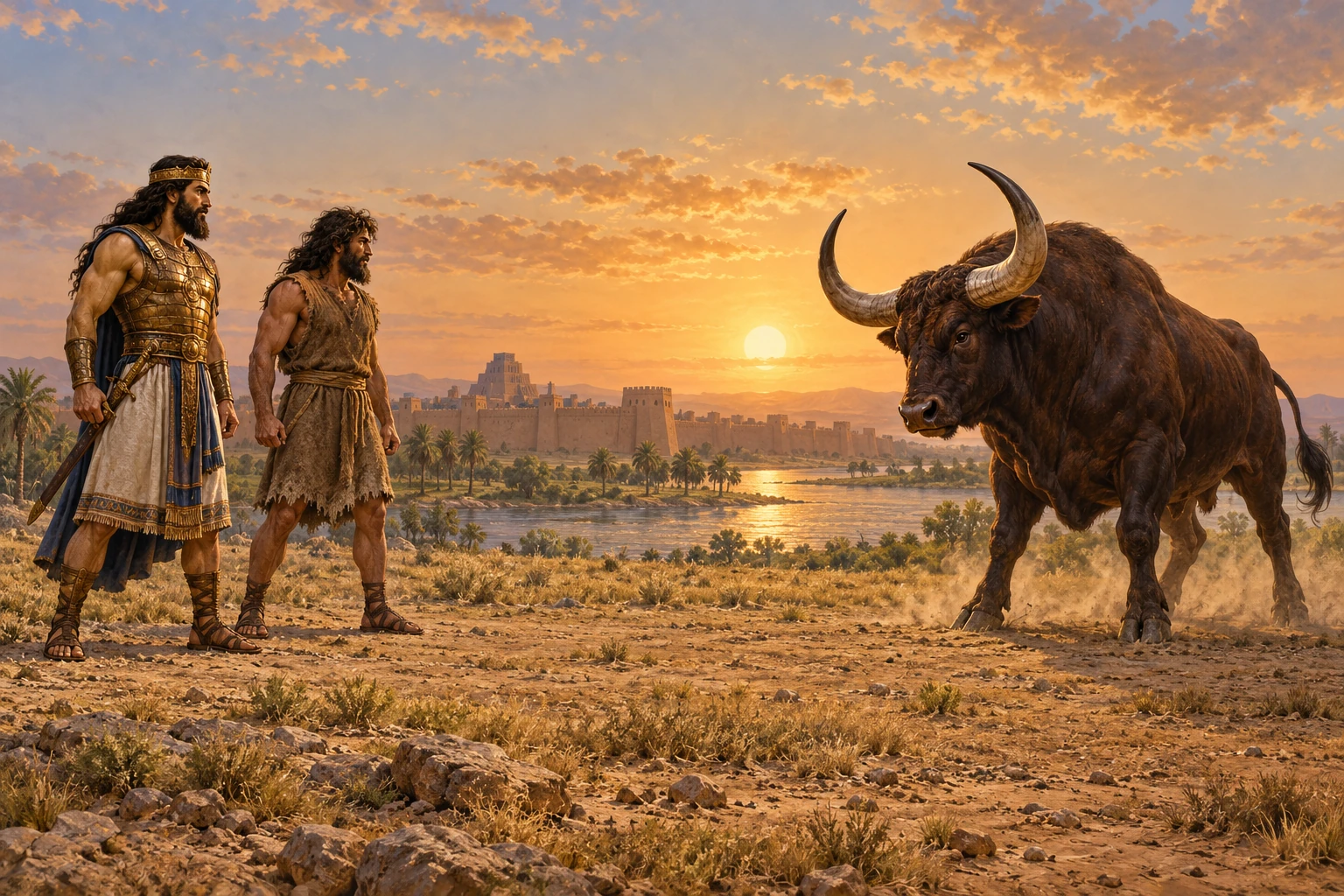
AI-generated interpretation of the Bull of Heaven episode in Budge’s historical account. The two companions and formidable bull follow the narrative; their faces, clothing, animal colouring and landscape are artistic choices. The source’s uncertain fire-breathing is not depicted. This is not an archaeological reconstruction or a Final Fantasy scene.
The image imagines the confrontation before the account’s joint battle, without combining later lament or celebration.
Overview
Budge’s headed account of the Sixth Tablet begins with Gilgamish returning to Erech, washing his armour and weapons, arranging his hair and putting on clean royal dress. Ishtar notices him and invites him to become her lover. Her speech promises a richly furnished chariot, deference from rulers and tribute from the land. Budge supplies twenty-one numbered opening lines before continuing in explanatory prose, so this is his complete historical account of the episode rather than a new translation of every surviving line of the ancient tablet.
Gilgamish refuses by recalling the misfortunes he attributes to the goddess’s earlier lovers and creatures. Budge’s summary includes Tammuz and animals harmed or destroyed after entering her service. These accusations belong to the hero’s speech within this version. Ishtar angrily appeals to Anu and Antu, then asks her father to create a heavenly bull to destroy Gilgamish. Anu sends the bull to Erech, where it kills many inhabitants. The historical author marks its possible fire-breathing with a question mark; that uncertain feature is not made a secure trait here.
Enkidu and Gilgamish confront the animal together. Enkidu holds its tail while Gilgamish strikes it, and they kill it. Ishtar curses the hero from the city’s battlements. Enkidu answers defiantly and throws part of the bull toward her, after which she gathers women to lament. This sequence preserves the different actions of the goddess and the two companions, rather than assigning the entire victory or confrontation to one hero.
Gilgamish calls the artisans to admire the horns, then places them in Lugalbanda’s temple as an offering. Budge gives traditional comparisons for their bulk and capacity; these are not converted into independently measured animal anatomy. The companions wash in the Euphrates and return through the city while people gather to see them. Women of the palace answer Gilgamish’s boast with praise, and he orders a festival. The unit ends when Enkidu wakes from a dream and tells his companion. Its contents and consequences are not supplied in that ending, and the following headed account expressly acknowledges uncertainty. No punishment-causes-death explanation is imported from another edition.
Origins & earliest records
E. A. Wallis Budge’s 1920 British Museum account incorporates translated opening lines and prose summary of the Sixth Tablet. His Gilgamish spelling identifies the hero elsewhere called Gilgamesh. No original cuneiform, complete critical Tablet VI translation or earliest oral history independently collated.
Records & interpretation
Complete headed Sixth Tablet unit, pp. 46–49, including the textual caption for a cuneiform extract, read from the root-retained master. Complete adjacent Fifth and Seventh headed accounts and the earlier identity note inspected for framing; no image pixels or original tablet reading claimed.
Selected bibliography
Documented works and useful reading. This is not a list of every appearance.
- 01
The Babylonian Story of the Deluge as Told by Assyrian Tablets from Nineveh
Author signature 24 July 1920. The Sixth Tablet heading, pp. 46–49, complete; 21 opening translated lines plus prose summary. Caption refers to Rawlinson IV, plate 41, column 2, K. 2589; actual image and cuneiform not inspected.
Family, evolution & connections
Gilgamesh (Final Fantasy)
Budge’s historical Gilgamish account gives a distinct Ishtar proposal, joint Bull of Heaven battle and city celebration. It provides namesake epic context for Final Fantasy’s fictional Gilgamesh, not proof that this scene influenced the games or that their biographies and powers are shared.
References
Sources supporting this profile. Linked pages have their own scope and editorial standards.
- Historical English author account with translated extractsBudge 1920, The Sixth Tablet, complete headed accountResearch access: 2026-10-26
Image credits
Modern interpretation of a historical literary accountAI-generated interpretation of the Bull of Heaven episode in Budge’s historical account. The two companions and formidable bull follow the narrative; their faces, clothing, animal colouring and landscape are artistic choices. The source’s uncertain fire-breathing is not depicted. This is not an archaeological reconstruction or a Final Fantasy scene.
The image imagines the confrontation before the account’s joint battle, without combining later lament or celebration.