
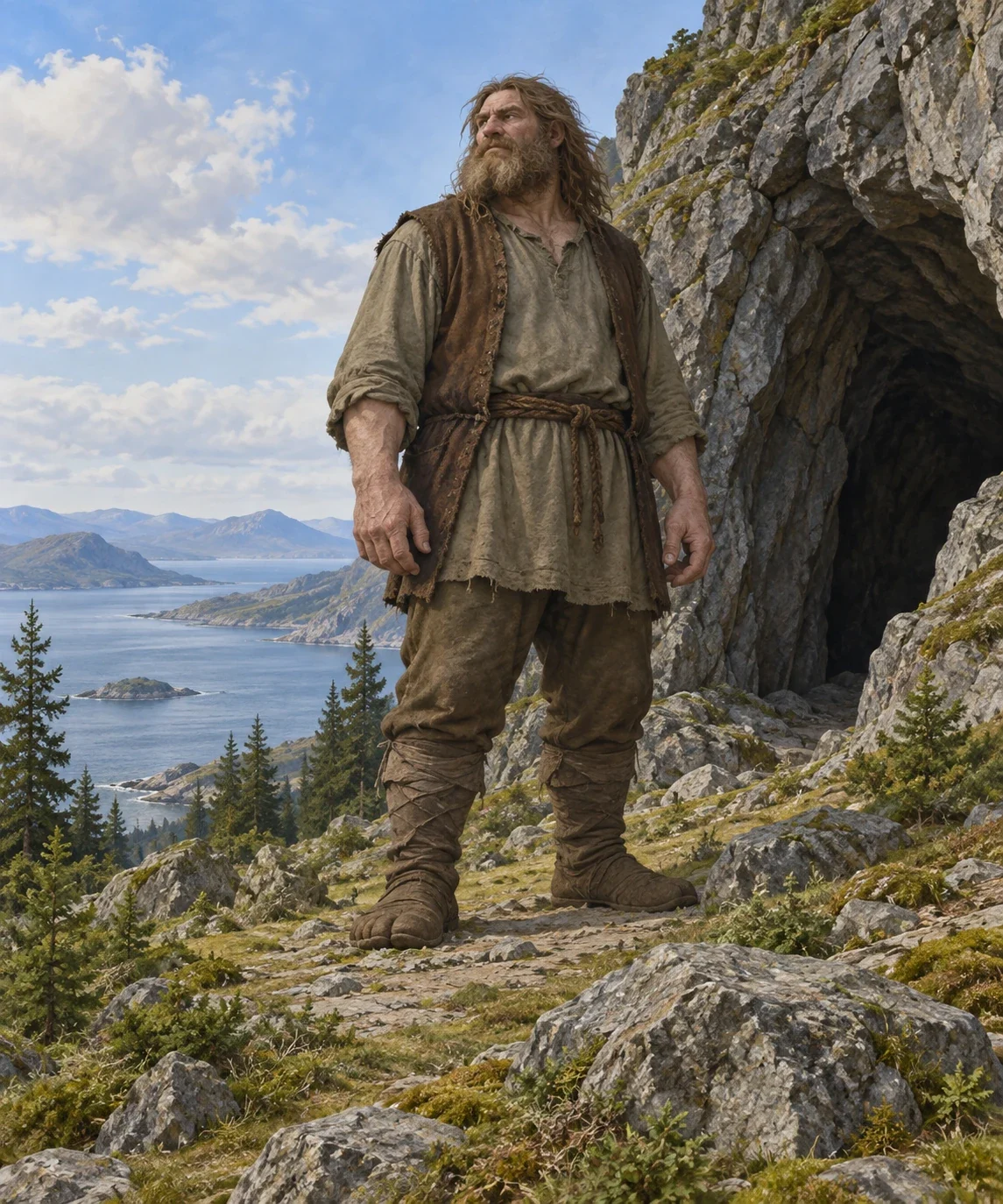
AI narrative interpretation of the Giant Puke near his mountain dwelling.
Face, garments, scale and landscape are imagined after the cited narrative.
Overview
Hofberg locates Puke’s former dwelling in a fissure ending in a cave or hall inside Puke Mountain, near the sea in the parish of Lofta, North Tjust. The chapter presents local storytelling about the mountain rather than evidence that a giant historically lived there.
The building of Lofta church makes its bells intolerable to Puke. He also complains about Kofre Spring, a pond formed from the mountain’s watercourses where baptism was sometimes performed. His phrase about Lofta’s scolding is explained as a reference to the bells.
During prolonged Sunday ringing, Puke sends his daughter to the mountaintop. She turns her apron strings into a sling and throws an enormous stone toward the church tower, overshooting it. In a separate episode she gathers three children and their make-believe plow into her apron. Puke orders her to return them, recognizing that the giants’ time has passed and the small people will rule instead.
Puke eventually moves to Götland, as the translation spells the destination. When a ship’s master later finds him there, the giant entrusts him with a box to place on Lofta’s altar while the congregation is present, insisting that it remain unopened until then. The tale does not describe the box’s contents.
As a reward, Puke describes a key beneath the left forefoot of Lofta’s white mare, explicitly meaning the church. The key opens his mountain, where two black dogs guard an interior room containing silver vessels. The captain may take the largest vessel, but taking more would bring misfortune. The white mare is a metaphor, not a separate animal in this episode.
The crew instead throws the box onto a small island during the homeward journey. The island immediately bursts into flames. The narrative connects its brown, desolate appearance with that event; it does not report that the church actually receives or opens the box.
The retained note identifies the account as a combination of giant stories localized at Puke Berg and gives a parallel to the daughter’s plowing-children episode at Kläppe in Oldesborg parish, Dalland. This profile follows the Lofta composite in the selected English edition. The daughter’s stone throwing and collection of children remain her actions, and the footnote’s wider parallels do not establish one identical giant across Sweden.
Origins & earliest records
Chapter XIII, “The Giant Puke,” in Herman Hofberg’s Swedish Fairy Tales, translated by W. H. Myers (Chicago, 1890), printed pp. 52–55.
Records & interpretation
The complete English chapter and its retained footnote support a localized composite legend; the Swedish original and omitted authorial notes have not been independently consulted.
Selected bibliography
Documented works and useful reading. This is not a list of every appearance.
- 01
Swedish Fairy Tales: The Giant Puke
The complete English chapter and its retained footnote support a localized composite legend; the Swedish original and omitted authorial notes have not been independently consulted.
Family & connections
A source-supported family tree or inspiration record has not yet been compiled for this profile. Related reading below indicates a connection in subject matter, not a proven lineage or creative influence.
References
Sources supporting this profile. Linked pages have their own scope and editorial standards.
- Primary historical collection in English translationHofberg / Myers, Swedish Fairy Tales, complete selected chapter in the 1890 editionResearch access: 2026-10-21
Image credits
AI-generatedAI narrative interpretation of the Giant Puke near his mountain dwelling.
Face, garments, scale and landscape are imagined after the cited narrative.