
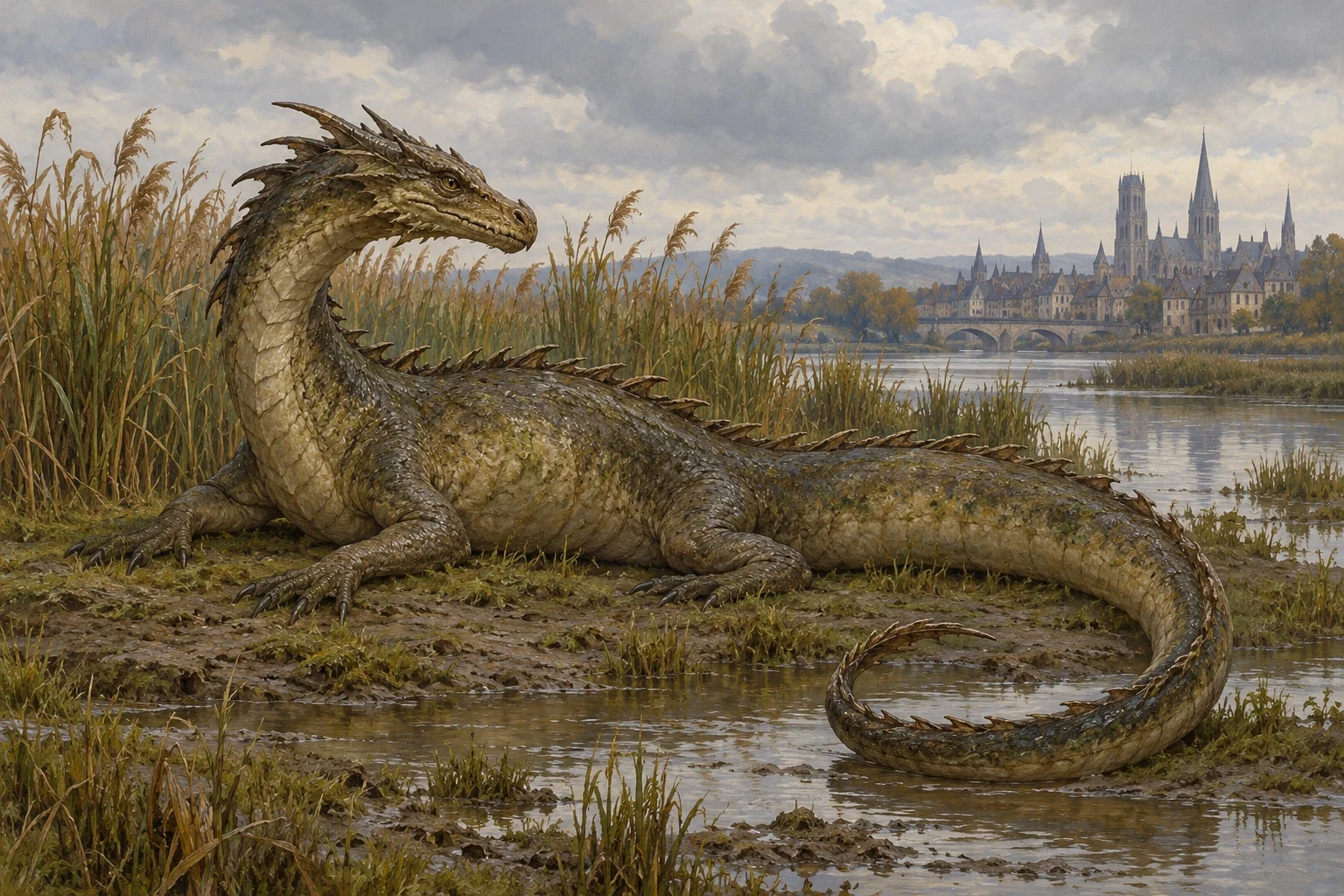
AI-generated interpretation of Cook’s Rouen Gargouille legend; anatomy, colour, scale and setting are explicitly imagined.
The selected account describes a large dragon in river marshes and reed-beds. Its exact anatomy, limbs, spines, scales, colour, size and the distant buildings in this illustration are imagined. This is neither an architectural waterspout or stone carving nor an authenticated medieval depiction or D&D design. No source artwork was supplied as a reference.
Overview
Theodore Andrea Cook's The Story of Rouen retells the Gargouille legend while questioning the historical explanation attached to it. The monster is an immense, voracious dragon inhabiting the marshes and reed-beds beside the river. It threatens the town's inhabitants, making its watery refuge part of the danger surrounding Rouen. Cook does not give it a fixed number of legs, a detailed arrangement of wings or the body of an animated architectural carving. Those familiar later visual possibilities cannot be inserted into this particular description as though the text supplied them.
Saint Romain brings the danger under control with the help of a condemned prisoner. In Cook's telling, the prisoner serves as bait to draw the dragon out. The saint makes the sign of the cross and leads the creature into the town by his stole, without resistance. The dragon is then burned. The legend continues by connecting the prisoner's release with a royal grant allowing the cathedral to free a prisoner every Ascension Day. The monster's defeat therefore explains more than personal bravery: it supplies a miraculous origin for an institution's claimed privilege. The precise anatomy of the beast is less developed than the relationship between the saint, the prisoner and the town.
Cook treats this explanation as a legend constructed around a custom, rather than an authenticated report of a dragon. He argues that evidence for the privilege is stronger than evidence for the miracle and offers a different origin involving religious performance. That remains his historical argument; the medieval records and chronicles he invokes were not independently inspected for this entry. His proposed dates and reconstruction are not presented here as established modern conclusions. The account is valuable as a distinctly dated retelling that also examines the authority the story was used to support.
Architectural gargoyles have a separate role in another passage of the same book. Cook describes long projecting figures carrying rainwater and refuse from roofs into the street. Their operation as waterspouts, rather than the mere presence of a monstrous face, is the relevant distinction in that description. His surrounding inventory also includes decorative signs and carvings. Neither a working spout nor an ornamental grotesque becomes a living creature simply because it looks fantastic. This legend, those architectural objects and later fictional stone monsters therefore retain separate identities; the selected source does not establish a derivation or a creator's route between them.
Origins & earliest records
Theodore Andrea Cook, The Story of Rouen, London: J.M.Dent & Co., 1899. Complete Gargouille retelling and immediate historical critique, pp. 38–41, with notes 8–10. A separate townscape paragraph describes working architectural gargoyles. This is a nineteenth-century witness to a legend, not a contemporary record of Saint Romain’s supposed encounter.
Records & interpretation
Complete selected 960-word account and critique, complete notes 8–10 and complete 394-word architectural paragraph read from the 1899 edition transcription. Historical source references, artworks and civic privileges named by Cook were not newly authenticated. The date of the legend’s events and the origin of the word gargoyle are not independently established.
Selected bibliography
Documented works and useful reading. This is not a list of every appearance.
- 01
The Story of Rouen — Gargouille account, pp. 38–41
J.M.Dent & Co., London; complete selected account and critique with notes 8–10. Separate complete townscape paragraph describes functioning roof waterspouts.
Family, evolution & connections
Gargoyle (Dungeons & Dragons)
Cook’s Rouen Gargouille is a river-marsh dragon subdued by Saint Romain; the retelling connects its defeat with a prisoner-release privilege that Cook examines critically. The architectural waterspouts Cook separately calls gargoyles and the linked fictional Gargoyle retain their own scopes; no word derivation or creator route is established.
References
Sources supporting this profile. Linked pages have their own scope and editorial standards.
- Historical English retelling and commentaryCook, The Story of Rouen (1899), Gargouille retelling and architectural contextResearch access: 2026-10-24
Image credits
AI-generated historical interpretationAI-generated interpretation of Cook’s Rouen Gargouille legend; anatomy, colour, scale and setting are explicitly imagined.
The selected account describes a large dragon in river marshes and reed-beds. Its exact anatomy, limbs, spines, scales, colour, size and the distant buildings in this illustration are imagined. This is neither an architectural waterspout or stone carving nor an authenticated medieval depiction or D&D design. No source artwork was supplied as a reference.