
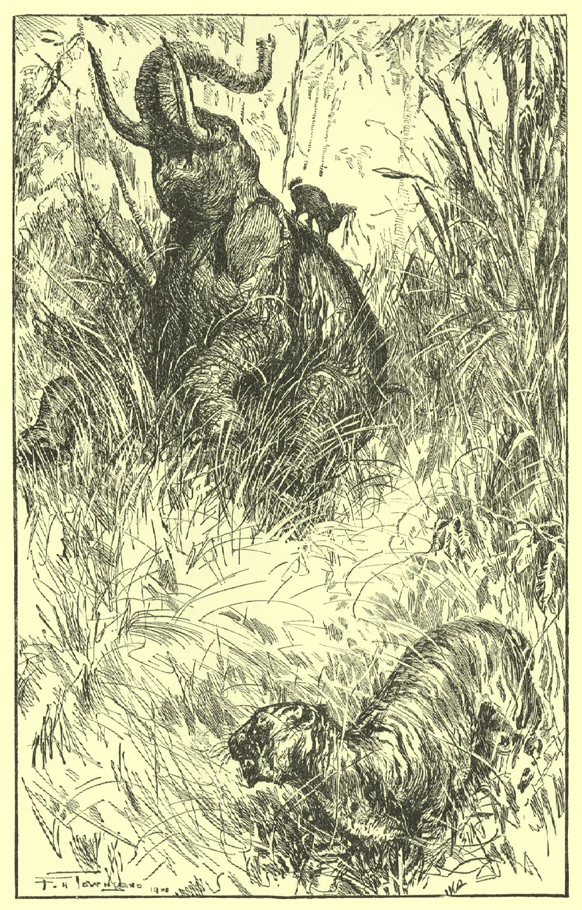
Townsend’s Gājah elephant with the mouse-deer on its back as a tiger flees
The elephant acts as though it is being eaten while the mouse-deer licks molasses from its back. The fleeing tiger mistakes the performance for real predation. The image illustrates this bluff, not blood-drinking mouse-deer anatomy.
Overview
Gājah wagers his life against Rīmau’s on frightening a monkey out of its tree. The tiger succeeds, and the elephant obtains seven days to visit his wife and children. A mouse-deer rescuer has him pour molasses over his back and pretend to suffer while it licks the syrup, frightening the tiger with an apparent elephant-eating creature. When a black ape brings the tiger back, another bluff alleges that the ape promised two tigers as payment. The tiger flees and threatens the ape, explaining their enmity. Neither the syrup nor the acting establishes actual blood-drinking or carnivorous mouse-deer anatomy. Gājah’s pledge of service includes his descendants, but no later fulfilment is narrated.
Origins & earliest records
Malay Peninsula; Che Busu, Kelantan Malay narrator
Records & interpretation
Complete relevant tale and attached scholarly notes directly read.
Selected bibliography
Documented works and useful reading. This is not a list of every appearance.
- 01
Fables & Folk-Tales from an Eastern Forest
XVII, The Elephant has a bet with the Tiger, pp. 41–48; note p. 81
- 02
Fables & Folk-Tales from an Eastern Forest — XVII The Elephant Has a Bet with the Tiger
Fables & Folk-Tales from an Eastern Forest, collected and translated by Walter Skeat; Cambridge: University Press, 1901. Original title leaf13 visually checked. Complete selected named tale, conclusion, footnotes and corresponding source notes read from Elfinspell historical transcription; individual page ranges in this batch are host body labels, not independently scan-collated. Introduction states collection during1899 expedition with some limitation of original phraseology; no unedited original-language transcript claimed.
Family & connections
A source-supported family tree or inspiration record has not yet been compiled for this profile. Related reading below indicates a connection in subject matter, not a proven lineage or creative influence.
Primary records and illustrations
Walter Skeat, Fables & Folk-Tales from an Eastern Forest (Cambridge: University Press, 1901)
XVII, The Elephant has a bet with the Tiger. XVII, The Elephant has a bet with the Tiger, pp. 41–48; note p. 81
Complete tale and associated notes directly read. Regional spellings and differing accounts retained; commentary does not establish present-day practice or biological facts. Teller attribution follows the profile and complete source notes.
Located primary passages
Specific passages supporting details in this entry, grouped by their published witness.
Fables & Folk-Tales from an Eastern Forest
Fables & Folk-Tales from an Eastern Forest, collected and translated by Walter Skeat; Cambridge: University Press, 1901. Original title leaf13 visually checked. Complete selected named tale, conclusion, footnotes and corresponding source notes read from Elfinspell historical transcription; individual page ranges in this batch are host body labels, not independently scan-collated. Introduction states collection during1899 expedition with some limitation of original phraseology; no unedited original-language transcript claimed.
- Gājah and Rīmau wager which can frighten a monkey from a tree, staking each loser’s life as the winner’s food. The tiger succeeds; the elephant gets seven days to visit wife and children, then mourns without sleeping or eating. Mouse-deer offers aid for promised service, obtains molasses and stages an apparent attack by riding the sticky, trumpeting elephant. Believing the small rider is eating it and wants tiger meat too, Rīmau flees. A black ape guesses the deception and brings the tiger back. Mouse-deer pretends the ape owes it two tigers and has supplied only one. Rīmau again flees, thinks the ape betrayed it to pay a debt, and threatens to kill it whenever it descends. The tale explains their lasting enmity. Che Busu is the credited narrator.
XVII The Elephant Has a Bet with the Tiger, complete hosted page labels 41–48; note81
CompleteXVII41–48 and note81 read, including final ape-return sequence. Elephant’s threatened death avoided; no actual elephant or tiger eaten. Mouse-deer’s apparent blood is molasses, and animal relatives unnamed. Promise binds descendants as a narrative debt, not verified human law. No preparation recipe copied.
References
Sources supporting this profile. Linked pages have their own scope and editorial standards.
- Historical collected narrative with locality and editorial notesSkeat, Fables & Folk-Tales (Cambridge University Press, 1901), XVII, The Elephant has a bet with the Tiger, pp. 41–48; note p. 81Research access: 2026-10-05
Image credits
Historical illustrationTownsend’s Gājah elephant with the mouse-deer on its back as a tiger flees
The elephant acts as though it is being eaten while the mouse-deer licks molasses from its back. The fleeing tiger mistakes the performance for real predation. The image illustrates this bluff, not blood-drinking mouse-deer anatomy.