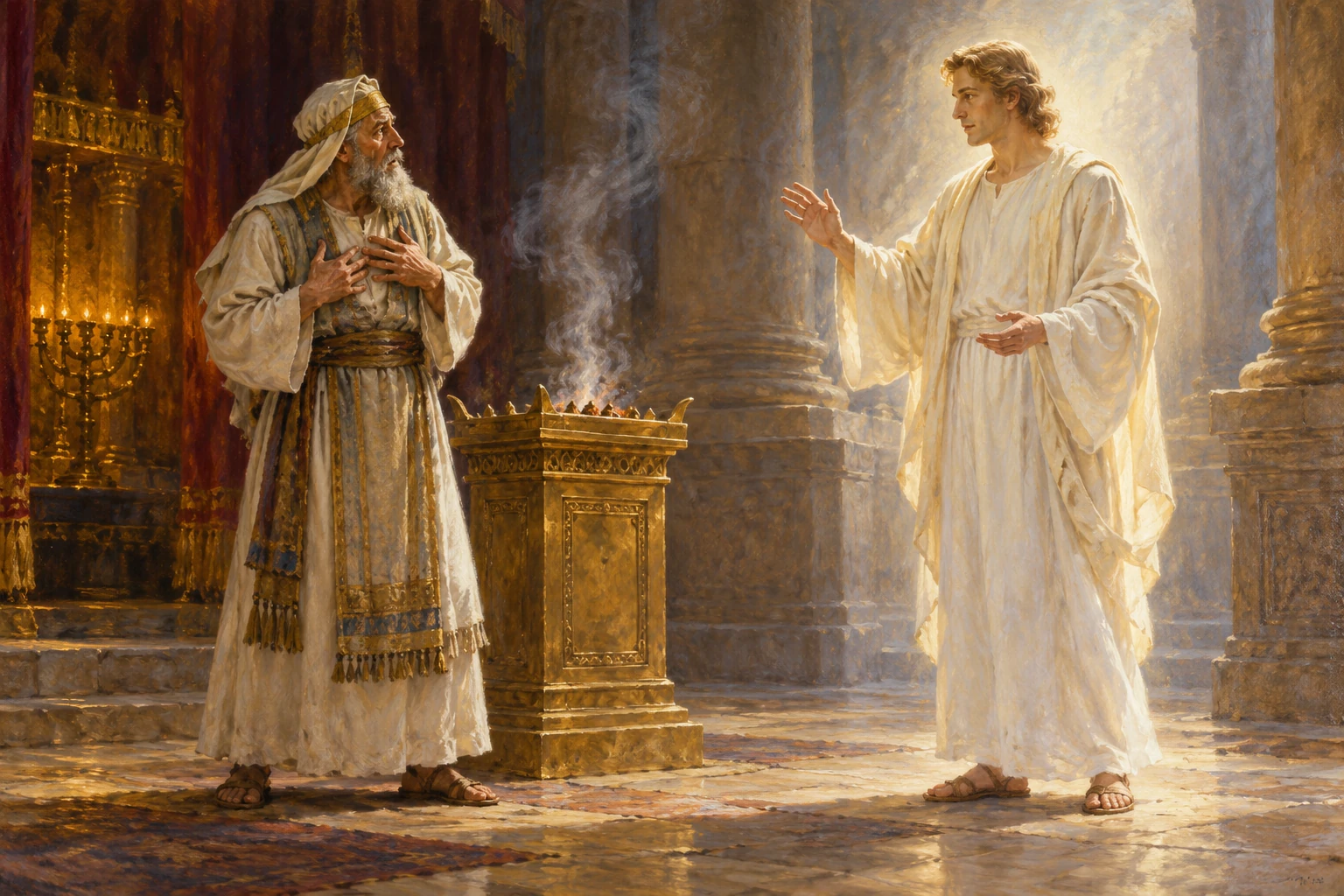
AI-generated interpretation of Gabriel’s temple announcement in Luke 1. The incense, messenger and startled priest follow the narrative. Faces, garments, architecture, lighting and decorative objects are imagined; this is not an archaeological reconstruction. The chapter does not describe wings, and this illustration does not establish a universal angelic appearance.
A respectful modern interpretation of a sacred narrative in Weymouth’s historical rendering; no direct Digimon design or creator influence is asserted.
Overview
In the first chapter of Luke, Gabriel appears as a named messenger in two connected birth announcements. This entry follows Richard Francis Weymouth’s historical English rendering, whose retained e-text identifies itself as the third edition of 1913. It records what that scriptural narrative says without treating an angel as a zoological specimen or presenting one translation as a complete account of Christian belief.
The first encounter takes place during Zechariah’s allotted priestly service. While people pray outside, he enters the sanctuary to burn incense. An angel stands on the right of the incense altar, and Zechariah is frightened. The messenger reassures him that his petition has been heard: his wife Elizabeth will bear a son to be named John. The promised child will prepare people for the Lord, turning them toward God in the spirit and power of Elijah. These are announced roles for John, rather than combat abilities attributed to Gabriel.
Zechariah asks what proof he can have because he and Elizabeth are old. The angel identifies himself as Gabriel, standing in God’s presence and sent to deliver good news. He announces that Zechariah will remain unable to speak until the words are fulfilled, because he did not believe them. Outside, the waiting people recognize that something extraordinary has happened when the priest can communicate only by signs. His service ends, he returns home, and Elizabeth subsequently conceives.
The account does not leave the imposed silence unresolved. When the child is born, Elizabeth rejects the proposed family name Zechariah and insists on John. Asked by signs, the father requests a tablet and confirms that name in writing. His speech immediately returns, and he blesses God. The neighbours’ wonder and Zechariah’s song extend the outcome beyond the private temple encounter; the chapter closes with John growing and living in the desert before appearing publicly to Israel.
Between the promise and its fulfilment, Gabriel is sent to Mary at Nazareth. He announces the birth and kingship of Jesus, answers her question by referring to the Holy Spirit and the power of the Most High, and points to Elizabeth’s pregnancy. Mary accepts, and the angel departs. Her visit to Elizabeth and song belong to the chapter’s connecting context. This named messenger’s appearances are not described here with wings, armour or a weapon. Luke’s account does not identify Gabriel with a Digimon, establish a universal angelic anatomy, or document the creative sources of a modern game.
Origins & earliest records
This is an attributed Gospel of Luke account in an identified historical English translation, not a claim to the earliest Gabriel tradition or an independently dated first oral account. Other scriptural appearances and later Jewish, Christian and Islamic interpretations require their own witnesses.
Records & interpretation
Complete Luke 1:1–80 read from the retained PG8830 historical e-text, including both annunciations, Elizabeth and Mary’s meeting, both songs, John’s naming and Zechariah’s restored speech. No independent Greek translation or full-gospel review claimed.
Selected bibliography
Documented works and useful reading. This is not a list of every appearance.
- 01
Weymouth New Testament in Modern Speech, Luke
E-text title states Third Edition 1913. Complete chapter 1:1–80 inspected; no physical title page or original Greek manuscript inspected.
Family, evolution & connections
Angemon
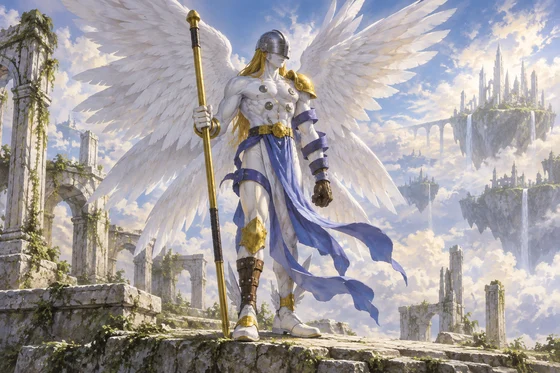
Gabriel’s messages and Zechariah’s restored speech belong to this particular scriptural narrative. Angemon provides a modern fictional comparison through its angelic imagery. Their theology, bodies, powers and narrative identities remain separate, and no direct creative source is established.
References
Sources supporting this profile. Linked pages have their own scope and editorial standards.
- Historical English rendering of scriptureWeymouth, Luke 1:1–80, historical third edition 1913, PG8830Research access: 2026-10-26
Image credits
Modern interpretation of a historical literary accountAI-generated interpretation of Gabriel’s temple announcement in Luke 1. The incense, messenger and startled priest follow the narrative. Faces, garments, architecture, lighting and decorative objects are imagined; this is not an archaeological reconstruction. The chapter does not describe wings, and this illustration does not establish a universal angelic appearance.
A respectful modern interpretation of a sacred narrative in Weymouth’s historical rendering; no direct Digimon design or creator influence is asserted.