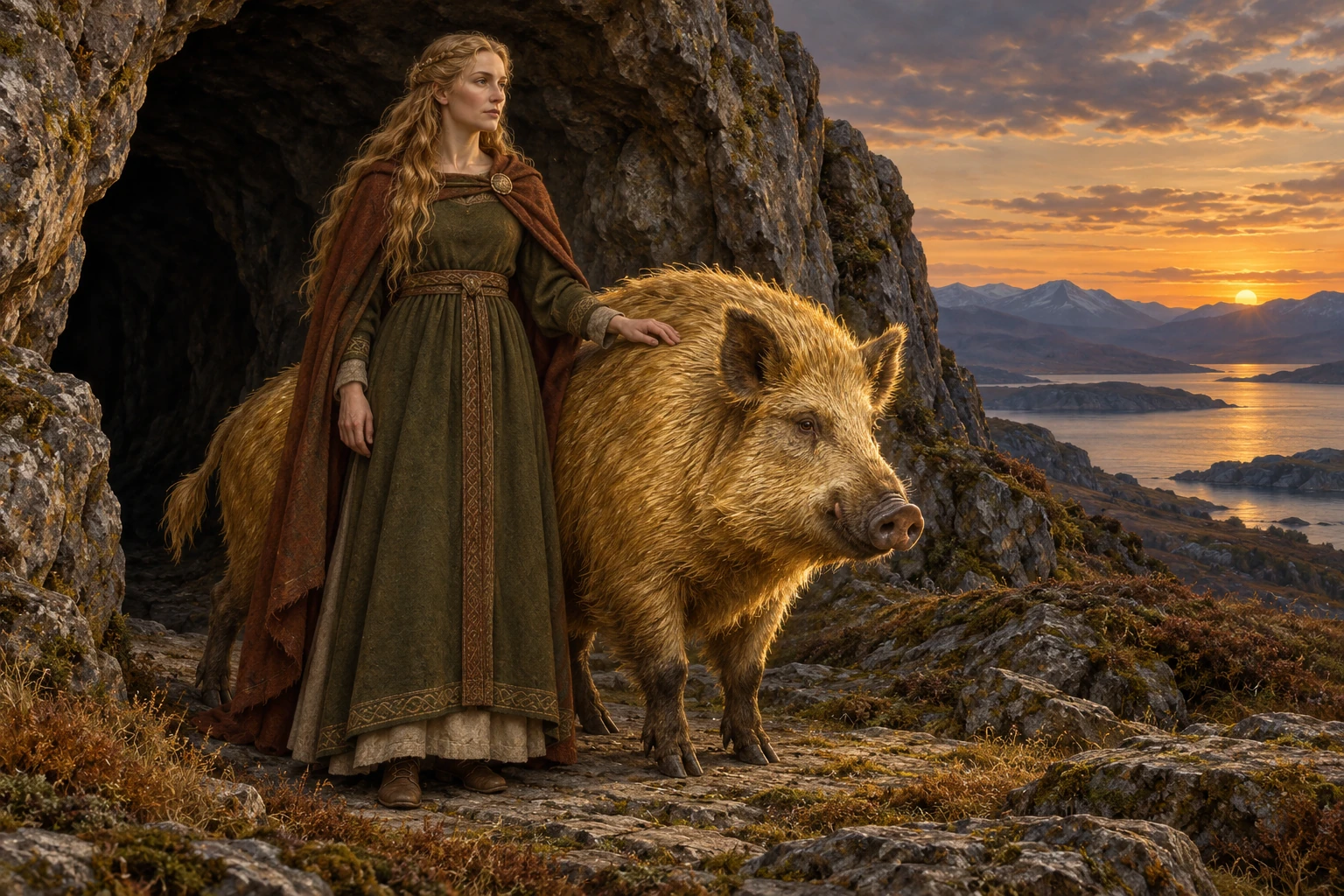
AI-generated interpretation of Freyia with her golden-bristled mount Hildisvini in Thorpe’s Lay of Hyndla. Her face, hair, clothing, posture and landscape are imagined; this is not a reconstruction of historical worship or the Final Fantasy character.
The selected poem distinguishes Freyia’s account of her boar from Hyndla’s accusation. The picture does not resolve that dialogue into a verified transformation.
Overview
In Benjamin Thorpe’s Lay of Hyndla, Freyia is the divine advocate of Ottar, a man whose ancestry matters in a dispute over inherited wealth. Thorpe’s prose introduction explains the purpose of their visit to the prophetess Hyndla: Ottar needs genealogical knowledge to contest Angantyr’s claim. The poem opens with Freyia waking Hyndla and proposing a journey to Valhall. Her concern is practical as well as personal. She says that Ottar should obtain his paternal inheritance and recalls the stone altar he built for her and sprinkled with ox blood, and says that he trusted the goddesses.
The exchange also gives Freyia a distinctive mount. Hyndla accuses her of travelling with young Ottar, Innstein’s son. Freyia answers by describing Hildisvini, her golden-bristled boar, made for her by the skilful dwarfs Dain and Nabbi. The accusation and reply belong to different speakers; the profile does not resolve them into an independently verified transformation. Freyia then asks for an account of princely families. Hyndla supplies a long sequence of human and divine relationships, repeatedly telling Ottar that the named lineages belong to him. These are the poem’s genealogical claims, not independently verified pedigrees.
Knowledge alone is not enough for Freyia’s purpose. Near the end she asks Hyndla to bring a memory-cup so that Ottar can repeat the account on the third morning, when he and Angantyr compare their descent. Hyndla refuses further assistance and attacks Freyia’s conduct. Freyia threatens fire; Hyndla describes flames and threatens a drink mixed with venom. Freyia rejects the malediction, promises that Ottar will drink a pleasant draught and calls on the gods to favour him. Thorpe’s introductory prose summarises this as coercion followed by a curse turned into blessing. The verse itself closes with Freyia’s protective words rather than a narrated legal judgment. This selected witness presents a deity acting as a patron, negotiator and defender; it is not a complete account of every tradition concerning her.
Origins & earliest records
The Lay of Hyndla, translated by Benjamin Thorpe, in the Norroena Society’s 1906 collected Eddas. The spelling Freyia follows this selected witness; Freyja is a common modern spelling.
Records & interpretation
Complete prose introduction, all 48 numbered stanzas and attached notes 42–43 read. Title and publication statement inspected in the retained source. The Old Norse manuscript and all later critical editions were not independently collated.
Selected bibliography
Documented works and useful reading. This is not a list of every appearance.
- 01
The Lay of Hyndla, in The Elder Eddas and The Younger Eddas
Norroena Society, London, Stockholm, Copenhagen, Berlin and New York. Complete prose frame, stanzas 1–48 and notes 42–43. Title-page attribution to Sæmund is historical edition wording, not established authorship. I. A. Blackwell translates the separate Younger Edda, not this poem.
Family, evolution & connections
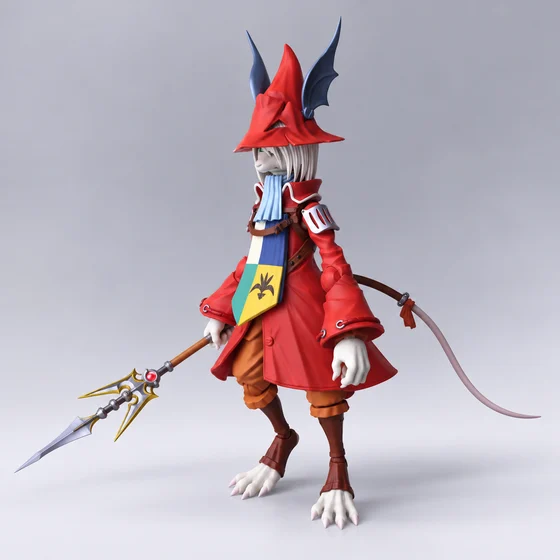
Freya Crescent (Final Fantasy IX)
The names Freya and Freyia permit a limited historical namesake comparison. In Thorpe’s Lay of Hyndla, the deity seeks ancestral knowledge and a memory-cup for Ottar and counters Hyndla’s curse. This does not identify the fictional character with the deity or establish that her creators consulted the poem.
References
Sources supporting this profile. Linked pages have their own scope and editorial standards.
- Historical primary poetic translationThorpe, The Lay of Hyndla — selected 1906 collected editionResearch access: 2026-10-25
Image credits
Modern interpretation of a historical narrativeAI-generated interpretation of Freyia with her golden-bristled mount Hildisvini in Thorpe’s Lay of Hyndla. Her face, hair, clothing, posture and landscape are imagined; this is not a reconstruction of historical worship or the Final Fantasy character.
The selected poem distinguishes Freyia’s account of her boar from Hyndla’s accusation. The picture does not resolve that dialogue into a verified transformation.