
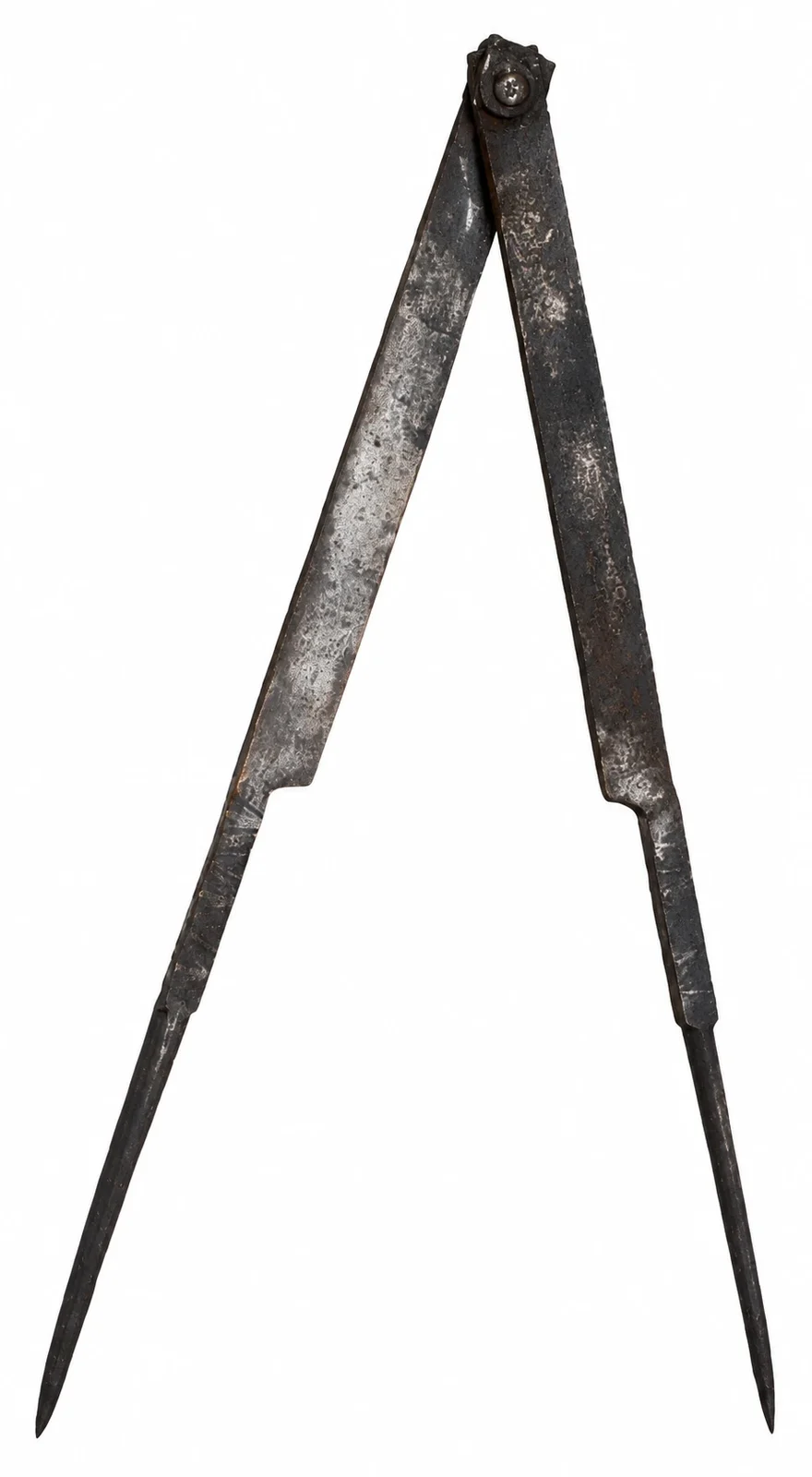
AI-generated contextual material interpretation; not a photograph of the accessioned object or an authenticated replica.
Overview
Welsh identifies accession 61.548 as the large dividers illustrated in figure 13. Its caption attributes the object to France in the early eighteenth century. The instrument belongs to the equipment of builders or shipwrights: the associated text describes such dividers as tools for scribing and measuring timbers. The native photograph shows two long metal legs joined at the top, spreading toward widely separated sharp points. Broad upper lengths narrow into much slimmer lower portions, with small changes of contour near the transition. No scale or measured overall length accompanies this photograph.
The object matters in Welsh’s account because useful tools also preserve evidence of metalworking style. He places it among early dividers and calipers whose forms varied before standardization, and compares their decoration with ironwork beyond the tool chest. The pointed legs and joint thus document an implement’s work while its outline contributes to the study of period design. This is the curator’s historical interpretation of a particular survivor, not proof that all French builders used one form or that its maker belonged to a named workshop.
The accession and photograph number provide firmer identity than a generic label such as old compasses. They do not supply an individual user or a complete history of ownership. Welsh’s introduction stresses precisely these difficulties: daily wear, long working lives and transfer between craftsmen often obscure the origin of hand tools. A plain material interpretation can preserve the photographed two-leg structure without inventing calibrated graduations, pencil fittings, a modern adjustment screw or an absolute size. It remains an interpretation of the documented tool, rather than another photograph of accession 61.548.
History & identity
Peter C. Welsh’s curator-authored Smithsonian historical study, published by the U.S. Government Printing Office in 1966.
Sources & representation
Complete selected framing and configuration passages plus figure 13 caption read; complete native photograph viewed. Accession 61.548 appears in the related prose.
Selected bibliography
Documented works and useful reading. This is not a list of every appearance.
- 01
Woodworking Tools, 1600–1900
Contributions from the Museum of History and Technology, Paper 51, pp.178–228; U.S. Government Printing Office, Washington.
Language & cultural connections
Source-supported language and cultural connections have not yet been compiled for this profile.
References
Sources supporting this profile. Linked pages have their own scope and editorial standards.
- Curator-authored Smithsonian collection studyWelsh’s institutional tool study and original collection photographsResearch access: 2026-10-21
Image credits
AI-generatedAI-generated contextual material interpretation; not a photograph of the accessioned object or an authenticated replica.