
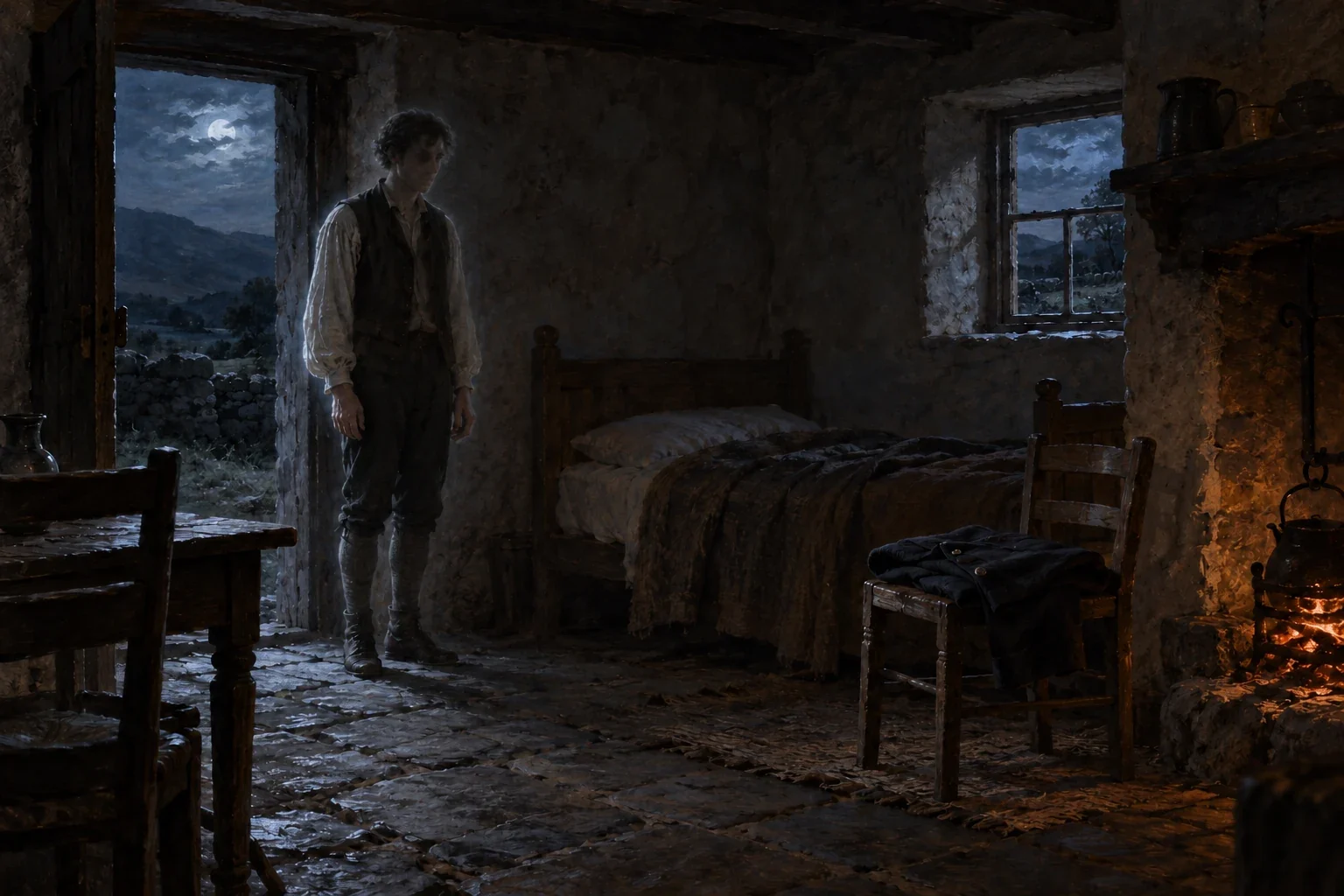
AI-generated interpretation of the reported Frank M’Kenna apparition in Carleton’s account. The young man’s likeness and the clothing dispute follow the narrative; room, face, clothes, faint translucency and staging without visible witnesses are artistic reconstruction. It is not a portrait or evidence of a verified apparition.
AI-generated interpretation of the reported Frank M’Kenna apparition in Carleton’s account. The young man’s likeness and the clothing dispute follow the narrative; room, face, clothes, faint translucency and staging without visible witnesses are artistic reconstruction. It is not a portrait or evidence of a verified apparition.
Overview
William Carleton’s account joins a fatal hare hunt with later reports that Frank M’Kenna appeared to a neighbour’s daughter. The family lives near the hills dividing Tyrone from Monaghan. On a snowy Christmas morning, dated hesitantly by the narrator to1814, the young man refuses his father’s demand that he attend mass instead of hunting. His father prays that he will not return alive. Carleton condemns that destructive imprecation as well as recounting the son’s refusal. A large dark hare leads the hunters farther into the hills. Frank’s companions turn home, but he pursues it into a severe snowstorm.
After days of searching and a thaw, his body is found within a circle made with his hunting stick, with a prayer-book covering his mouth beneath his hat. A further story says the same dark hare crosses before the funeral procession and withstands a stone, giving out a hollow sound like an empty barrel. The tale does not identify it as a witch or establish that the dead hunter and hare share one identity. Its association with his fate remains part of the narrated sequence.
About a fortnight after the funeral, a fourteen-year-old girl in a nearby isolated household reports seeing Frank in the room. Her father searches but sees nothing, and initially suggests fear or moonlit shadows as an explanation. Further visits are reported. The girl eventually asks why the apparition comes to her. It says it cannot address its own family because they parted in anger, and wants a dispute over its new Christmas breeches resolved: the clothing must be given to charity. The narrator says that the dispute and another reported detail, pain from the poles used to carry the body, were treated locally as corroboration.
The conversations become friendly and are said to occur by daylight as well as at night. During episodes the narrator calls syncope, the girl reports moral and religious exchanges with the visitor. Crowds gather at the cabin. Carleton recalls the public excitement but explicitly says that he did not go there himself. His ironic treatment of the clothing mission and his closing description of the supposed apparition must therefore remain part of the account, rather than being converted into his personal testimony that he saw a ghost.
The conclusion describes a stone heap at the place where the body was found and the household’s later ruin. The narrator admits uncertainty about the householder’s surname, given as Daly, and about the meaning of the stone-placing custom. He offers no final exorcism or firmly dated end to the reported visits. The story preserves the interaction of tragedy, warning, rumour and communal attention; it establishes neither supernatural causation of a death nor a medical explanation for the girl’s reported experiences.
Origins & earliest records
The Fate of Frank M’Kenna, printed pp139–145. Retained Walter Scott Publishing Co. title undated; complete unit, no attached numbered note.
Records & interpretation
Complete selected narrative, ending, source attribution and apparatus.
Selected bibliography
Documented works and useful reading. This is not a list of every appearance.
- 01
Fairy and Folk Tales of the Irish Peasantry
The Fate of Frank M’Kenna, printed pp139–145. Retained Walter Scott Publishing Co. title undated; complete unit, no attached numbered note.
Family & connections
A source-supported family tree or inspiration record has not yet been compiled for this profile. Related reading below indicates a connection in subject matter, not a proven lineage or creative influence.
References
Sources supporting this profile. Linked pages have their own scope and editorial standards.
- Historical primary literary/folklore collectionFairy and Folk Tales of the Irish Peasantry — complete selected account and apparatusResearch access: 2026-10-27
Image credits
AI-generated illustrationAI-generated interpretation of the reported Frank M’Kenna apparition in Carleton’s account. The young man’s likeness and the clothing dispute follow the narrative; room, face, clothes, faint translucency and staging without visible witnesses are artistic reconstruction. It is not a portrait or evidence of a verified apparition.
AI-generated interpretation of the reported Frank M’Kenna apparition in Carleton’s account. The young man’s likeness and the clothing dispute follow the narrative; room, face, clothes, faint translucency and staging without visible witnesses are artistic reconstruction. It is not a portrait or evidence of a verified apparition.