
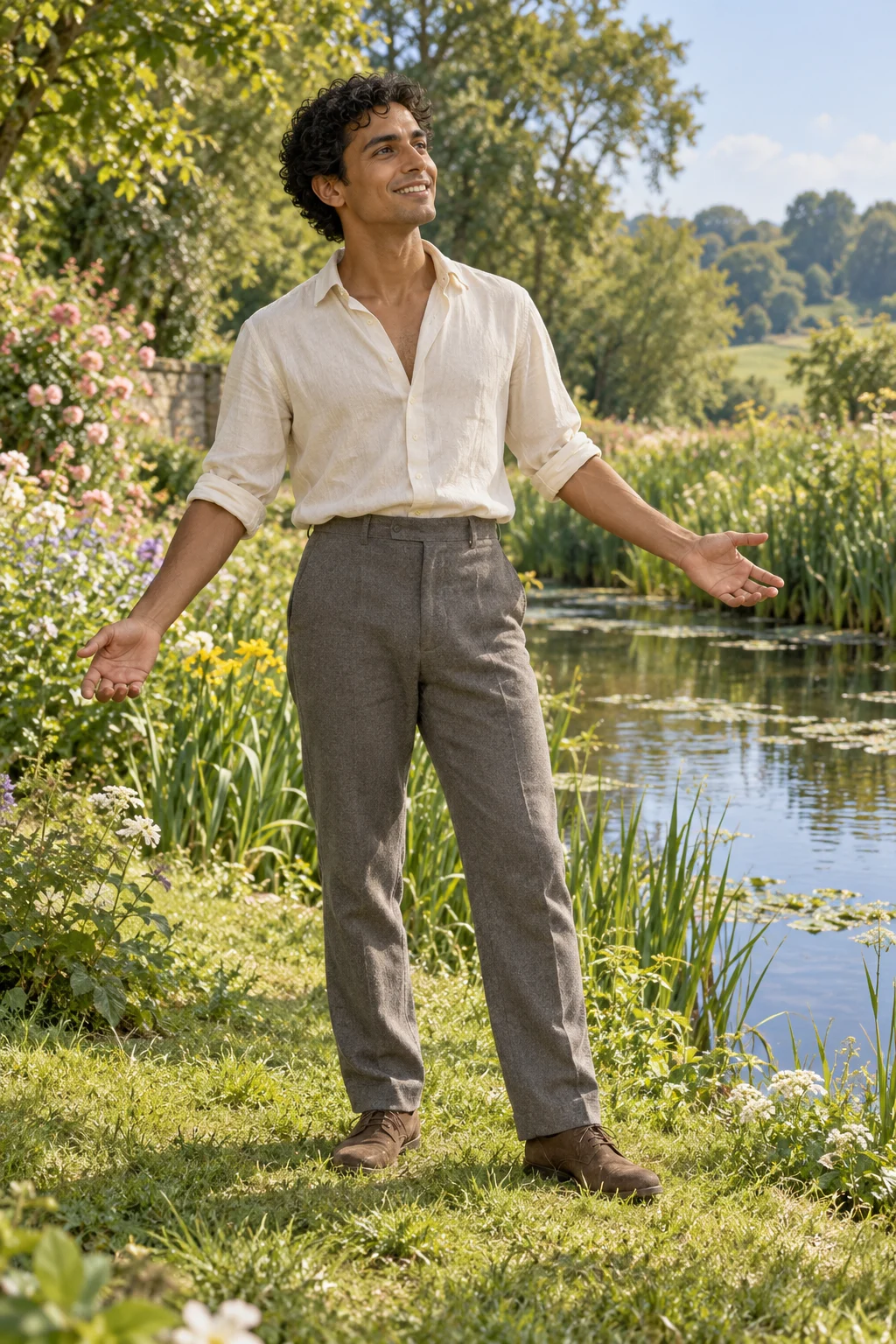
AI-generated interpretation of Benson’s Frank Halton beside the stream; his youthful human appearance follows the story, while costume colours, shoes and exact staging are reconstructed.
Halton is the rejuvenated artist, not the witnessing Darcy or the unseen Pan. The illustration portrays his living human form and does not imply proven immortality.
Overview
Frank Halton abandons his successful artistic work and withdraws to a house beside the river Fawn. When his old friend Darcy visits after six years apart, the thirty-five-year-old Frank looks about twenty. He is of medium height, slender but apparently strong, with a small finely modelled head, dark complexion, thick short black curls and dark brown eyes. He lives largely outdoors, swims, sleeps in a hammock or beneath the sky, and wears simple informal clothes. His bodily youth accompanies what he describes as an inward renewal, rather than the mere preservation of an unchanged appearance. Darcy’s initial disbelief is repeatedly challenged by the vigour and youth he sees before him.
Frank explains that he has cultivated happiness by attending to the natural world and deliberately avoiding pain. He hears an unending flute-like music in the reeds, sky and trees, which he understands as Pan’s pipes and the sound of life itself. Birds approach him with unusual familiarity, and he quickly soothes the sleepless Darcy into sleep; Darcy subsequently considers hypnotism as an explanation. Yet Frank’s apparent harmony has a serious limit. He recoils from a crying child and flees rather than offer comfort, because suffering threatens the state he has sought. Darcy argues that a union with nature which excludes its cruelty cannot be complete. Frank recognises the possibility that his final revelation will be suffering, even while refusing to retrace his path.
During a thunderstorm Darcy hears Frank cry out in terror, followed by a mocking bleat. He and the servant reach the garden, where a dark shape springs from the hammock and retreats with the sound of hard hoofs. Frank is briefly seen rigid with anguish, then collapses and dies. His face becomes peaceful again, while pointed marks emerge on his arms and chest as though a great goat had stamped upon him. The narrative’s opening also reports villagers’ claims that his ghost still walks by the stream and woods. This ending defeats his expectation of bodily immortality; it does not provide a complete view or anatomy of Pan, nor prove the villagers’ later ghost reports independently. His philosophy and extraordinary condition are elements of Benson’s fiction, not a method for obtaining youth or health.
First appearances & development
E. F. Benson’s authored English tale in the dated 1912 second edition of The Room in the Tower and Other Stories. The preface identifies this story as the germ of the later-developed book The Angel of Pain; that separate book was not consulted.
Canon & continuity
The complete selected story, its opening account of later ghost reports, final encounter and ending were read with the complete preface and historical title. Darcy is the witnessing friend; Frank Halton is the rejuvenated artist and reserved subject.
Selected bibliography
Documented works and useful reading. This is not a list of every appearance.
- 01
The Room in the Tower and Other Stories — The Man who went too Far
London: Mills & Boon, Limited; Second Edition. Historical title and copyright page retained; selected tale on pages 206–241.
Family & connections
A source-supported family tree or inspiration record has not yet been compiled for this profile. Related reading below indicates a connection in subject matter, not a proven lineage or creative influence.
References
Sources supporting this profile. Linked pages have their own scope and editorial standards.
- Primary historical authored fictionThe Man who went too Far — complete tale with dated collection title and prefaceResearch access: 2026-10-18
Image credits
AI-generatedAI-generated interpretation of Benson’s Frank Halton beside the stream; his youthful human appearance follows the story, while costume colours, shoes and exact staging are reconstructed.
Halton is the rejuvenated artist, not the witnessing Darcy or the unseen Pan. The illustration portrays his living human form and does not imply proven immortality.