
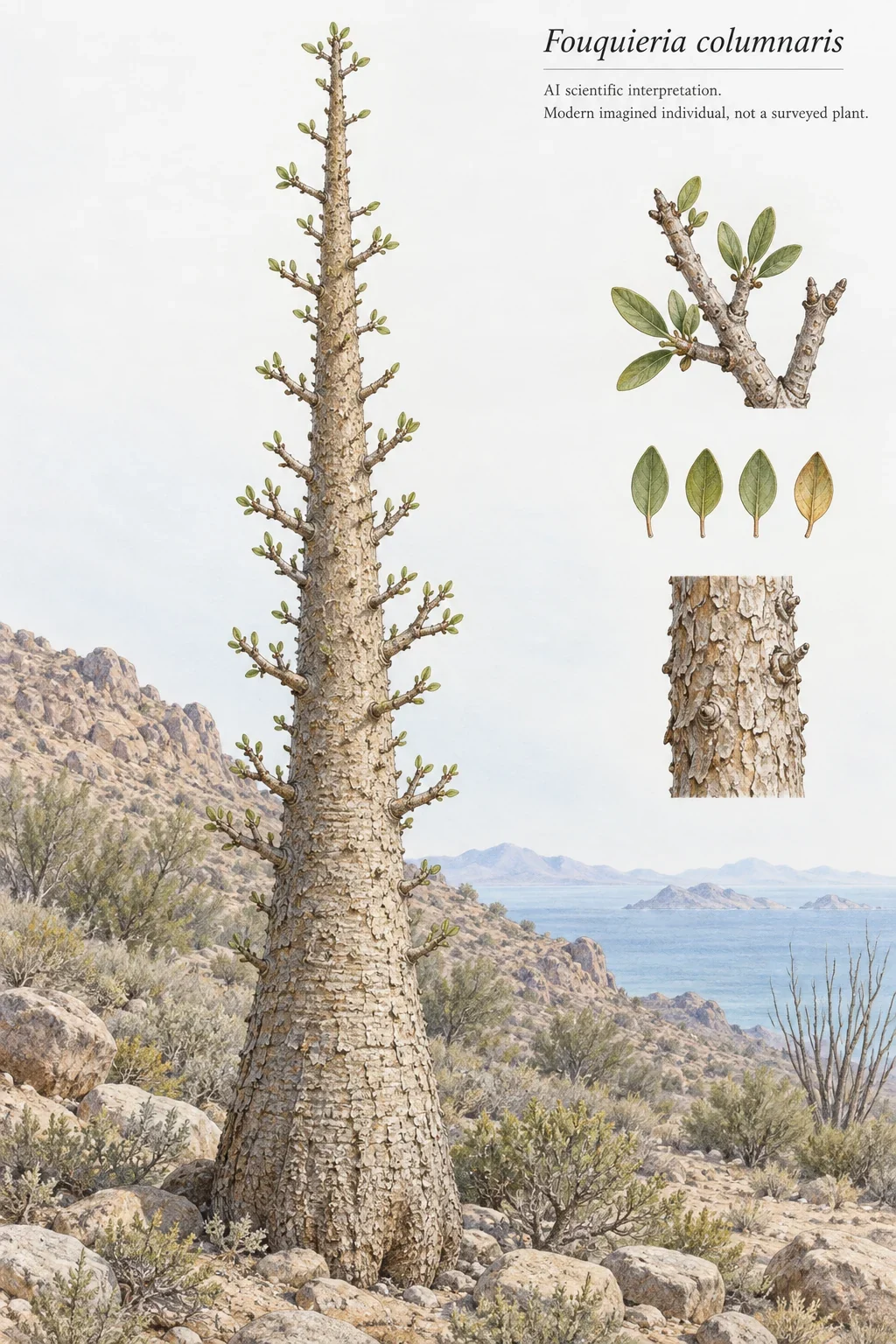
AI scientific interpretation of Fouquieria columnaris.
AI scientific interpretation of an imagined Fouquieria columnaris.
Overview
San Diego Natural History Museum describes a tapering trunk reaching eighteen metres, with pencil-like branches bearing deciduous leaves. Older trees may fork near the top. Cream to yellow tubular flowers form at the stem tips. The species inhabits rocky hills and alluvial plains of Baja California, with a disjunct Sonoran population.
University of Arizona’s arboretum account relates the soft wood, epidermis and temporary leaves to water storage. Growth follows cooler weather, winter rain and spring or autumn fog. The account distinguishes survival through low rainfall from the apparent importance of humidity during germination and establishment.
The arboretum documents plants installed in 1929. Three survivors measured in 2006 stood thirty-four, twenty-six and a half, and twenty-two feet tall. Their approximate cultivated growth rate exceeded the Baja rate quoted in the same account, illustrating why growth estimates require their environmental context.
Origins & earliest records
A regional museum diagnosis complements documented university cultivation history.
Evidence & interpretation
Measured campus growth and inferred humidity effects retain their source-specific contexts.
Selected bibliography
Documented works and useful reading. This is not a list of every appearance.
- 01
- 02
Family, evolution & connections
Taxonomic classification
A hierarchy of classified groups, not a chain of direct ancestors.
Source note: The museum retains Fouquieria and notes historical placement in Idria.
- FamilyFouquieriaceae
References
Sources supporting this profile. Linked pages have their own scope and editorial standards.
- Museum field guideBoojum TreeResearch access: 2026-10-11
- University arboretumThe Boojum TreeResearch access: 2026-10-11
Image credits
AI-generated interpretationAI scientific interpretation of Fouquieria columnaris.
AI scientific interpretation of an imagined Fouquieria columnaris.