
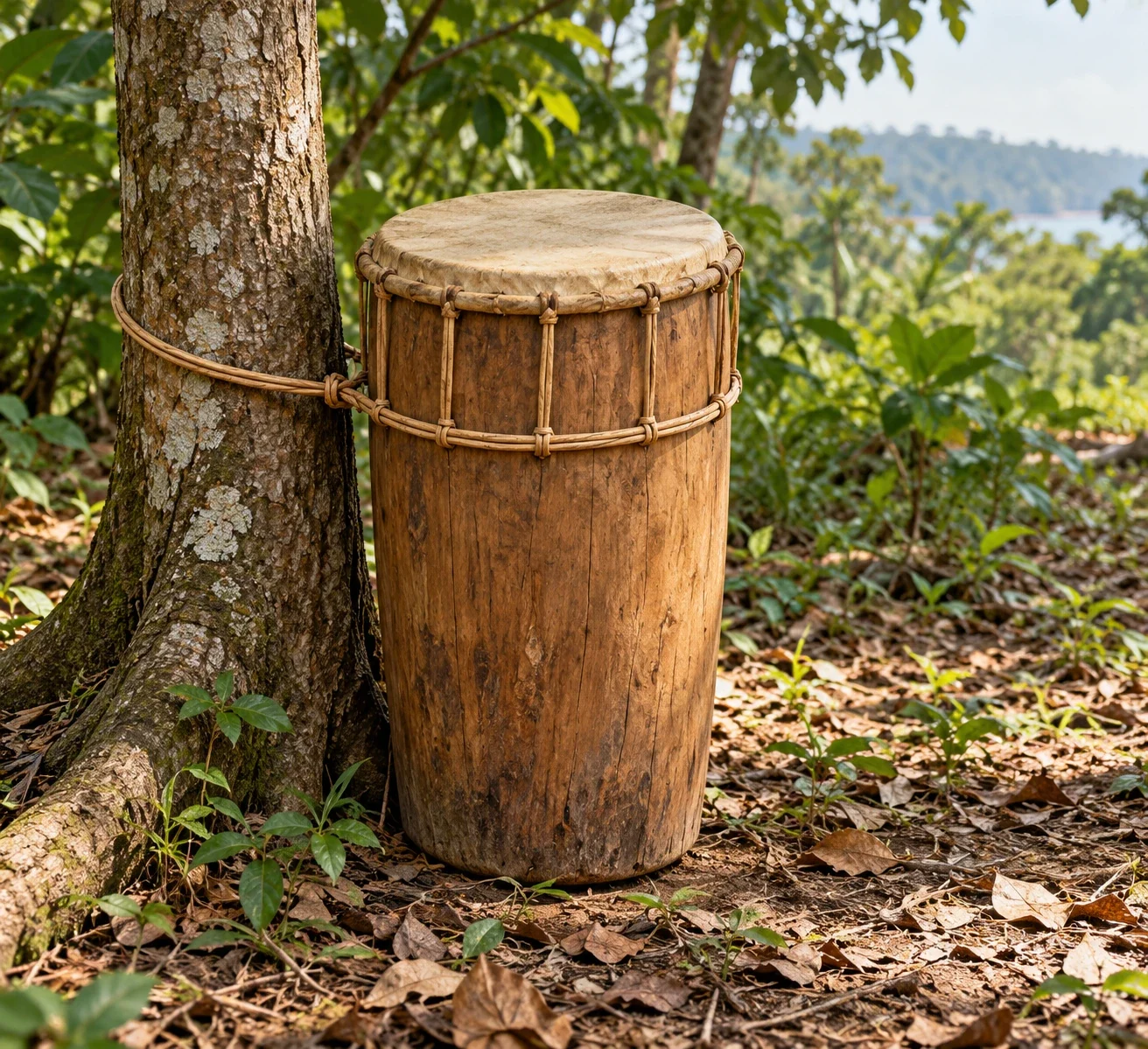
Portrayal of The Food-providing Drum (Nassau’s Benga Tale).
Portrayal selects the first food-providing drum alone, tied with plain rattan near the base of a tree. Plain portable drum construction is imagined because the narrative supplies no exact design. No claimed ritual reconstruction, face, limbs, inscriptions, second drum, whip, violence or ceremonial performer.
Overview
Nassau’s Benga “The Magic Drum” distinguishes two magical drums. The first is the food-providing object chosen by Kudu, Tortoise; it is the subject here. The cast labels a magic drum Ngâmâ, and Tortoise addresses both the first and replacement drum that way. The word therefore does not establish that they are one individual object or that Ngâmâ is a unique personal name. The account describes a portable drum which can be struck with a palm, carried by hand or shoulder, and tied to a tree with rattan. It gives no precise shape, dimensions, decoration or construction, and no authenticated ceremonial design.
A famine afflicts the mixed community of humans and animals under King Maseni. While seeking food, Tortoise follows a fallen coconut into a river and reaches a strange town. People there advise him to ignore the drums calling to be taken and choose one which makes only an echo without real words. He follows that advice. On being beaten, the selected drum produces a table with food and takes it back when commanded. Tortoise hides it in a bending tree, repeatedly feeds himself and brings food to his family. His eldest son discovers the process, removes the drum and uses it to feed the household.
Their secret becomes public through children sharing scraps, and Leopard obtains access. The drum ceases supplying food after roughly two weeks in his house because, the narrator says, it is displeased by his rough usage. Nevertheless it later produces a meal for the entire community at the king’s house. On returning home it again refuses service; this time the text attributes its indignation to use by hands other than Tortoise’s. These successive failures and the intervening successful feast remain in their narrated order rather than being simplified into a single permanent breaking of the drum.
Tortoise returns to the strange town for another drum. Disregarding the repeated advice, he chooses a talking one. This replacement supplies whips instead of food, beats him, and then becomes his instrument of revenge against Leopard and the king. The first food drum is not explicitly transformed into the whip drum, and the narrative gives no final restoration of its usefulness. The ending explains Tortoise’s flight into water through fear of reprisal; it is a story explanation rather than zoological evidence. The section foreword places tale11 among thirty accounts narrated by three adults at Batanga in a Bapuku dialect of Benga, recorded in English notes and expanded by Nassau the following morning. It is not one of the four Corisco Primer translations.
Origins & earliest records
Nassau, Where Animals Talk (1912), Part Second, tale11, The Magic Drum, printed pp. 113-120. Collection and translation chain follows the complete section foreword, not an independently consulted original-language text.
Records & interpretation
Complete selected English tale, cast list, prefatory note and ending read, with complete general preface and both relevant section forewords. Retained original HTML decoded strictly with its declared ISO-8859-1 encoding; no original-page image or source artwork inspection claim.
Selected bibliography
Documented works and useful reading. This is not a list of every appearance.
- 01
Where Animals Talk: West African Folk Lore Tales
Part Second, tale11, The Magic Drum, pp. 113-120; complete selected narrative and note with general preface and section transmission context.
Family & connections
A source-supported family tree or inspiration record has not yet been compiled for this profile. Related reading below indicates a connection in subject matter, not a proven lineage or creative influence.
References
Sources supporting this profile. Linked pages have their own scope and editorial standards.
- Primary historical collected folklore in English translationNassau, retained original historical collection transcriptionResearch access: 2026-10-10
Image credits
AI-generatedPortrayal of The Food-providing Drum (Nassau’s Benga Tale).
Portrayal selects the first food-providing drum alone, tied with plain rattan near the base of a tree. Plain portable drum construction is imagined because the narrative supplies no exact design. No claimed ritual reconstruction, face, limbs, inscriptions, second drum, whip, violence or ceremonial performer.