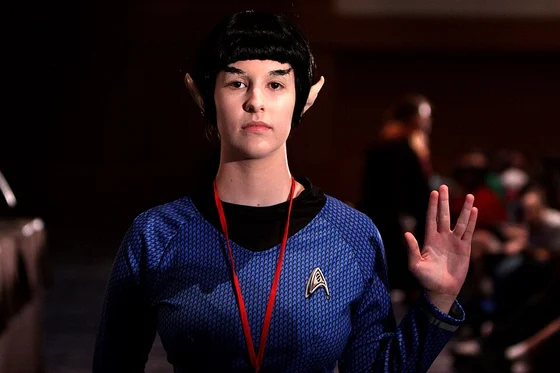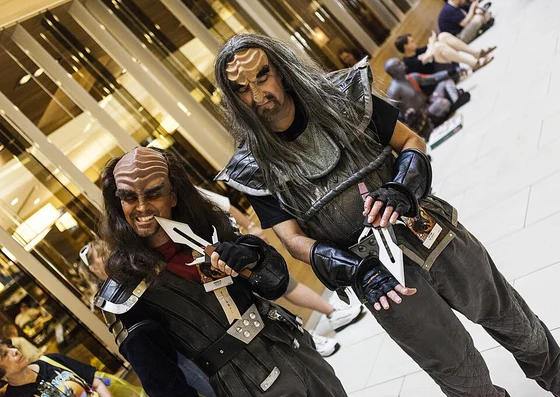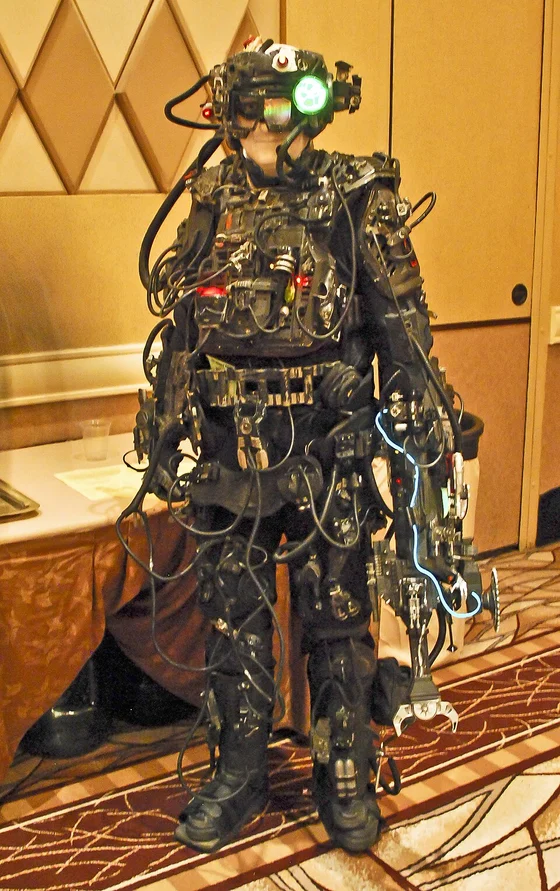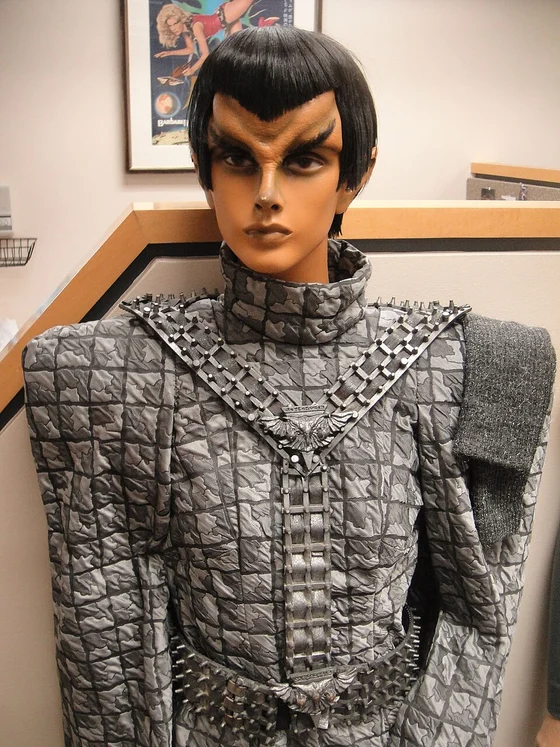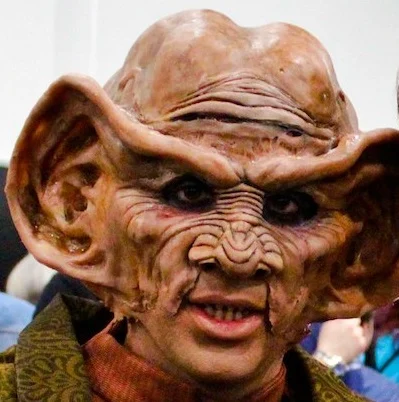
Ferengi costumed participant at Destination Star Trek London
Fan costume photograph.
Overview
Ferengi are a humanoid people associated with commerce, conspicuous ears and a profit-centred social order. Deep Space Nine develops their institutions through Quark's bar and his family's life on the station. The Rules of Acquisition express commercial ideals; the Ferengi Commerce Authority enforces economic power. In Bar Association, wage cuts and mistreatment lead Rom to organize Quark's staff, challenging both his employer and his older brother.
The Authority's enforcer Brunt uses intimidation, including violence against Quark. Rom persists; the brothers agree to dissolve the union in exchange for raises, and Rom leaves Quark's employment. This compromise does not abolish exploitation. In direct retrospective testimony, Robert Hewitt Wolfe identifies labour organizing as an intentional subject, while Ira Steven Behr emphasizes the sibling relationship.
Gender restrictions create another conflict between established law and individual ability. Ishka earns substantial profits, travels and wears clothing despite prohibitions applying to females. Her business competence and influence on the Grand Nagus undermine the claim that exclusion reflects inability; other women begin wearing clothes as well. Nog challenges a different expectation: he recognizes that business will not suit him and pursues Starfleet, with Rom's unfulfilled engineering potential informing his decision. Neither ambition requires abandoning Ferengi identity. These family histories reveal reformers, workers and specialists within a society initially presented through aggressive commercial stereotypes.
First appearances & development
The Last Outpost introduced the Ferengi to The Next Generation in 1987. Deep Space Nine subsequently developed recurring families and economic institutions. The 1996 Bar Association story pitch came from Barbara J. Lee and Jenifer A. Lee; Behr and Wolfe later explained the episode's intended themes.
Canon & continuity
The complete official labour feature includes direct writer testimony and an episode account. The complete grandmothers essay supplies the selected Ishka and Nog examples; its judgement of good Ferengi is evaluative, not biological. The retained general reference supplies identification and earlier publication context, rather than newly inspected screen footage.
Selected bibliography
Documented works and useful reading. This is not a list of every appearance.
- 01
The Last Outpost
Next Generation introduction of the Ferengi.
- 02
Bar Association
Deep Space Nine episode on Ferengi workers and profit.
- 03
How 'Deep Space Nine' Made a Case for Unions
Official feature with direct Behr and Wolfe testimony on labour and sibling themes.
Family & connections
A source-supported family tree or inspiration record has not yet been compiled for this profile. Related reading below indicates a connection in subject matter, not a proven lineage or creative influence.
Encyclopedia background
An additional attributed reference, separate from the editorial profile above.
Read the open encyclopedia overview
The Ferengi () are a fictional extraterrestrial species in the American science fiction franchise Star Trek. They were devised in 1987 for the series Star Trek: The Next Generation, played a prominent role in the following series Star Trek: Deep Space Nine, and have made brief appearances in subsequent series such as Star Trek: Voyager, Star Trek: Enterprise, Star Trek: Discovery, Star Trek: Lower Decks and Star Trek: Picard.
When launching Star Trek: The Next Generation in 1987, Gene Roddenberry and the show's writers decided to introduce a new alien species to serve as antagonists for the crew of the USS Enterprise-D. The Ferengi first appeared in "The Last Outpost", the show's fourth episode, which was set in the year 2364. The writers decided that the Ferengi ultimately failed to appear sufficiently menacing, instead replacing them with the Romulans and Borg as primary antagonists. Throughout the rest of the series, Ferengi characters were primarily used for comedic effect.
When creating Star Trek: Deep Space Nine, the show's writers decided to introduce the Ferengi bartender Quark (Armin Shimerman) as a major character, and subsequently his brother Rom (Max Grodénchik) and nephew Nog (Aron Eisenberg) as recurring characters, again frequently using them for comedic purposes.
Ferengi culture, especially as portrayed on Deep Space Nine, is depicted as hyper-capitalistic, focused on the acquisition of profit as the highest goal. Deep Space Nine writers have described how they saw the Ferengi as a satirical presentation of 20th century humans. The Ferengi, while initially compared within the show to Yankee traders, have repeatedly drawn comparisons to stereotypes of Jews.
Text from Wikipedia contributors, “Ferengi”. CC BY-SA 4.0. Extracted introduction; formatting changed. Retrieved 5 October 2026. The source article may have changed since retrieval.
References
Sources supporting this profile. Linked pages have their own scope and editorial standards.
- ReferenceFerengi — reference guideResearch access: 2026-10-05
- OfficialVilas-Boas: How Deep Space Nine Made a Case for UnionsResearch access: 2026-10-05
- OfficialBoches: Honoring Star Trek's GrandmothersResearch access: 2026-10-05
Image credits
Cosplay interpretationFerengi costumed participant at Destination Star Trek London
Fan costume photograph.