
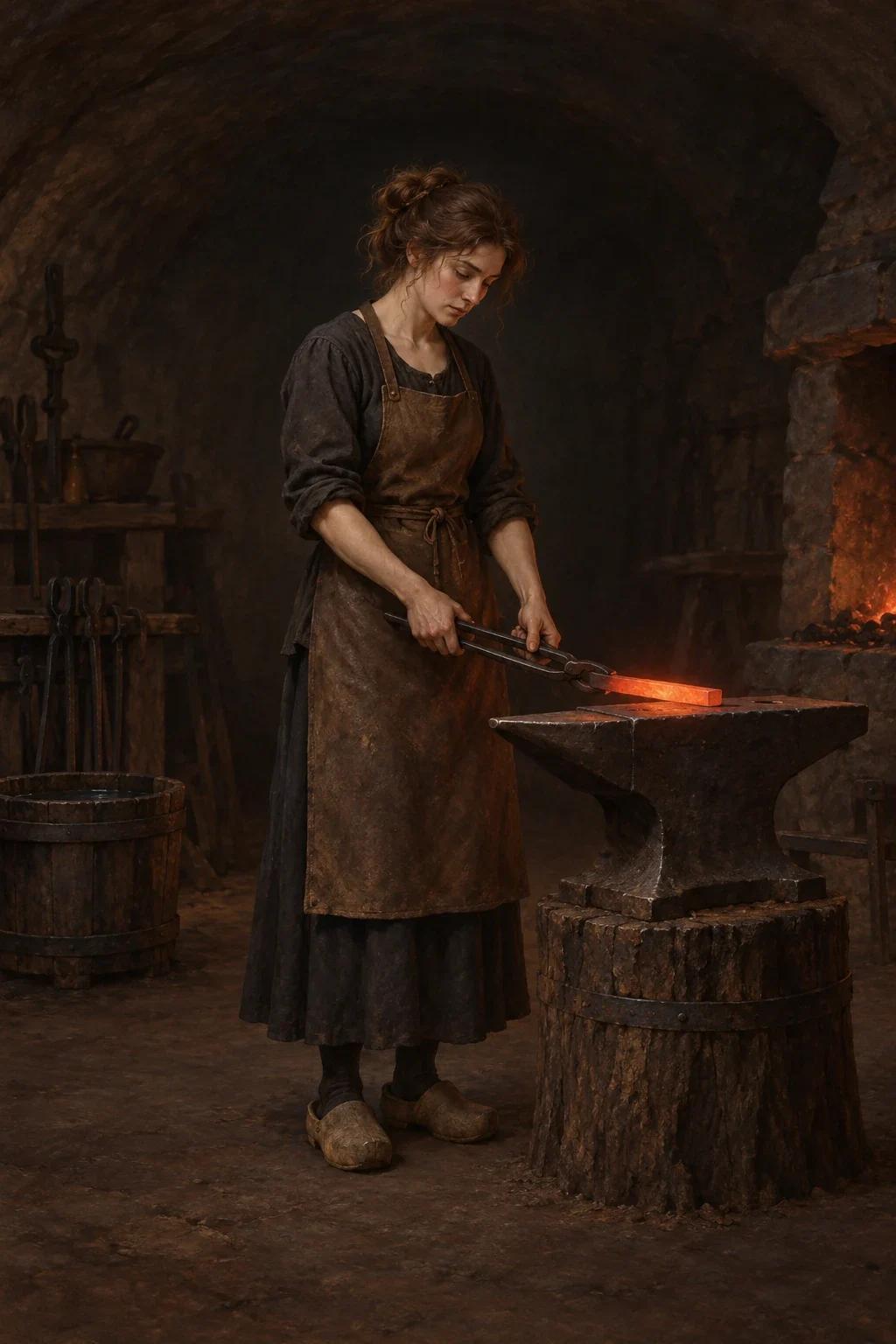
AI narrative interpretation of Fairy of the Poppies in Griffis’s Belgian Fairy Tales (1919).
Adult casting, face, clothing cut, stance and workshop layout are AI interpretation of Griffis’s literary fairy, not an ethnographic portrait.
Overview
Griffis introduces the fairy through a quarrel among surface-dwelling fairies, all of whom want high rank without subjects to serve them. The unnamed female fairy offers to abandon her finery, live underground as a kabouter, and learn to make something beautiful around which the others can gather. Her companions suspend their quarrels while awaiting her return; the narrator immediately explains that she never comes back.
She removes her beautiful garments and puts on clothes of a dark, sad color. Descending below the coal mines of the Boringue and the zinc mines of Moresnet, she encounters kabouters who resent the surface fairies’ contempt. They seize her, tie a blacksmith’s leather apron around her waist, put old wooden shoes on her feet and tongs in her hands, and force her to flatten a red-hot iron bar before an anvil. A cruel overseer scolds and beats her when the unfamiliar labor exhausts her.
Despite this treatment, she learns underground secrets. Griffis’s account makes the kabouters gather iron from the blood of generations killed on Belgian soil and connects metals with the colors of flowers and other materials. These are the collection’s fanciful explanations, rather than botanical or chemical evidence. A different, kindly old kabouter tells her how to bring forth the red poppy.
The fairy wants the new flower to end her companions’ jealousies and remind people of those who died on the land. The old kabouter makes the exchange explicit: her own life must pass into the flowers. She agrees, sinks down and dies. The fairies bury her at the center of a fairy ring among grass and yellow and blue flowers; the following spring the red blooms cover the earth, and peace returns among the fairies.
The ending turns the poppy into a lasting memorial, using the language of Decoration Day and comparing the blossoms to tiny memorial fires. The flowers do not literally burn. This profile follows Griffis’s authored 1919 narrative and its Belgian and Flemish settings; it does not establish an independently documented oral tradition or the tale’s national prevalence. The chapter gives no proper name, exact stature, wings, or detailed facial features for the fairy.
Origins & earliest records
Chapter VI, “The Fairy of the Poppies,” in William Elliot Griffis’s Belgian Fairy Tales (New York: Thomas Y. Crowell, 1919), printed pp. 56–64.
Records & interpretation
Authored English literary retelling, chapter 6 (printed pp. 56–64). Complete chapter, opening preface-story, closing chapter, and original title/copyright inspected; no individually attributed oral witness is supplied for this tale.
Selected bibliography
Documented works and useful reading. This is not a list of every appearance.
- 01
Belgian Fairy Tales
Authored English literary retelling, chapter 6 (printed pp. 56–64). Complete chapter, opening preface-story, closing chapter, and original title/copyright inspected; no individually attributed oral witness is supplied for this tale.
Family & connections
A source-supported family tree or inspiration record has not yet been compiled for this profile. Related reading below indicates a connection in subject matter, not a proven lineage or creative influence.
References
Sources supporting this profile. Linked pages have their own scope and editorial standards.
- primaryBelgian Fairy Tales: selected complete chapterResearch access: 2026-10-21
- primaryBelgian Fairy Tales: 1919 original edition scanResearch access: 2026-10-21
Image credits
AI-generatedAI narrative interpretation of Fairy of the Poppies in Griffis’s Belgian Fairy Tales (1919).
Adult casting, face, clothing cut, stance and workshop layout are AI interpretation of Griffis’s literary fairy, not an ethnographic portrait.