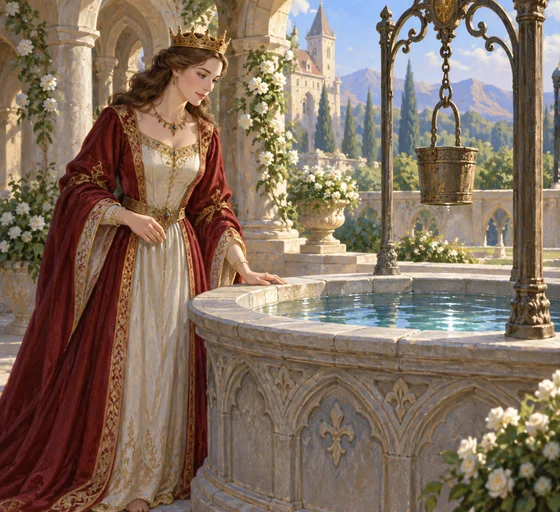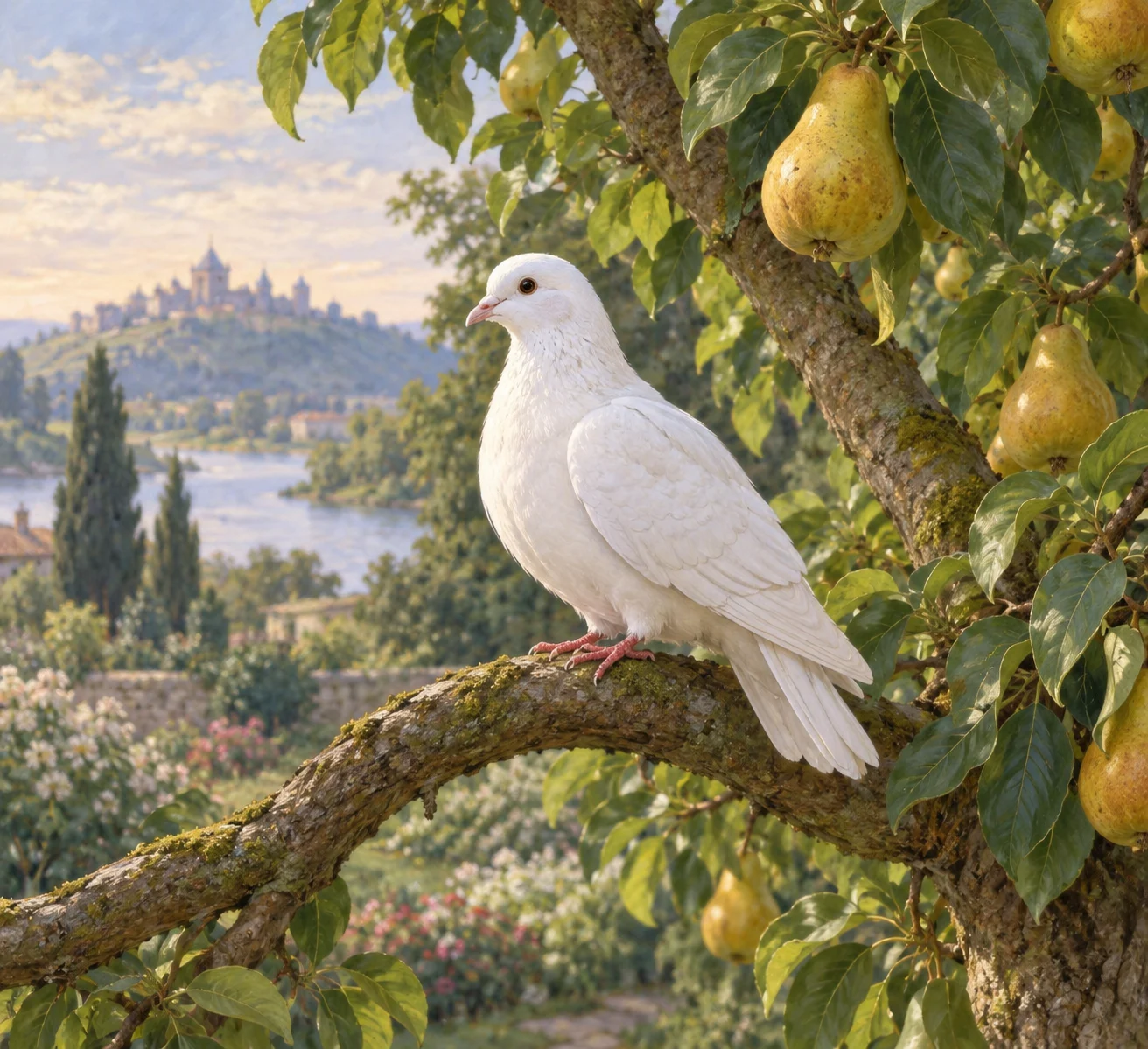
White pigeon beside a pear tree.
Original narrative interpretation. Appearance, anatomy, clothing or setting not specified in the selected tale are imagined. Compressed for display.
Overview
In the tale, three fairy sisters come to a lake as white pigeons and turn into women by somersaulting. On his third attempt, a giant's adopted son takes the youngest one's dress without looking back. His foster father hides it inside a walnut sewn into his waistcoat. Elizabeth then arrives in a carriage that vanishes, and she marries the youth.
On a visit to his human family, she dances with her feet never touching the floor. Her mother-in-law drugs the husband and hands Elizabeth the dress at her request. Elizabeth dances again, becomes a pigeon and flies to a pear tree. A tear she sheds wakes him, and she tells him to seek her at Johara in the country of Black Sorrow.
The husband grows old during his long search. When he finally reaches her palace, she openly mocks his aged body while secretly ordering a bath of rejuvenating plants and youth-giving water. The couple renew their wedding and go back to the giant's home rather than to the family where the betrayal happened.
Origins & earliest records
A collected Magyar tale linked in the translators' notes to Kriza (no. xv). It is read here as tale XIX, pp. 95–109, of the 1889 Jones/Kropf translation. The individual teller is not identified.
Records & interpretation
The narrative was read directly in the public-domain Project Gutenberg text of the translation. It was not collated against a Hungarian original.
3D model
An original procedural model made for the Mythscribe World Builder. It is an interpretation based on this entry, not a historical source or a depiction from the records cited here.

Procedural folklore creature kit · 22,973 triangles · 2 MB
Opens mythscribe.cloud in a new tab. Sign-in is required.
In the literature
“open, and Fairy Elizabeth turned a somersault, became a white pigeon, and flew out of the window. Outside there was a pear tree, and she settled upon the top of it, the people looking on in wonder and astonishment;”
XIX, Fairy Elizabeth, pp.95–109; recovered dress and departure · W. Henry Jones and Lewis L. Kropf
The fragment follows the opening of the windows: Elizabeth regains her dress and leaves in pigeon form.
Selected bibliography
Documented works and useful reading. This is not a list of every appearance.
- 01
The Folk-Tales of the Magyars
Selected bibliography; tale XIX, Fairy Elizabeth, pp. 95–109, with the translators' note on Kriza xv.
Family & connections
A source-supported family tree or inspiration record has not yet been compiled for this profile. Related reading below indicates a connection in subject matter, not a proven lineage or creative influence.
References
Sources supporting this profile. Linked pages have their own scope and editorial standards.
- Public-domain primary translationThe Folk-Tales of the Magyars (Project Gutenberg plain text)Research access: 2026-10-07
- Catalogue recordThe Folk-Tales of the Magyars (Project Gutenberg catalogue)Research access: 2026-10-07
Image credits
Original interpreted illustrationWhite pigeon beside a pear tree.
Original narrative interpretation. Appearance, anatomy, clothing or setting not specified in the selected tale are imagined. Compressed for display.